
Overview:
Buster Dunsmore is a brilliant Purdue computer science professor whose lifelong dedication to teaching, family, mentorship, and student success has profoundly impacted both his loved ones and generations of students.
Buster. Funny first name, right? Especially for someone who has earned the right to go by his actual first name rather than a silly, southern nickname given to him when he was an infant. His actual first name is Hubert. He was the firstborn in my family and is a junior so his full name is Hubert Earl Dunsmore, Jr.
After Buster earned his computer science degree at the University of Maryland in 1978 and landed a position as a professor at Purdue University, he decided it was time to go by Hubert. The story goes that, about a week into the first semester he taught at Purdue, one of his colleagues asked, “Buster, how are your classes going so far?” How did this colleague know? Who had told him? In any case, Buster decided to drop the attempt at being known as Hubert. He was before and has been ever since Buster to everyone who knows him.
Perhaps because Buster didn’t want to be the only one with a funky nickname, he saw to it that our younger sister Patti’s best friend Anne Murray Cummins would also have a nickname that would stick with her into her adulthood. You see, Patti couldn’t pronounce Anne Murray. It sounded more like Aunt Murphy. Buster mimicked Patti’s pronunciation and then shortened it to just Murphy. That was eventually shortened to Murph, which was then misspelled by a high school friend so that it became and still is to this day Merf. I know all of this because I’m blessed to be married to Merf.
When I decided to go on a gratitude tour at the end of my career, I knew that at some point I’d “interview” my brother. He’s had remarkable success over a 48-year career as a computer science professor, all at Purdue University. I have many reasons to be thankful for him as my older brother, and it could be argued that I should have paid tribute to him before anyone else. However, I at first decided that he would always be available for a visit from his younger brother, so he could wait.
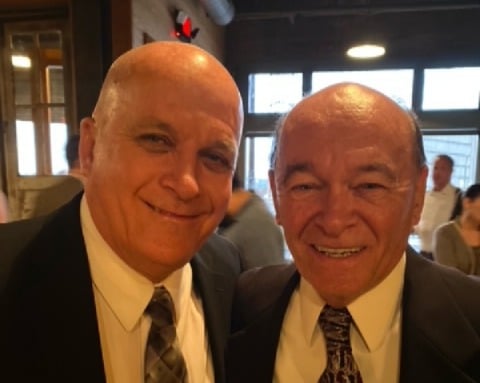
My earliest memory of a computer is seeing the one with which Buster was involved at the University of Tennessee Knoxville. I could not have been older than nine or ten. I walked into a room where I saw dozens of people sitting at desks around this massive machine. A few of them held cards in which numerous small slivers were punched. At times, these cards were fed into the slots in the machine. It hummed. It blinked. At least that’s how I remember it. Sixty years later, my cell phone sits on the table near me as I tap out this tribute on my Dell laptop. How far computers have come and how much we rely on them. If you’d like to Google Hubert Earl Dunsmore, Jr. or even just Buster Dunsmore, you’ll learn that he has had a great deal to do with the advancement of computer technology as well as our understanding of it.
Buster earned his BS in math and physics in 1968 from UT. He was a Neyland Scholar. He was brilliant in all things math, science and computer related, but he was also the big brother who provided practical and emotional support for me when that younger sister Patti passed away in 1970 and our father passed away in 1972. This is why I can’t write about Buster only as an educator. I must at every step write about him as a loving older sibling.
Buster married while still living in Knoxville, then became a PhD student at the University of Maryland in College Park. He and his wife lived on the campus of Gallaudet College, now Gallaudet University, during that time with his father-in-law. I remember our mother taking me to visit him on that campus while I was still in high school. When she passed away in early 1978, Buster once again stepped in to provide much needed parental guidance. He also earned his PhD in computer science later that spring.
With every accomplishment on his educational journey, he never made a big deal of it. Instead, he made a big deal of me and his other two siblings by concerning himself with how we were doing. To this day, forty-eight years after earning his PhD and becoming a professor at Purdue University, he still makes a big deal of me. He isn’t comfortable with my making a big deal of him. He’ll just have to get over it.
Arriving at the University of Maryland, Buster pursued a computer science degree and began conducting a good deal of research. At one point, he was given an opportunity to teach. It was love at first class. “Far greater than research, I enjoyed walking into a room in which nobody knew certain things, and then, when I walked out an hour later, they did know certain things.”
While interviewing for faculty positions at several schools, including the University of Illinois and Ohio State, he got a knock on his door from Sam Conte, former Purdue Computer Science department head, who was collaborating at the time with University of Maryland professors. He asked Buster to put Purdue on his list. Buster received offers from other schools, but perhaps it was the personal touch of a knock on his door that persuaded him to choose Purdue. Sam Conte, who passed away in 2002 after his own illustrious career in education, would certainly be on Buster’s own gratitude tour.
Buster was an immediate hit at Purdue shortly after arriving in 1978 at the age of thirty-two. He spent countless hours preparing for his classes as he enjoyed sharing anecdotes and performing little skits to illustrate the points he was making. He had nearly failed his first computer science exam at UT because he had an instructor with very little interest in teaching. Buster vowed then, “If I ever get a chance to teach computer science, I’ll actually teach it. Students deserve better than this guy.” As he thinks about the thousands of students he has taught at Purdue, he is grateful for them as well. When they return to visit, and they often return, they let him know that he introduced them to and give them a love for computer science.
He was also giving time to his own two children. At least in part because of his guidance, they have found success as adults, too, with their own families and in their own professions. In 1978, his three younger siblings back in Knoxville were twenty-eight, twenty-one (me) and ten. Yes, the age difference between my older brother and baby sister is twenty-two years. Buster continued to care for us in those early years by way of frequent visits, even-more frequent phone calls and occasional financial support even as he worked tirelessly to establish his career at Purdue. His practical and emotional support of me and our siblings has never wavered, and I am forever grateful.
I had to Google Kristyn Childres’ 2017 well-written and informative article about Buster to learn of the many accolades he has received over the years for his superior teaching at Purdue. They include the coveted Murphy Award for outstanding undergraduate teaching in 1996 and the ACM Faculty Award, chosen by the students in the department. In fact (and he would never admit this to me so I am relying on Ms. Childres’ article), he has won the ACM so many times that he now refuses it, telling the students to vote, instead, for other outstanding and younger faculty members just as deserving. In her feature, I read of several other recognitions and professional accomplishments that my humble brother has never mentioned.
Ms. Childres also explains how Buster has been instrumental in increasing student retention in computer science. In 2013, he developed the Bridge program, which involves bringing incoming freshmen to campus for a two-week intensive course before the fall semester begins. The course was helpful in building the students’ confidence, but Buster feels the camaraderie that happened naturally during those two weeks was a crucial factor in many of them sticking with computer science through graduation day. “I strongly believe they remained in the program because they didn’t want to disappoint their peers.” He considers the Bridge program, his constant encouragement, and his other ways of helping students navigate the program as his greatest achievements at Purdue.
Buster has obviously experienced the ways in which countless technological advances have impacted instruction and student learning since the late 70’s. He, like many younger educators, feels that AI currently poses the greatest challenge to teaching and learning. “We must find ways for students to use it as a learning aid and not simply to have it do all their assignments.” Thinking for oneself, being a problem solver, has been a concern of Buster’s since day one of teaching. He’d never think of taking someone else’s information and claiming it as his own, but he recognizes it unfortunately happens too frequently among his students. “Not thinking for yourself completely undermines what should be happening in a classroom. Insisting that students do their own work, solve their own problems, became a focus in my classes, but I finally just had to move beyond knowing I wasn’t catching all the cheaters.”
As a way to grab his students’ attention early in any course, Buster has often made the statement that it’s time for them to grow up and take responsibility for their own lives. I can’t help but think that what he and his siblings have had to do in the aftermath of multiple deaths in our family is a factor in his giving this advice. He doesn’t necessarily continue to say it throughout the course and wondered when he first started teaching if it even registered with his students. He has been pleasantly surprised at the number of students who have returned to campus and thanked him for that advice. “I never realized how much that resonated with students.”
Meetings are a necessary evil in any profession, I suppose, and they can particularly eat into one’s day in education. Buster has always hated meetings, or at least the length of them. His advice to newcomers to the profession is to attend the meetings, then volunteer to become the chair of the committees that hold the most drawn-out gatherings. As chair, you can then keep those meetings as short as you’d like. That’s just clever.
He also advises young educators not to expect immediate rewards. “Teaching is challenging, and often times students complain more than they show their gratitude when they are in your class. Years later, though, they will walk through your door to say thank you. It’s delayed satisfaction, but it is sweet satisfaction.” This is why Buster works as hard at his craft today as he did in 1978. Retirement is nowhere in sight.
An unexpected event in late summer of 2025 removed my older brother from the he-could-wait category and shifted him to he-probably-has-time-for-that-in-person-interview-now status. Buster felt a tightness in his back on Wednesday, July 30, of that year while playing tennis. After a visit to his primary physician the next day, he was admitted to the hospital. His heart was receiving so little oxygen that it wasn’t safe for him to be at home. On August 5, he had open heart quadruple bypass surgery in Lafayette, IN, at the Indiana University Health Arnett Hospital. The surgery was successful. He took a leave of absence from teaching that fall (sort of) and was told he should not play tennis again until at least early January 2026.
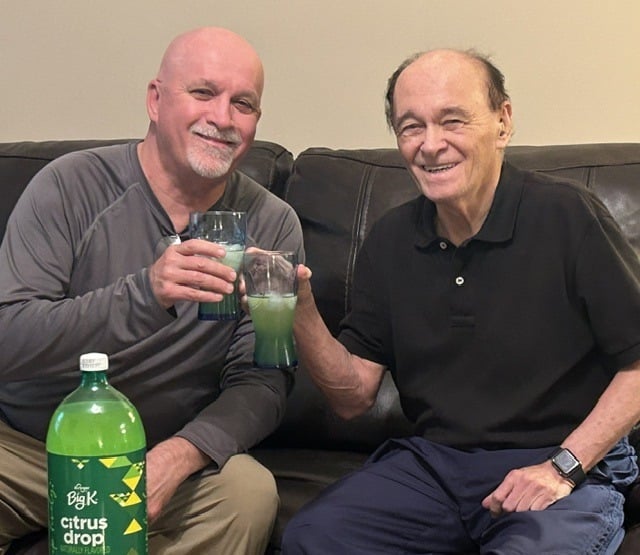
I knew this break from teaching and tennis, hopefully temporary, would be a sobering blow and was a wake-up call for both of us. He needed time to recover, so I didn’t immediately hit the road to see him, but I wanted to purchase him a beverage of his choice in the spirit of Chick Donohue’s gesture to thank his buddies still fighting in Vietnam as recounted in The Greatest Beer Run Ever. In typical Buster fashion, he humbly asked for a $1.25 2-liter bottle of Big K Lemon Lime Soda. His wife Kimba made the purchase, and they snapped a picture for proof.
After his recovery from bypass surgery, Buster returned to the tennis court only to find his left knee in excruciating pain. He’d felt that pain before but not quite that severe. He returned to the doctor and learned that he would need knee replacement surgery. That surgery happened on April 13, 2026. This once again sidelined Buster from the classroom (but not from being involved in teaching) and from tennis. I felt that visiting him during this recovery period would guarantee he’d be home even if not particularly mobile. On May 5, 2026, I embarked on my longest gratitude tour drive to date as I made my way from Millersville, MD, to West Lafayette, IN.
The drive was nothing as I anticipated a long-overdue visit with a brother who has been a father figure to me since my teen years. Buster had once again begun drinking the caffeinated Big K sodas he loved before his heart surgery, so this time he requested the Citrus Drop flavor. In a move to spend more on him than he had spent on himself, I purchased two 2-liter bottles to make up for the one Kimba had purchased for him on my behalf. The cost was $2.68. Buster, Kimba, and their two beloved dogs Cooper and Chloe met me at the door as I delivered the beverages. Their cat Miss Kitty made only a fleeting appearance. The following evening, Buster, Kimba, their canines and feline treated me to a pizza dinner. My attempt to be more generous to him than he was to me had once again failed.
Buster has been a role model in so many ways. Yes, he’s been a mentor, but, more importantly, he has been an older sibling who continues to step in when needed to care for me and the rest of our family. I can’t help but view him at times as a surrogate parent. He clearly has cared for his students, too, in ways that have been recognized time and time again by them and by Purdue University. He has an analytical mind, and he’s great at giving practical, common sense advice, but his heart dwarfs those other qualities. It was a joy to have some time with him in West Lafayette, to remind him of his importance to me and our family, to hug him, and to tell him I love him. I am so very fortunate to call him my big brother.