

Overview:
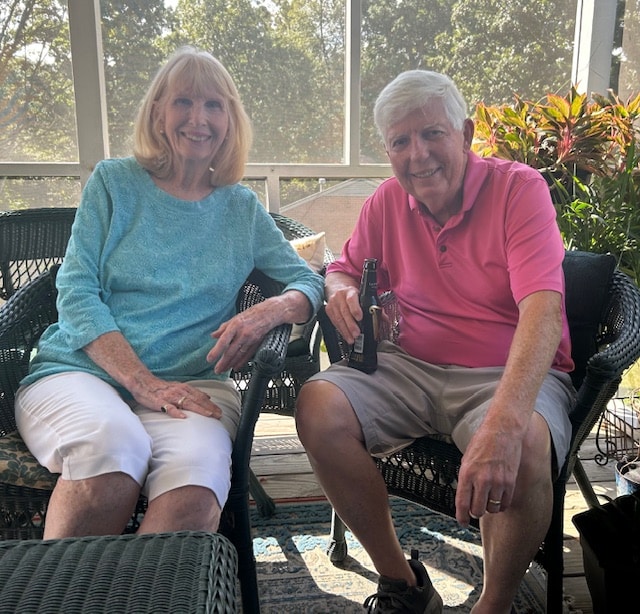
Carl and Nancy Frye’s decades of humble, dedicated service to Blue Ridge School, emphasizing their lasting impact on students, colleagues, and community through leadership, mentorship, and an unwavering commitment to education and gratitude.
Carl Frye was one of the first colleagues I came to know well at Blue Ridge when I arrived in 1998. I wouldn’t coach until the winter, but, as the athletic director, he welcomed me to the School during the opening faculty meetings that August. He was already a legend at Blue Ridge, but that status clearly had not gone to his head. He was and still is one of the humblest, most dedicated, hardworking colleagues I’ve ever had.
One of the qualities that may be unique to boarding schools is that you get to know the spouses nearly as well as your colleagues. Usually, they are involved in the life of the school in important ways even if they aren’t on faculty or staff. Such was the case with Nancy Frye. Nancy was always nearby taking pictures, encouraging the boys, and being a good friend to everyone. She was also welcoming to me during my first weeks at Blue Ridge.
I visited Carl and Nancy in their Charlottesville, VA, home on Wednesday, September 3, 2025, thirteen years into Carl’s retirement. They at first refused my offer of a beverage, but I eventually talked them into allowing me to bring them a six pack of Guinness Draught Stout 11.2 ounce bottles from St. James Gate Dublin, Ireland. This token of my appreciation was meant to resemble the gratitude shown by Chick Donohue for his friends in The Greatest Beer Run Ever.
As is sometimes also true of faculty members at boarding schools, Carl and Nancy raised a family at Blue Ridge – in their case, a daughter and three sons. All three sons were students at Blue Ridge, and one of those sons was also a colleague of mine for a few years. Carl retired in 2012, which meant that he and Nancy moved off campus into Charlottesville. Carl said no to parttime opportunities with Blue Ridge, knowing that the best break was a completely clean one. Their love for the school has never diminished, though. They are often seen on campus for sporting events and other occasions, which has made it possible for me and others to stay in touch with them.
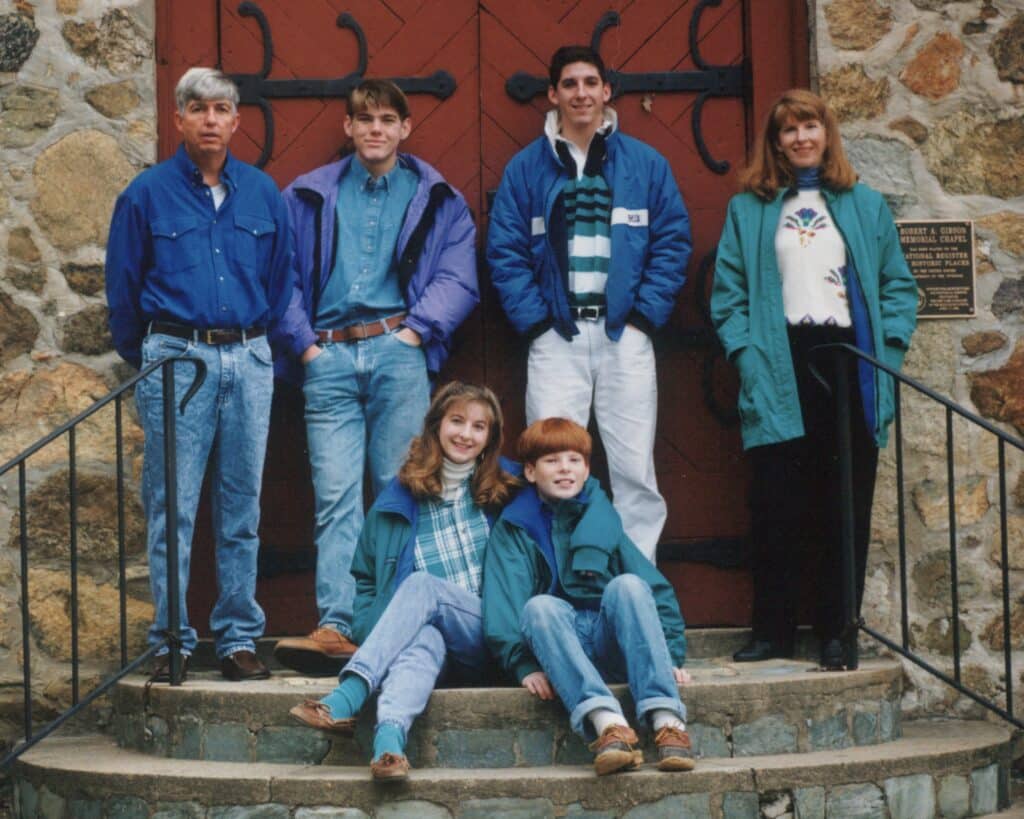
Having been raised in northern Virginia, Carl attended Shenandoah University from 1962 to 1964, seeking an AA degree in education. He then attended VCU from 1966 to 1968 at which time he earned a BS degree in major health and physical education with a minor in biology. He eventually earned a masters of education in athletic administration from UVA. Nancy attended Radford College, graduating in 1968 with a BS degree in Art Education.
After two years as Recreation Director for the town of Front Royal, VA, while still in college, Carl then taught science at A. G. Richardson Middle School. During that same time, he coached JV football, JV wrestling and JV baseball at Culpeper High School. Early in the fall of 1968, Nancy attended faculty meetings at A.G. Richardson, where she would be teaching art to the entire sixth grade. That’s where she met Carl, a gentleman who certainly gained her interest. It was in 1969 that Carl’s good friend John Young suggested that he and Nancy consider Blue Ridge, an all-boys boarding school where his younger brother Palmer was a student. Carl and Nancy visited and immediately fell in love with the campus. As newlyweds, they soon moved into the Upper North dorm apartment, and their love story began in earnest.
Nancy served as Blue Ridge School’s art teacher in 1969. After that and for the next forty-two years, she served the school in many other ways — photographer, med trip driver, chaperone, costumer, set painter, office assistant, and substitute sister/mom/grandma on the sidelines. One of her most cherished jobs was taking photos of each student doing his afternoon sport or outdoor activity and mounting the best shot of each boy on a postcard to send to his parents. “It was fun to be on the sidelines with Carl and our sons when they were coaching and a real kick when the players forgot I was there. That’s when I got the best shots! When the school acquired a digital camera, I was able to shoot hundreds more photographs and post them all online.”
The Head of Blue Ridge School in 1969 was Hatcher Williams. Though the School fulfilled an important mission at the time, money was tight. Hatcher worked hard to find what was still limited funding for the athletic department, which Carl knew was a sign of confidence in his abilities. “Hatcher believed in me to start two major programs, baseball and wrestling. He trusted me to get them started for future Barons with limited resources.” Carl held many positions in his forty-three years at Blue Ridge – biology teacher and driver’s education teacher as well as wrestling, football, basketball, track and baseball coach, and, of course, athletic director.
When I first met Carl, it took only a few minutes to notice his passion for teaching and coaching. I appreciated his sincerity and love for his students and athletes, too. Carl made me want to do my best as a coach but also reminded me with his actions and words that my first responsibility was to care for the students. It’s no wonder that anyone who had the privilege to be taught or coached by Carl sings his praises. He had a way of making them feel great about themselves even at times when they needed attitude adjustments. It’s also not a surprise that the baseball field at Blue Ridge is now called Frye Field in honor of all that Carl contributed to the school over forty-three years.
Soon after being hired at Blue Ridge, I was told that the school community is a family, a family that loves one another but also sometimes fights with one another as families do. I didn’t believe that was true until, at a low-energy point late one night in the Blue Ridge gym, I became very angry with Carl. He was, rightfully so, protective of the school’s varsity basketball court after a mixer we’d hosted on campus. As the social activities director at the time and exhausted after a long night of coordinating a mixer, I was unreasonable. The result was that I yelled at Carl, and he yelled back. We both stewed for a few days. It was Carl who offered the first apology and a sincere hope that we could make amends. This, more than any other personality trait, describes the remarkable man that is Carl Frye. I was the one who owed him the apology. I was the young upstart who didn’t know his place, yet it was Carl who made the first move to repair our friendship. Until now, I’ve never told Carl I am sorry. Pride. Stupid pride. And perhaps it’s a coward’s way to apologize, but I do now offer my sincere apology to a man for whom I have the deepest respect.
As Carl considered who he’d visit on his own gratitude tour, Hatcher Williams immediately came to mind. Hatcher saw something in Carl that he didn’t see in himself. He’d also visit Bob Eason, Assistant Head of School in 1969, and future Head of School Ed McFarlane. “Bob and Ed showed me how to solve problems as an administrator through their years of experience.” Carl is also thankful for the friend who originally suggested Blue Ridge — John Young. John would eventually teach at Blue Ridge School and become legendary, too. One more stop on Carl’s gratitude tour would be Frank DeAngelis, a career educator who, along with Ed McFarlane, hired me in 1998.
I mention Frank in the introduction to my gratitude tour as someone I’d also visit. He and his beautiful widow Dolores are more than worthy of my appreciation as well. Frank was a colorful, Italian force of nature who had a significant impact on Carl, me and many others. Both John and Frank showed by example that students deserved a teacher’s respect, even if and maybe especially if that student was struggling with academics or behavior. Their enthusiasm for teaching also impacted him.
Nancy wishes they could visit everyone — faculty, administrators, students and entire staff — to thank them wholeheartedly for the many ways they impacted their lives throughout the years and to learn the rest of their life stories. She would particularly like to thank Mrs. Alma Jones, her high school art teacher. “She clearly adored teaching art and encouraging her students’ talents. Despite very limited resources, her classroom was a creative and happy environment. I thought the world of Mrs. Jones and loved being in her classes. She encouraged my every endeavor.”
During my visit with Carl and Nancy on September 3rd, I explained that I had fully retired from teaching and that I was now visiting several past colleagues to offer gestures of gratitude. Nancy, ever the wise and insightful one, commented, “You haven’t retired from education even if you have retired from teaching.” I couldn’t argue with her. How could I leave this profession that meant so much to me over forty-three years without thanking those who had an enormous impact on me?
As our visit was winding down, I asked Carl and Nancy a question I’d never had the nerve to ask before. I wanted to know their secret to eternal youth, how they remained so young at heart. “We’re lucky,” Nancy said, and Carl nodded his agreement. I accept that. In a world that offers endless advice about how to remain healthy and happy as we age, I know that good fortune plays a significant role. However, I also know that Carl and Nancy take steps every day to maintain their youthful outlook on life. They had just attended a James Taylor concert at the relatively new Allianz Amphitheater in Richmond, VA, on Monday, September 1. Their grandchildren keep them young, too. They attend every sporting event and other occasion they can. After Carl first retired, he refereed basketball games for ten years. These days, Carl plays pickleball in a group he formed not long after retirement. The group now has over thirty members.
Nancy offered another kernel of wisdom by which we should all live. “We never take anything for granted.” I’m not sure I could write a better summarizing statement about Carl and Nancy than that. Since I first met both of them, that’s been true. They appreciate every positive moment and work together to overcome or move beyond every negative moment. The countless students who have had the honor of being taught, coached or otherwise influenced by them have carried that mantra into their adult lives. What remarkable role models they have been for me.
Those of us who have recently retired from the profession naturally have concerns. We know there are talented, passionate young people out there who would love to be teachers, but they also desire to be somewhat comfortable financially. Carl makes the point, “Other professions often have more success recruiting capable candidates to fill less stressful positions at higher salaries. Funding must be made available to increase teacher salaries so that college graduates will be attracted to the teaching profession.” This is a tall order that currently shows no signs of happening. If one does decide to enter the profession despite knowing the salary will be meager, Carl feels it’s critical to find dedicated mentors. “I was fortunate throughout my career that other educators believed in me. They guided me through difficult times and encouraged me to hang in there.”
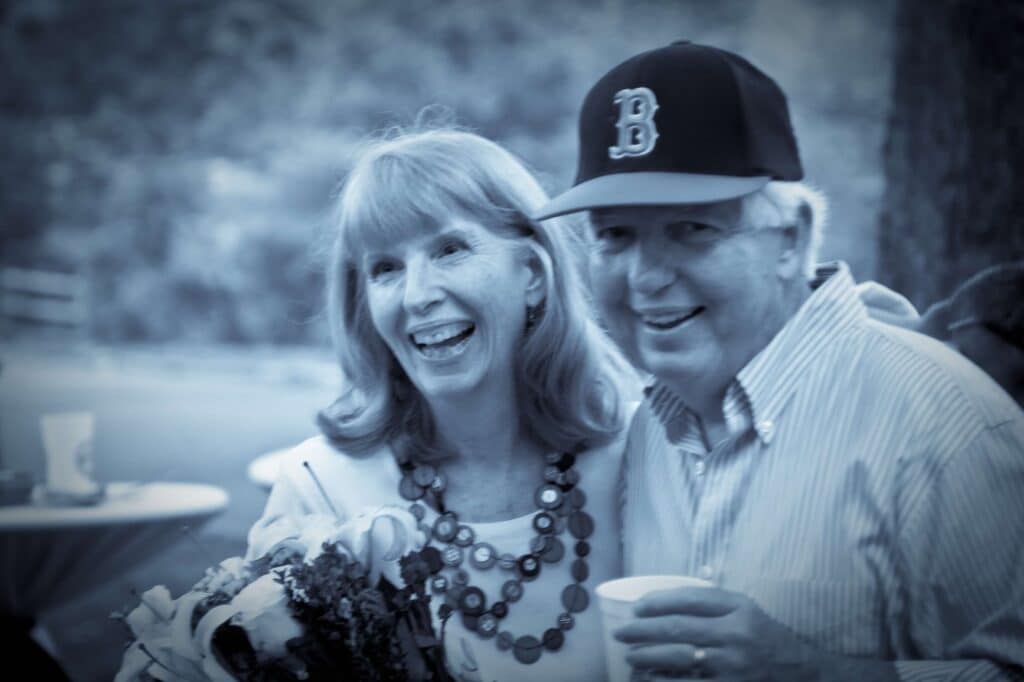
Carl also appreciates the role that Nancy played in his success. She had been a classroom teacher, too. When Carl was hired at Blue Ridge, Nancy immersed herself in the life of the campus in such a way that one can’t truly think of Carl without also thinking of her. Though they have their separate interests, they are inseparable. Spend a few minutes with either of them, and the other will be mentioned – along with children, grandchildren, and Blue Ridge School. I’m humbled that Carl once forgave me, and I’m lucky that both Carl and Nancy consider me family.





What a warm and welcome essay, Dan. You remind me how lucky I was to be a colleague of yours, and Carl’s and Nancy’s, at Blue Ridge School. For me, those few years were frosting on the cake of a lucky life. Thank you, Dan!
Thank you, Phil! Yes, we were all lucky to have Carl and Nancy as colleagues. We and Blue Ridge School were lucky, of course, that you graced the campus. I truly do appreciate your reading and kind comments about my tributes. Many more to follow.