


Overview:
Trump administration’s proposed 2027 budget increases Pell Grant funding to address a shortfall while cutting billions from higher education programs, research agencies, and federal education support,
The Trump administration on Friday released its proposed fiscal year 2027 budget, outlining a plan that increases funding for the Pell Grant program while introducing sweeping cuts to student aid, institutional support, and federal research funding.
The proposal calls for approximately $76.5 billion in discretionary funding for the U.S. Department of Education, a reduction of about $2.3 billion from the previous year. The broader federal budget includes $1.5 trillion in defense spending, alongside a 10 percent cut to nondefense spending, bringing it to $660 billion. According to the administration, the proposal reflects an ongoing effort to reduce the federal role in education while maintaining military strength.
Despite continued calls to eliminate the Department of Education, the administration’s proposal would still fund the agency at more than $75 billion. However, officials reiterated that the budget “continues the Department of Education’s path to elimination,” a move that would ultimately require congressional approval—something lawmakers have repeatedly rejected.
At the center of the proposal is a $10.5 billion increase for the Pell Grant program, raising total discretionary funding to more than $33 billion. The maximum Pell Grant award would remain at $7,395 for the 2027–28 academic year. The additional funding is intended to address a projected shortfall, estimated by the Congressional Budget Office to reach at least $5.5 billion by the end of the fiscal year and potentially grow to nearly $17 billion by 2027 if unaddressed.
Advocates have largely welcomed the effort to stabilize Pell funding. The National College Attainment Network noted that fully funding the program addresses immediate concerns, though leaders emphasized that flat funding over multiple years has already reduced the grant’s purchasing power for students.
Major Cuts to Higher Education Programs
While the Pell Grant sees increased investment, the proposal offsets those costs through approximately $4.5 billion in cuts to higher education and student aid programs. The administration again proposes eliminating the Federal Supplemental Educational Opportunity Grant (FSEOG) program and dramatically reducing Federal Work-Study from $1.23 billion to $123 million, shifting more financial responsibility to employers.
Additional programs targeted for elimination include TRIO, GEAR UP, the Fund for the Improvement of Postsecondary Education, Strengthening Institutions grants, and support programs for student parents and international education. The proposal also seeks to eliminate funding for all Minority-Serving Institution (MSI) grant programs, though some funding for historically Black colleges and universities (HBCUs) and tribal colleges would continue through reallocation.
Emmanual Guillory of the American Council on Education criticized the approach, noting that “we’re not supportive of zeroing out funding for MSI programs and neither is Congress,” and warning that such cuts could undermine support systems for low-income students who also rely on Pell Grants.
The budget also reduces funding for the Institute of Education Sciences to $261.3 million—down from nearly $800 million—and proposes a 35 percent cut to the Office for Civil Rights, reducing staffing significantly.
K–12 Funding Shift and Block Grant Proposal
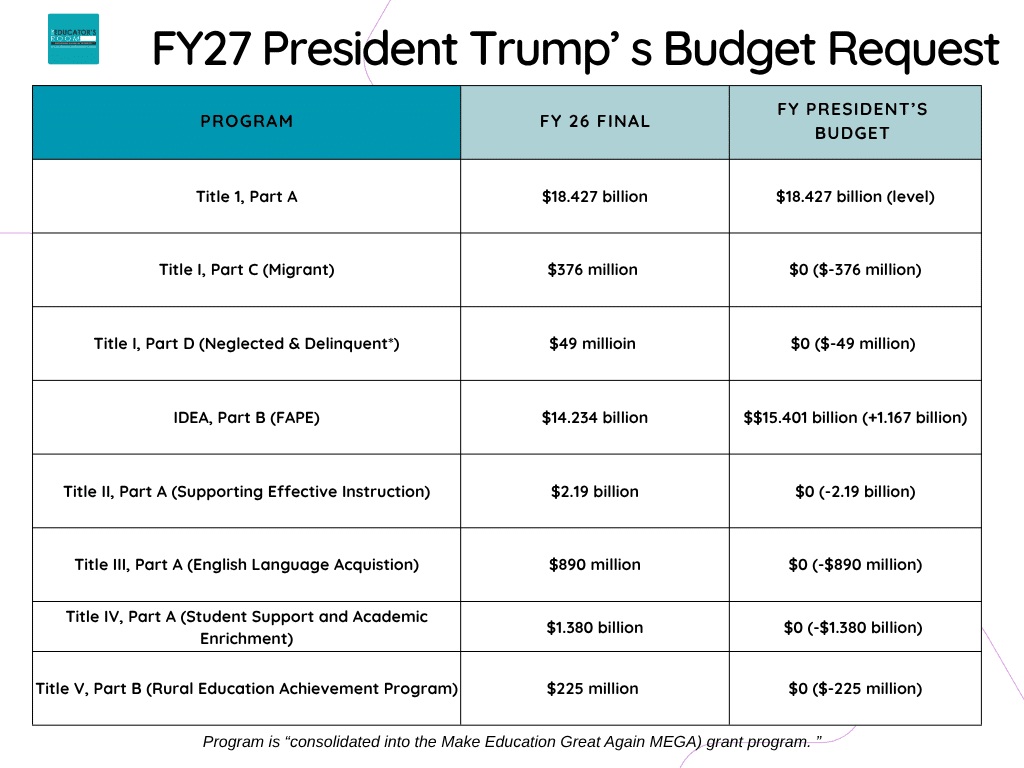
The administration is also renewing its push to consolidate federal K–12 education funding into a $2 billion “Make Education Great Again” block grant. This proposal, first introduced in the 2026 budget, would combine most federal elementary and secondary education grant programs into a single funding stream.
According to budget documents, the program would maintain full support for Title I while directing “virtually all of its fexible [sic] funding to States and school districts for K-12 education and empowers them to make spending decisions based on the needs of the 26 million students they serve.” The plan is framed as an effort to expand local control over education spending.
Restructuring Federal Education Programs
The proposal continues efforts to shift federal education responsibilities to other agencies. Career and technical education (CTE) programs would be permanently moved to the Department of Labor, which is requesting $1.45 billion to oversee these initiatives. Administration officials argue this change would streamline workforce development and better align training programs with labor market needs.
Research Funding Cuts Raise Alarm
The budget also renews efforts to significantly reduce federal investment in research, a move Congress has previously rejected. The National Institutes of Health (NIH) would see a $5 billion reduction, substantially smaller than the roughly $19 billion cut proposed last year but still significant. The plan also calls for eliminating several NIH institutes, including the National Institute on Minority Health and Health Disparities, the Fogarty International Center, and the National Center for Complementary and Integrative Health.
The National Science Foundation (NSF) faces even steeper reductions, with proposed cuts exceeding 50 percent, or approximately $4.8 billion. The proposal would also eliminate the agency’s social, behavioral, and economic sciences directorate, reshaping its research portfolio.
Additional cuts include a $1.1 billion reduction to the Department of Energy’s Office of Science, particularly targeting climate and clean energy research programs. Administration documents indicate a shift in priorities toward fields such as artificial intelligence, quantum computing, and critical minerals.
Research advocates have expressed strong opposition. Sudip Parikh, CEO of the American Association for the Advancement of Science, urged Congress to reject the proposal, emphasizing the importance of sustained federal investment in research for U.S. competitiveness and innovation.
Political Response and Next Steps
The proposal has drawn sharply divided reactions from lawmakers. House Education and Workforce Committee Chair Tim Walberg praised the budget as a step toward reducing waste and improving efficiency. In contrast, Sen. Patty Murray, vice chair of the Senate Appropriations Committee, strongly criticized the plan, arguing it would harm students and weaken investments in medical research.
As with all presidential budget requests, the proposal serves as a starting point for negotiations. Congress, which has rejected many similar proposals in recent years, will now draft its own appropriations legislation ahead of the September 30 deadline. The outcome will determine whether key education and research programs are preserved or significantly reduced.
To see how this new budget will affect your congressional district, click here.
Related posts:
 New Jersey Governor signs law banning book bans; cites intellectual freedom
 GOP ‘One Big Beautiful Bill Act’ threatens key services for students
 Federal Workers’ Union sues Trump administration over partisan shutdown messaging
 Banners at Department of Education Honor Education Leaders, But Charlie Kirk’s Inclusion Draws Criticism
