
Overview:
Jair Solis graduated from UC Merced after years of navigating family detention, fears of deportation and immigration raids.
This story was originally published by EdSource. Sign up for their daily newsletter.
Top Takeaways
- Jair Solis graduated from UC Merced after years of navigating family detention, fears of deportation and immigration raids.
- Research shows immigration enforcement can harm students’ mental health, attendance and academic performance — challenges Solis said he experienced firsthand.
- The family’s educational pursuits continue as his mother plans her return to school.
When immigration agents pounded on his family’s apartment door in 2019, 15-year-old Jair Solis stood between them and his father, refusing to let agents inside without the proper warrant.
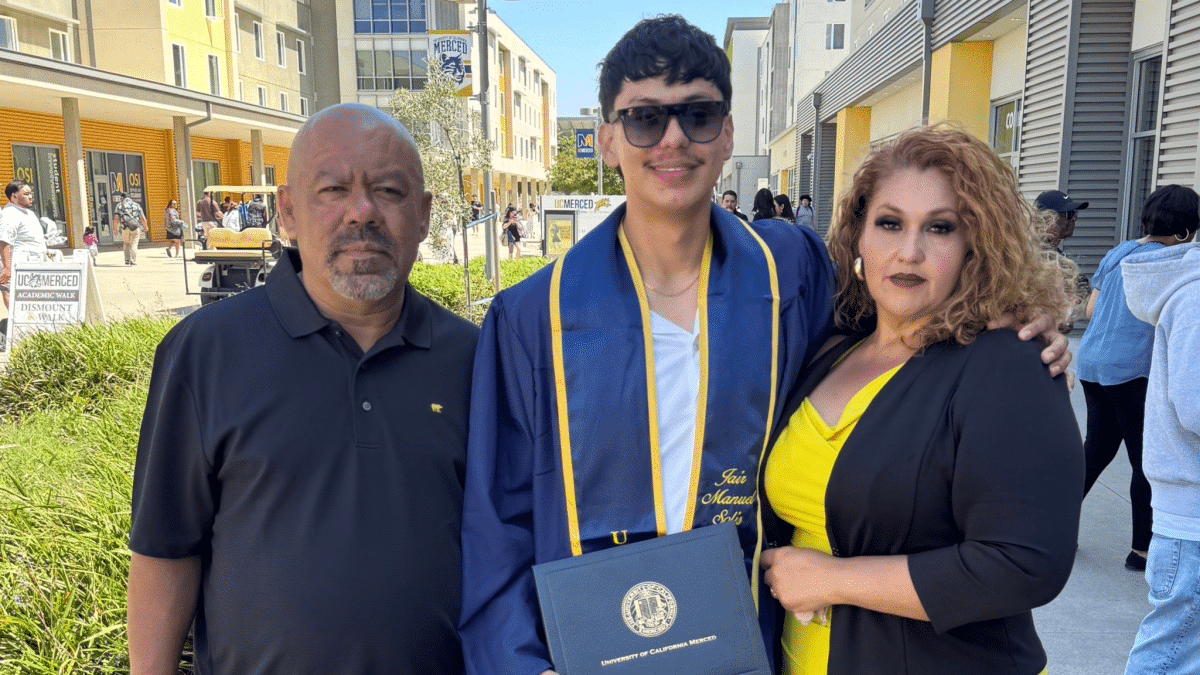
Seven years later, Solis became the first in his family to earn a college degree, graduating from UC Merced two months after his mom became a permanent U.S. resident.
The milestone is one that had long felt out of reach for Solis and his family. His mother gave up her dream of becoming a kindergarten teacher because she was undocumented. Though he fended off immigration agents after asking for a warrant, they would later detain his dad on his way to work. During college, he took a gap year to work and save money so he could continue attending school.
The stole Jair Solis wore during his UC Merced graduation. Source: Solis family“Knowing that I’m the only one to get an education and have that opportunity — have the platform to grow as an academic, as a professional, it’s really a blessing for me,” said Solis, 22. “I don’t take it for granted, but it’s just — I never thought I would be in this position.”
Solis is far from the only student navigating these experiences. A recent analysis from the Brookings Institute estimated that more than 100,000 children — most of them U.S. citizens — have been separated from their parents during the Trump administration’s latest immigration crackdown, though researchers believe the number is likely higher.
Multiple studies have found that children whose parents are detained or deported report higher levels of anxiety and depression. And, a 2025 report from Children’s Equity Project at Arizona State University also found that children exposed to immigration detention or deportation are more likely to experience chronic absenteeism, lower academic performance and higher dropout risks — challenges Solis himself faced during and after his father’s detention.
Those experiences are now shaping Solis’ future. During his final semester as a political science major, he interned with a national immigration policy organization in Washington, D.C. He plans to attend law school and is applying for jobs in policy and the legal field.
A pervasive immigration system
The immigration system has been omnipresent in Solis’ life. For most of his childhood, both his parents were undocumented. Then, during his final years in college, he found himself confronting the return of the federal administration that had once detained his father, a sharp increase in immigration raids in Los Angeles, where his family lives, and several high-profile deaths involving immigration enforcement agents.
“The fact that I’m working for an immigration firm and I’m learning about immigration [law in a class] right now, this is all that I’m thinking about right now,” said Solis about his time in Washington, D.C., earlier this year. “From work to class to when I’m talking to my parents, this is just on top of my mind.”
His fears intensified because, about two years earlier, he had urged his mother to begin preparing paperwork to apply for permanent residency once he turned 21, the age at which he could petition for her legal status.
But when they filed the paperwork after his birthday, they did not know immigrants attending the type of court appointments his mother would later attend would soon begin facing detention — and, in some cases, rapid deportation — under the Trump administration’s immigration policy.
Solis said he often spiraled into rabbit holes, imagining the multiple ways his mother could be detained and worrying about what would happen to his younger brothers if they lost her.
“It was kind of like when you have an open wound and they just pour alcohol in it,” said Solis.
The wound traces back to 2019, when his father was detained by immigration authorities. The arrest came two years after his school, Academia Avance Charter School, made national headlines when one of his classmates recorded a video of immigration agents detaining her father near campus.
The school community rallied around the classmate as her family successfully fought to stop her father’s deportation.
Around that same time, Solis joined Wise Up!, a school-based club organized by the Coalition for Humane Immigrant Rights, or CHIRLA — the same organization where he later interned in Washington, D.C.
Solis said he joined because he felt a responsibility to understand how to protect his family.
“My parents sacrificed everything, left their whole lives in a whole other country to come start something new here and to provide for me,” he said. “I saw it as a responsibility to be educated and know the steps to take for them to be safe.”
The legal rights training he learned through Wise Up! would become critical two years later, when it was Solis and his family whom the school community rallied around.
A father’s detention
Solis’ mother says that her son’s instinct to demand the proper warrant from immigration agents that Sunday morning in 2019 is likely why they left shortly after. But before school the following Tuesday morning, she woke him in a panic: Immigration agents had tailed and detained his father as he drove to work.
As his mother called their pastor and a family member, Solis contacted the school staff member who led the Wise Up! program. She informed CHIRLA, who quickly provided an immigration attorney for the family.
“Jair called all the right people,” said Ofelia Garcia, Solis’ mother, about that day. “It’s traumatic because you see it on the news, but you never imagine it will happen to you.”
CHIRLA’s attorneys secured his father’s release within a month and continued supporting the family until he was approved for permanent U.S. residency, but the detention immediately destabilized the family. Solis said his father lost his job and the family was denied his final paycheck. Their church and school communities stepped in with meals, emotional support and financial help, but Solis knew the family was struggling.
Eventually, he spoke with his mother about leaving school to work and help pay bills.
“She just looked at me with this look of … I could just tell it was this look of disappointment and hurt because my mom tried to pursue her own educational dreams, but she stopped due to her status,” said Solis.
Solis credits his mother with keeping him in school and not missing a single day during his father’s detainment. For her, it was the most practical and safest choice.
“They were safest at school,” Garcia said, explaining that if she were also detained, her children would at least be surrounded by trusted adults. She also feared they would isolate themselves emotionally if they stopped attending classes.
“I told them that the only way they could help me was by studying,” she said.
Solis’ final college years
Solis pushed forward through high school and college, where his focus turned to adjusting to a completely new environment. He was passionate about what he was learning in school, but there were moments where his family’s experiences would seep back in.
He left Merced for a school year to save up money, for example, because the family’s ongoing financial struggles meant they couldn’t support him monetarily. He said he was also racially profiled by police multiple times, experiences that strengthened his resolve to pursue law school.
He also recently realized that he’s gone through college without fully processing his father’s detention and eventual release. But last year, as immigration raids intensified while his mother’s permanent residency application was being processed, those memories resurfaced.
“What happened to my dad, I’ve been avoiding thinking about it. I feel like I didn’t fully grieve, in a way,” said Solis. “During that time, I was just thinking about staying afloat, staying afloat, and I wasn’t really thinking about my mental [health]. It just finally got to me when I was in D.C., because I was by myself.”
Now, with both of his parents holding legal status and his college degree completed, Solis said he is finally beginning to confront the anger, resentment and fear tied to his family’s experiences with the immigration system. He recently began seeing a therapist for the first time and plans to continue.
Seven years later, he is still looking out for his parents — this time by encouraging his mom to return to school. Now that she has a legal work permit, she can pursue better work opportunities and continue the three years of community college she once put aside.
Solis’ mother recently told her children: “I’m going to return to school so you can attend my graduation and feel proud of me,” he said.