


Overview:
The Education Department's 2026 regulatory agenda proposes 19 rules-rolling back DEI, redefining sex under Title IX, and easing college merger and aid rules—that align with Trump's 2025 executive orders.
The Trump administration is moving to rewrite the rules governing American higher education.
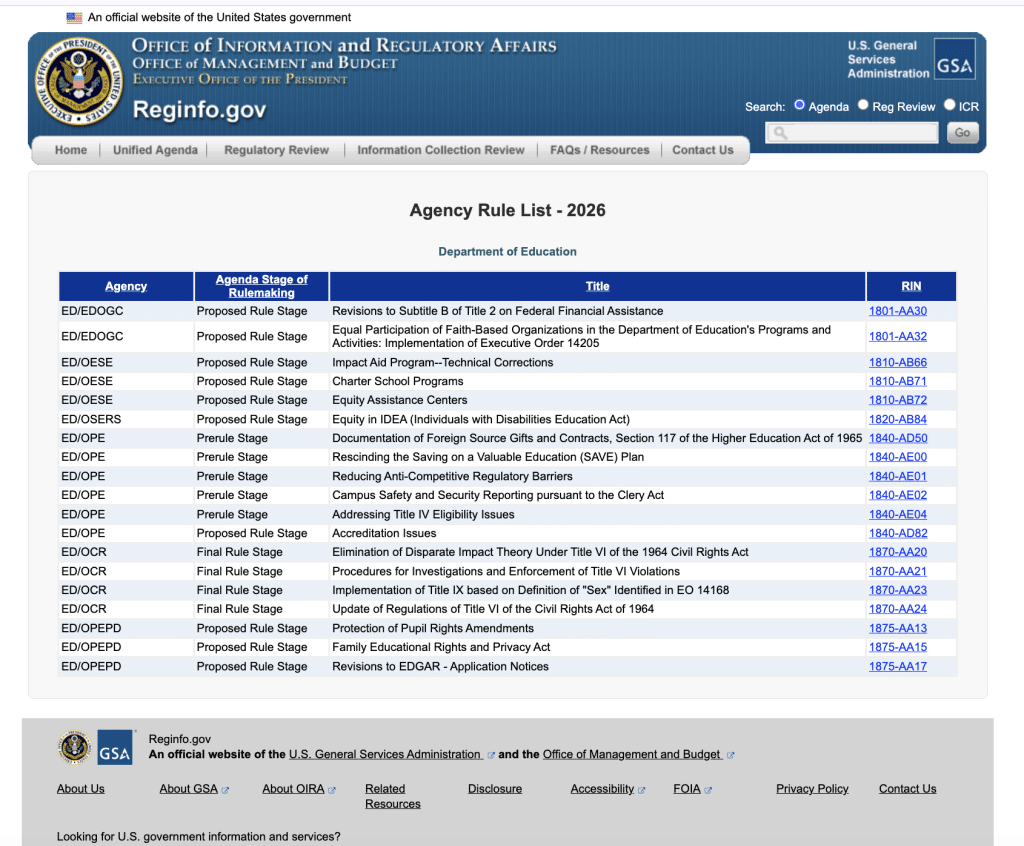
The Department of Education released its 2026 regulatory agenda Friday, laying out 19 proposed rule changes that would reshape civil rights enforcement, financial aid eligibility, accreditation, and how the government defines sex under federal education law, a sweeping set of priorities first reported by Politico.
The full rule list, part of the administration’s broader 2026 Unified Agenda, summarizes the department’s key priorities and the approximate timetables officials hope to hit in finalizing each regulation. Six of the 19 items deal directly with higher education, and four more concern civil rights enforcement. The agenda offers only brief descriptions of what the department intends to change, without additional detail, and the projected timelines are widely understood across administrations to be aspirational rather than binding. At least four items on this year’s list, in fact, were carried over from 2025.
Taken together, the proposals track closely with President Trump’s campaign promises and with executive orders he signed last year addressing the legal definition of sex, the rollback of diversity, equity, and inclusion initiatives, efforts to combat antisemitism on campus, and a broader overhaul of higher education oversight.
What Is the Unified Agenda?
The Unified Agenda of Federal Regulatory and Deregulatory Actions is the federal government’s master list of upcoming rules across every agency, not just the Department of Education. Published twice a year, typically in spring and fall, the agenda’s primary purpose is to bring transparency to the executive branch by giving the public advance notice of which rules agencies plan to propose, revise, or eliminate, before those rules are formally drafted or put out for comment.
A Department Shifting Focus
Last summer, after Trump signed the One Big Beautiful Bill Act into law, the department spent much of its bandwidth negotiating three major policy packages in under a year. Officials also prioritized rewriting accreditation regulations, an approach the administration has used as a lever to influence which colleges can access federal aid, whom they hire, and what their curricula look like.
With that accreditation rewrite now moving forward and the OBBBA regulations in effect, Education Secretary Linda McMahon is turning her attention elsewhere, including an overhaul of how the Office for Civil Rights investigates discrimination complaints.
Key Priorities on the Agenda
Cracking down on DEI. The department plans to amend regulations under Title VI of the Civil Rights Act of 1964 to spell out how the law’s prohibitions on race, color and national-origin discrimination “impact development and implementation of diversity, equity, and inclusion programs.” The rule is also expected to explain how, in the administration’s view, Title VI bars race-based, race-exclusive or race-conscious affinity groups and educational programs. This fits into a wider White House attack against DEI, which has extended the Supreme Court’s ban on considering race in admissions to cover co- and extracurricular programs more broadly. Separately, the administration has floated policies at the Office of Management and Budget and the General Services Administration that would deny federal grants to programs seen as promoting disparate-impact theories or DEI.
Defining sex under Title IX. In line with a January 2025 executive order declaring there are only two sexes, the department intends to amend Title IX regulations to clarify that “sex” refers exclusively to a person’s immutable biological classification as male or female. The move follows a recent Supreme Court decision upholding state bans on transgender athletes competing on teams matching their gender identity; the Court’s conservative majority wrote that “sex” in Title IX “cannot plausibly be interpreted to refer to anything other than biological sex.”
Eliminating disparate impact theory. The department is moving to repeal the legal doctrine, codified in 1991, that allows a facially neutral policy to be found discriminatory if it disproportionately harms a particular group.
Limiting foreign influence. Officials plan to codify an executive order requiring colleges to disclose gifts and partnerships from foreign donors, with federal funding on the line for institutions that fail to comply.
Federal aid eligibility and mergers. The department wants to rework aid-eligibility rules it says currently “unnecessarily target faith-based or for-profit institutions and interfere with efficient and beneficial mergers, sales, and transfers of institutions of higher education.” With more colleges under financial strain, experts have long argued existing rules make mergers unnecessarily difficult. The same rule-making session is expected to revisit eligibility criteria for the Ronald E. McNair Postbaccalaureate Achievement Program, a $60 million grant program aimed at first-generation, low-income and minority students pursuing doctoral degrees. The Young America’s Foundation sued over the program’s criteria, and the administration has agreed to change them after the Justice Department found parts of the criteria unconstitutional in December 2025, though it concluded the program as a whole remains permissible.
Title IV eligibility. The department also wants to loosen rules to make it easier for certain for-profit and religious institutions to qualify for federal student aid.
Beyond these six issues, the agenda includes plans to formally rescind the Biden-era Saving on a Valuable Education (SAVE) loan-repayment plan, ease the path for colleges to merge or consolidate, and pursue changes to lower textbook costs and improve credit-transfer policies.
Several other items on the formal list were not mentioned in the department’s public summary of priorities, including technical corrections to the Impact Aid Program, changes to Charter School Programs and Equity Assistance Centers, an “Equity in IDEA” rule affecting students with disabilities, new Clery Act campus-safety reporting requirements, a rule on faith-based organizations’ participation under Executive Order 14205, and updates to FERPA and the Protection of Pupil Rights Amendments.
The Executive Order Throughline
The four OCR rules in final-rule stage line up closely with the executive orders Trump signed last year: the Title IX rule (1870-AA23) implements the administration’s definition of “sex” under Executive Order 14168, while the two Title VI rules (1870-AA20 and 1870-AA24) carry out the DEI rollback. The enforcement-procedures rule (1870-AA21) likely reflects the administration’s emphasis on combating antisemitism, since Title VI’s national-origin protections have been the primary legal basis for OCR’s antisemitism-related enforcement actions in recent years. Meanwhile, the accreditation rule (1840-AD82) and the anti-competitive-barriers rule (1840-AE01) form the backbone of the administration’s broader push to overhaul higher education oversight.
Timelines listed in the Unified Agenda are the department’s stated goals, not guarantees. Regulatory agendas routinely slip, and several items on this year’s list were themselves carried over from 2025.
[^1]: See reginfo.gov; GSA: Unified Agenda of Federal Regulations; EPIC: The Unified Regulatory Agenda Explained; video explainer.