Overview:

A reflective tribute recounts Chuck Roser’s decades-long impact as a compassionate, talented chemistry teacher, craftsman, and mentor whose kindness, humility, and courage and deeply influenced his students, colleagues, and community.

I visited Chuck Roser, his husband Tom, and their sweet rescue dog Patsy in their Pittsboro, NC, home on Friday, September 12, 2025.  As a gesture of my gratitude, I took Chuck and Tom a six pack of 12-ounce bottles of Kona Big Wave Liquid Aloha.  I gave Patsy dog treats and gentle pats on the head when she would allow. 

In 1985, shortly after I was hired at Durham Academy in Durham, North Carolina, I met Chuck during a beginning-of-the-year faculty gathering.  I was going to teach in the middle school.  Chuck was Durham Academy’s upper school chemistry teacher on another campus.  That didn’t matter to Chuck, who I quickly learned had many friends among the middle school faculty.  In fact, Chuck had friends throughout the four divisions of the school and enjoyed hosting gatherings at his home throughout the school year.  Those gatherings, early in my first year at DA, allowed me to get to know many teachers, several of whom would become dear friends.  
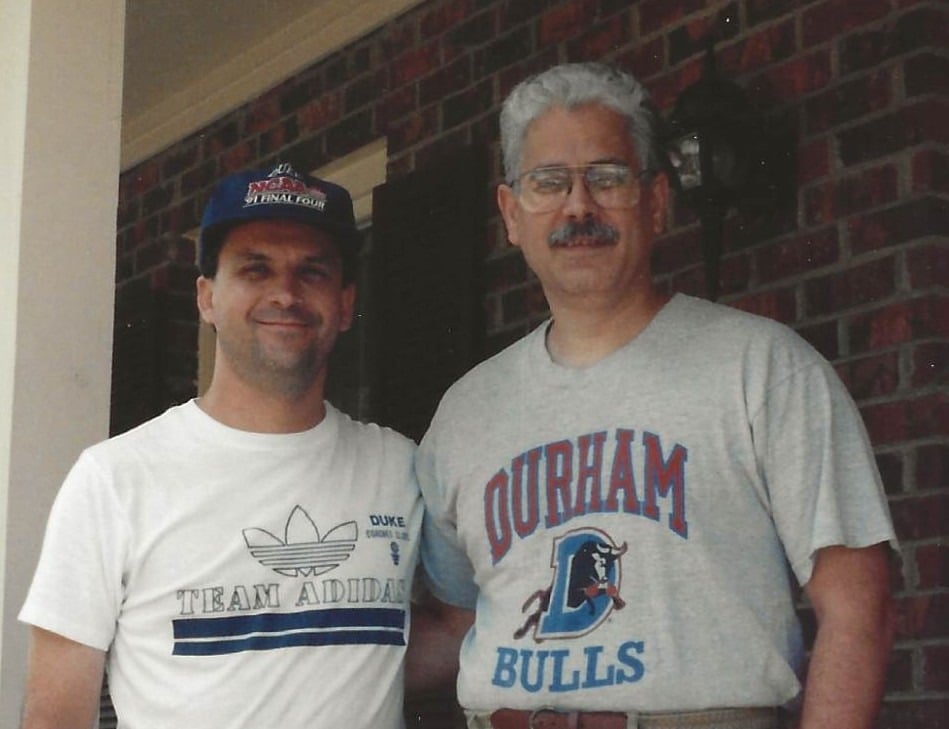
When I first met Chuck, he was a thirty-six-year-old bachelor.  He had never married and, as far as I could gather through casual conversations with others, had not been in any serious relationships.  I had seldom met anyone quite as welcoming to newcomers in a school as was Chuck.  Though we seldom saw one another during the week, I found myself gravitating to him during full-school faculty meetings and other all-school events.  What wasn’t to like about this friendly, funny, talented person?  And his parties were fun. 

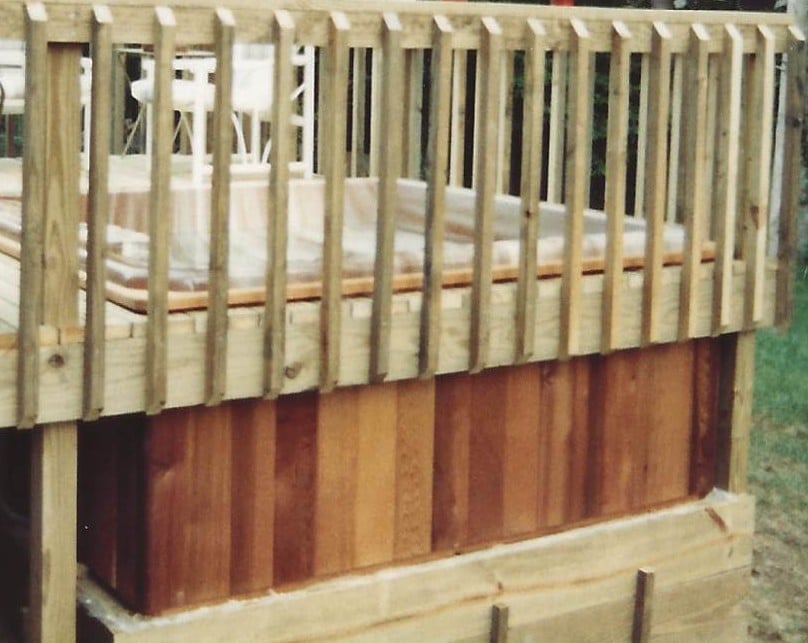
Chuck is an artist as well as a scientist, making him in many ways a Renaissance man.  He is particularly skilled in carpentry and other forms of wood work.  When my wife and I decided to expand our back deck, Chuck was the first person I called.  He’d arrive daily that summer with his own thermos of iced tea to implement my way-too-intricate design/build plan that would allow our expansion to surround a sunken hot tub.  He never asked for anything other than conversation.  Chuck admitted later that he was very nervous the day the hot tub arrived and was inserted into the square hole we’d left.  We were both silently pondering, “Was the opening big enough but not too big? Was the support structure strong enough to support the weight of the tub, water and the occupants?  Was the support high enough so that the lip of the tub was just above the surface of the deck but not resting on the deck?”  It was one of my proudest engineering moments, and I owed so much to Chuck for its success.
When our daughter Liza was born, he built a rocking cradle for her with the help of one of his friends for whom he had previously built a cradle.  When the next DA faculty friend was about to become a dad for the first time, I helped Chuck build that cradle.  That was the deal, you see, and I loved it.  Chuck would eventually create a wooden Santa decoration as well as a vertical marble maze for Liza.   

Born into a loving, conservative Catholic family in Birmingham, AL, Chuck attended Catholic schools from kindergarten through 12th grade.  He graduated from John Carroll Catholic High School in 1967.  He earned his BS in chemistry from Birmingham Southern College in 1971, then his MA in chemistry from Duke University in 1974.  

When considering what he might do with a master’s in chemistry, he recalled his high school chemistry and physics teacher.  She had been encouraging to all of her students, even those who had little interest in science.  This made her class more enjoyable and engaging for everyone.  He thought he might want to have that same sort of impact on others.  

Durham Academy was in need of a chemistry teacher in 1974.  Chuck’s positive impact on students and his colleagues would be felt for the next seventeen years.  As a middle school teacher, I would hear students and their families talk about the impressive chemistry teacher at the upper school.  He wasn’t impressive just because of his knowledge of the subject but more because of how he managed to engage students who had not previously been interested in chemistry (or any science for that matter).  At the core of his personality was a sense of humor that won over everyone.  He cared about his students outside the classroom, too, and they appreciated seeing him on the sidelines of their basketball games and tennis matches.     

The day he called me in a way-too-somber tone to let me know he needed to talk about something serious, I became concerned.  This was not the perpetually upbeat Chuck I knew.  I wondered if maybe he was ill or was planning to move.  Maybe one of his family members had passed away.  His solemn mood continued after he arrived at my house and we walked out to the new deck.  He fidgeted for a few minutes, made small talk, took sips of his tea, then nervously managed to utter that he was gay.  I could not hide the relief I felt in that moment.  I jumped up to give him a hug and to tell him thank goodness it wasn’t anything actually serious.  Of course, it was serious, very serious to Chuck.  But not to me, and not to his friends who loved him.  If a person can blossom in the way a flower does, that’s what Chuck did that day and the days to come as he talked with other friends and family members.  It was 1990.  Coming out was hard to do in those days.  I admired his bravery while also giving him a hard time for worrying me so.        

A much-sought-after position became available at the North Carolina School of Science and Math in 1991.  Chuck would teach chemistry there for the next nineteen years before wrapping up a thirty-six-year fulltime career in education.  Chuck loved chemistry, and he loved people even more.  “I enjoyed sharing my excitement about chemistry with my students.  I also wanted to encourage them to try to reach their goals even if the path was difficult.”  He continued to fill in for teachers at Science and Math for several years before fully retiring.  

Since he left DA and I left Durham, Chuck and I have stayed in touch.  He became an important sounding board for me as I considered when to retire.  He began dating Tom in 1998.  They married in 2015 immediately after the Supreme Court legalized gay marriage for the entire country.  It was important to them that the ceremony could take place in Durham.            

Chuck recently underwent heart valve surgery at Duke University Hospital.  A surgeon in that department, a Durham Academy graduate, learned that Chuck had once taught at DA.  Even though this graduate had not been Chuck’s student, he still changed his schedule so that he would be the one to perform Chuck’s surgery.  Upon learning that a DA graduate would be his surgeon, Chuck thought, “I hope he is someone who paid close attention in class!”  Fortunately, the surgeon had paid excellent attention, and the surgery went without any complications.  He had refused to leave Chuck’s surgery in anyone’s else’s hands.  That’s true loyalty to a school.       

When Chuck considers those he’d visit on his own gratitude tour, he’d begin with his parents.  Many of his woodworking skills came from his dad, who had been a lifelong woodworker.  They spent so many hours together in his dad’s wood shop that his dad would just need to reach out his hand and Chuck would know which tool he needed.  Chuck also recalls going to a building site with his dad when still quite young, which made him feel very much like an adult.  After his dad retired from the steel mills, he worked on repairing antique furniture.  He’d save the difficult woodturning jobs for Chuck when he came home to visit.  Chuck’s dad wanted him to have a different life than the one he’d had in the steel mills so he was really supportive of Chuck’s going to college.  Above all else, though, his parents taught him the importance of caring for others.  “When I came out to them, that was tough going for a while, especially for my mom, but ultimately they remembered their strong loving Catholic values.”  

Chuck would also jump at the chance to show gratitude to Dr. Calloway and Dr. Quin.  Dr. Calloway was his faculty advisor as well as chemistry professor at Birmingham Southern.  He helped Chuck navigate class registration and made sure that he took the right courses at the right time.  “He was always available to answer questions or just to talk. He took me under his wing and always had a smile.”  He had gotten to know Chuck well enough to recognize his nurturing personality.  For that reason, he suggested that Chuck should consider teaching as a career.  Dr. Quin was the chemistry department chair at Duke as well as the research director for Chuck’s MA.  He was an excellent and supportive teacher. Chuck learned a lot of advanced synthetic techniques and instrumentation working for him. “He was the strongest advocate we graduate students had.”  Because Dr. Calloway and Dr. Quin had the ability to explain difficult topics and have high expectations while supporting their students through the process, they were role models for Chuck when he began teaching.

Chuck is thankful for his colleagues, too. “I’ve been lucky to teach alongside so many talented educators over the years.  It would be fun to have one more backyard gathering to show my appreciation for all of them.”  Wouldn’t it be nice if such events could happen, that we could have one more get-together with all of those who mean the most to us?   

Another of Chuck’s interests is Habitat for Humanity.  I went with him a few times and witnessed his humility as he built shelters for those in need.  When he considers how education can improve today, he states, “Educators should provide the knowledge to be successful in life and also the motivation to build better communities.”  This is a tall order that will take more funding than is currently now provided to independent schools and public school systems.  The schools themselves need to be communities that exhibit fair, equitable and inclusive treatment of all students and faculty.    

Chuck’s career highlights speak to his values.  One of his students eventually became a colleague at Durham Academy.  “It was great to see how he had become an excellent teacher and especially someone who cared about his students.  I learned a lot from his example.”  During my twenty-six years at Blue Ridge School, a graduate’s return to teach happened several times.  I can attest to the swell of pride one feels.  While at NCSSM, Chuck recalls one student who had arrived from a very small school and at first felt overwhelmed.  He watched that student do the very best he could do every day, which made Chuck give his best in the classroom every day.  “He was one of the most successful students I ever taught.”  

Also while at NCCSM, Chuck started a student volunteer Habitat for Humanity group with the help and support of the Student Life adults who lived in the dorms.  He would accompany the students as they gave back to Durham.  Chuck earned many accolades for his teaching during his thirty-six-year career, but he considers that Habitat for Humanity group his most notable accomplishment.

If Chuck could change anything about his career, it would be a disappointment in himself.  “I wish I could have found the courage to be out as a gay faculty member sooner.  I could have been a role model and provided hope for gay students and other gay faculty.  I should have been more honest with my friends sooner, too.”  Not one person I’ve ever known who considers Chuck a colleague or friend has ever expressed this same disappointment in him.  Instead, we praise him for his bravery at a time when it unfortunately could have ended his career as an educator.  Ultimately, Chuck proved that an individual’s sexual orientation becomes insignificant when one considers the loving traits that matter in teaching.   

One trait that I’ve always admired about Chuck is his constant even keel.  How did he do that in the face of so much that could go wrong during the course of a school day?  Decisions he considered bad on the part of administrators, colleagues and students did affect him, but he learned that staying calm and being rational were more effective, healthier ways to bring about desired results.  His policy was never to begin nor end a school day angry.  Staying focused on all the good that happened each day kept him in good spirits.  

Chuck has additional advice for new teachers.  “Maintain high expectations of yourself and work hard for your students.  Treat them as individuals, not a group.  Students want to be treated with respect, caring and fairness. If you do that, they will work as hard as they can for you and themselves. Enjoy yourself, and you will enjoy the profession.”  Chuck’s students respected him for his sense of humor and emotional availability to them every bit as much as they admired his knowledge of chemistry.  Chuck cared about building friendships among his fellow faculty members, too.  He knew, as I came to learn, that they will be some of the best friends and support you will ever have.  

When Chuck entered the classroom that first day in 1974 at Durham Academy, he was both excited and nervous.  He’d had some experience teaching labs and recitation sessions but had never been responsible for an entire class.  He sometimes felt overwhelmed during his first year at DA.  He was the school’s first full-time chemistry teacher, and he also had to teach a section of 9th grade physical science.  He was so busy on most days that he didn’t have time to be scared.  His last day at NCSSM in 2010 was a sad one.  He’d been blessed with a talented senior class that year, which made his final days in the classroom all the more emotional.  He knew he was ending a career that he loved.  Years of memories with students anChuck Roser 

I visited Chuck Roser, his husband Tom, and their sweet rescue dog Patsy in their Pittsboro, NC, home on Friday, September 12, 2025.  As a gesture of my gratitude, I took Chuck and Tom a six pack of 12-ounce bottles of Kona Big Wave Liquid Aloha.  I gave Patsy dog treats and gentle pats on the head when she would allow. 

In 1985, shortly after I was hired at Durham Academy in Durham, North Carolina, I met Chuck during a beginning-of-the-year faculty gathering.  I was going to teach in the middle school.  Chuck was Durham Academy’s upper school chemistry teacher on another campus.  That didn’t matter to Chuck, who I quickly learned had many friends among the middle school faculty.  In fact, Chuck had friends throughout the four divisions of the school and enjoyed hosting gatherings at his home throughout the school year.  Those gatherings, early in my first year at DA, allowed me to get to know many teachers, several of whom would become dear friends.  

When I first met Chuck, he was a thirty-six-year-old bachelor.  He had never married and, as far as I could gather through casual conversations with others, had not been in any serious relationships.  I had seldom met anyone quite as welcoming to newcomers in a school as was Chuck.  Though we seldom saw one another during the week, I found myself gravitating to him during full-school faculty meetings and other all-school events.  What wasn’t to like about this friendly, funny, talented person?  And his parties were fun. 

Chuck is an artist as well as a scientist, making him in many ways a Renaissance man.  He is particularly skilled in carpentry and other forms of wood work.  When my wife and I decided to expand our back deck, Chuck was the first person I called.  He’d arrive daily that summer with his own thermos of iced tea to implement my way-too-intricate design/build plan that would allow our expansion to surround a sunken hot tub.  He never asked for anything other than conversation.  Chuck admitted later that he was very nervous the day the hot tub arrived and was inserted into the square hole we’d left.  We were both silently pondering, “Was the opening big enough but not too big? Was the support structure strong enough to support the weight of the tub, water and the occupants?  Was the support high enough so that the lip of the tub was just above the surface of the deck but not resting on the deck?”  It was one of my proudest engineering moments, and I owed so much to Chuck for its success.

When our daughter Liza was born, he built a rocking cradle for her with the help of one of his friends for whom he had previously built a cradle.  When the next DA faculty friend was about to become a dad for the first time, I helped Chuck build that cradle.  That was the deal, you see, and I loved it.  Chuck would eventually create a wooden Santa decoration as well as a vertical marble maze for Liza.   

Born into a loving, conservative Catholic family in Birmingham, AL, Chuck attended Catholic schools from kindergarten through 12th grade.  He graduated from John Carroll Catholic High School in 1967.  He earned his BS in chemistry from Birmingham Southern College in 1971, then his MA in chemistry from Duke University in 1974.  

When considering what he might do with a master’s in chemistry, he recalled his high school chemistry and physics teacher.  She had been encouraging to all of her students, even those who had little interest in science.  This made her class more enjoyable and engaging for everyone.  He thought he might want to have that same sort of impact on others.  

Durham Academy was in need of a chemistry teacher in 1974.  Chuck’s positive impact on students and his colleagues would be felt for the next seventeen years.  As a middle school teacher, I would hear students and their families talk about the impressive chemistry teacher at the upper school.  He wasn’t impressive just because of his knowledge of the subject but more because of how he managed to engage students who had not previously been interested in chemistry (or any science for that matter).  At the core of his personality was a sense of humor that won over everyone.  He cared about his students outside the classroom, too, and they appreciated seeing him on the sidelines of their basketball games and tennis matches.     

The day he called me in a way-too-somber tone to let me know he needed to talk about something serious, I became concerned.  This was not the perpetually upbeat Chuck I knew.  I wondered if maybe he was ill or was planning to move.  Maybe one of his family members had passed away.  His solemn mood continued after he arrived at my house and we walked out to the new deck.  He fidgeted for a few minutes, made small talk, took sips of his tea, then nervously managed to utter that he was gay.  I could not hide the relief I felt in that moment.  I jumped up to give him a hug and to tell him thank goodness it wasn’t anything actually serious.  Of course, it was serious, very serious to Chuck.  But not to me, and not to his friends who loved him.  If a person can blossom in the way a flower does, that’s what Chuck did that day and the days to come as he talked with other friends and family members.  It was 1990.  Coming out was hard to do in those days.  I admired his bravery while also giving him a hard time for worrying me so.        

A much-sought-after position became available at the North Carolina School of Science and Math in 1991.  Chuck would teach chemistry there for the next nineteen years before wrapping up a thirty-six-year fulltime career in education.  Chuck loved chemistry, and he loved people even more.  “I enjoyed sharing my excitement about chemistry with my students.  I also wanted to encourage them to try to reach their goals even if the path was difficult.”  He continued to fill in for teachers at Science and Math for several years before fully retiring.  

Since he left DA and I left Durham, Chuck and I have stayed in touch.  He became an important sounding board for me as I considered when to retire.  He began dating Tom in 1998.  They married in 2015 immediately after the Supreme Court legalized gay marriage for the entire country.  It was important to them that the ceremony could take place in Durham.            

Chuck recently underwent heart valve surgery at Duke University Hospital.  A surgeon in that department, a Durham Academy graduate, learned that Chuck had once taught at DA.  Even though this graduate had not been Chuck’s student, he still changed his schedule so that he would be the one to perform Chuck’s surgery.  Upon learning that a DA graduate would be his surgeon, Chuck thought, “I hope he is someone who paid close attention in class!”  Fortunately, the surgeon had paid excellent attention, and the surgery went without any complications.  He had refused to leave Chuck’s surgery in anyone’s else’s hands.  That’s true loyalty to a school.       

When Chuck considers those he’d visit on his own gratitude tour, he’d begin with his parents.  Many of his woodworking skills came from his dad, who had been a lifelong woodworker.  They spent so many hours together in his dad’s wood shop that his dad would just need to reach out his hand and Chuck would know which tool he needed.  Chuck also recalls going to a building site with his dad when still quite young, which made him feel very much like an adult.  After his dad retired from the steel mills, he worked on repairing antique furniture.  He’d save the difficult woodturning jobs for Chuck when he came home to visit.  Chuck’s dad wanted him to have a different life than the one he’d had in the steel mills so he was really supportive of Chuck’s going to college.  Above all else, though, his parents taught him the importance of caring for others.  “When I came out to them, that was tough going for a while, especially for my mom, but ultimately they remembered their strong loving Catholic values.”  

Chuck would also jump at the chance to show gratitude to Dr. Calloway and Dr. Quin.  Dr. Calloway was his faculty advisor as well as chemistry professor at Birmingham Southern.  He helped Chuck navigate class registration and made sure that he took the right courses at the right time.  “He was always available to answer questions or just to talk. He took me under his wing and always had a smile.”  He had gotten to know Chuck well enough to recognize his nurturing personality.  For that reason, he suggested that Chuck should consider teaching as a career.  Dr. Quin was the chemistry department chair at Duke as well as the research director for Chuck’s MA.  He was an excellent and supportive teacher. Chuck learned a lot of advanced synthetic techniques and instrumentation working for him. “He was the strongest advocate we graduate students had.”  Because Dr. Calloway and Dr. Quin had the ability to explain difficult topics and have high expectations while supporting their students through the process, they were role models for Chuck when he began teaching.

Chuck is thankful for his colleagues, too. “I’ve been lucky to teach alongside so many talented educators over the years.  It would be fun to have one more backyard gathering to show my appreciation for all of them.”  Wouldn’t it be nice if such events could happen, that we could have one more get-together with all of those who mean the most to us?   

Another of Chuck’s interests is Habitat for Humanity.  I went with him a few times and witnessed his humility as he built shelters for those in need.  When he considers how education can improve today, he states, “Educators should provide the knowledge to be successful in life and also the motivation to build better communities.”  This is a tall order that will take more funding than is currently now provided to independent schools and public school systems.  The schools themselves need to be communities that exhibit fair, equitable and inclusive treatment of all students and faculty.    

Chuck’s career highlights speak to his values.  One of his students eventually became a colleague at Durham Academy.  “It was great to see how he had become an excellent teacher and especially someone who cared about his students.  I learned a lot from his example.”  During my twenty-six years at Blue Ridge School, a graduate’s return to teach happened several times.  I can attest to the swell of pride one feels.  While at NCSSM, Chuck recalls one student who had arrived from a very small school and at first felt overwhelmed.  He watched that student do the very best he could do every day, which made Chuck give his best in the classroom every day.  “He was one of the most successful students I ever taught.”  

Also while at NCCSM, Chuck started a student volunteer Habitat for Humanity group with the help and support of the Student Life adults who lived in the dorms.  He would accompany the students as they gave back to Durham.  Chuck earned many accolades for his teaching during his thirty-six-year career, but he considers that Habitat for Humanity group his most notable accomplishment.

If Chuck could change anything about his career, it would be a disappointment in himself.  “I wish I could have found the courage to be out as a gay faculty member sooner.  I could have been a role model and provided hope for gay students and other gay faculty.  I should have been more honest with my friends sooner, too.”  Not one person I’ve ever known who considers Chuck a colleague or friend has ever expressed this same disappointment in him.  Instead, we praise him for his bravery at a time when it unfortunately could have ended his career as an educator.  Ultimately, Chuck proved that an individual’s sexual orientation becomes insignificant when one considers the loving traits that matter in teaching.   

One trait that I’ve always admired about Chuck is his constant even keel.  How did he do that in the face of so much that could go wrong during the course of a school day?  Decisions he considered bad on the part of administrators, colleagues and students did affect him, but he learned that staying calm and being rational were more effective, healthier ways to bring about desired results.  His policy was never to begin nor end a school day angry.  Staying focused on all the good that happened each day kept him in good spirits.  

Chuck has additional advice for new teachers.  “Maintain high expectations of yourself and work hard for your students.  Treat them as individuals, not a group.  Students want to be treated with respect, caring and fairness. If you do that, they will work as hard as they can for you and themselves. Enjoy yourself, and you will enjoy the profession.”  Chuck’s students respected him for his sense of humor and emotional availability to them every bit as much as they admired his knowledge of chemistry.  Chuck cared about building friendships among his fellow faculty members, too.  He knew, as I came to learn, that they will be some of the best friends and support you will ever have.  

When Chuck entered the classroom that first day in 1974 at Durham Academy, he was both excited and nervous.  He’d had some experience teaching labs and recitation sessions but had never been responsible for an entire class.  He sometimes felt overwhelmed during his first year at DA.  He was the school’s first full-time chemistry teacher, and he also had to teach a section of 9th grade physical science.  He was so busy on most days that he didn’t have time to be scared.  His last day at NCSSM in 2010 was a sad one.  He’d been blessed with a talented senior class that year, which made his final days in the classroom all the more emotional.  He knew he was ending a career that he loved.  Years of memories with students and what he had accomplished with them came flooding back on that final day.  Teaching had helped him grow both academically and personally.  The profession had given him a chance to become close friends with colleagues and to have a lasting impact on young lives.  His parents could not have asked for anything more.  

As I was about to end my visit with Chuck and Tom, Chuck presented me with a pen/pencil set for which he had lovingly crafted wooden barrels.  Though his gift caught me by surprise, it shouldn’t have.  How many gifts made from his loving hands had he given me before?  The pen/pencil set is symbolic of the way he appreciates meaningful relationships, the way he gives to all of his friends.  d what he had accomplished with them came flooding back on that final day.  Teaching had helped him grow both academically and personally.  The profession had given him a chance to become close friends with colleagues and to have a lasting impact on young lives.  His parents could not have asked for anything more.  
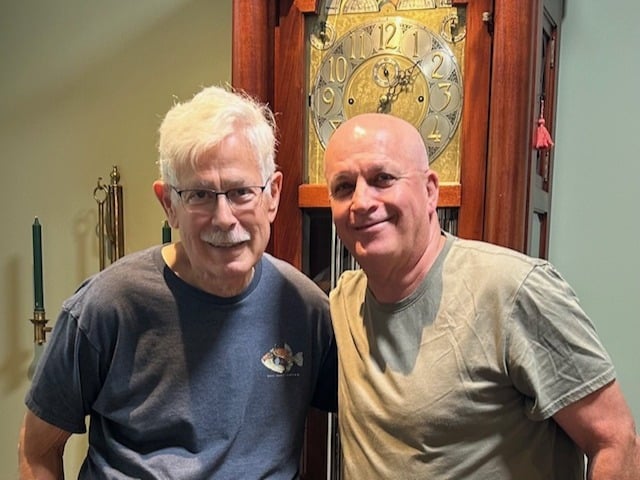
As I was about to end my visit with Chuck and Tom, Chuck presented me with a pen/pencil set for which he had lovingly crafted wooden barrels.  Though his gift caught me by surprise, it shouldn’t have.  How many gifts made from his loving hands had he given me before?  The pen/pencil set is symbolic of the way he appreciates meaningful relationships, the way he gives to all of his friends.  

Dan Dunsmore’s aspiration in 1979 was to become a sports journalist, but someone suggested that...

Leave a comment

Your email address will not be published. Required fields are marked *

This site uses Akismet to reduce spam. Learn how your comment data is processed.