
Overview:
Libby Lang is portrayed as a deeply dedicated, resilient, and relationship-centered educator whose lifelong connection to Durham Academy, personal perseverance, and unwavering commitment to students have made her a lasting and transformative influence on generations of learners and colleagues alike.
Six years into my still-fledgling career, I began teaching at Durham Academy, a Pre-K to 12 independent school in North Carolina. It would be difficult to find anyone who represents all that is wonderful and worthy about Durham Academy more than Libby Lang. Independent schools, especially, come to be known for certain families. I’d stack the Lang family, including mom and dad Steve and Ginny as well as Libby’s two younger brothers Jason and Adam, right up there in the top five families who have ever graced the grounds of Durham Academy.
I met Libby and her parents Steve and Ginny for dinner at The Refectory Café in Durham on Thursday, September 11, 2025. After explaining the inspiration I’d received from The Greatest Beer Run Ever, they allowed me to purchase their beverages for them. For Ginny, it was water. For Steve, it was non-alcoholic Stella Artois. Libby drank Sprite.
I didn’t teach Libby, at least not in a classroom. By the time I’d arrived at Durham Academy in 1985 to teach in the middle school, Libby was in her freshman year at the upper school. That spring, I coached the girls JV tennis team, which is when Libby first began to influence me. She was a talented-enough tennis player, but the qualities that set her apart from the others were her tenacity and leadership skills. I saw firsthand her drive and positive attitude. There’s no quit in Libby.
The following winter when I was looking for a manager to help with my boys jv basketball team, I hoped Libby would be willing. She was! It was during that time that I witnessed her impressive organizational skills. There was never a moment that season that water bottles weren’t filled and towels weren’t ready for the players. Having grown up with two brothers, she wasn’t put off by the often-off-color language of my players, either. She wasn’t above giving the coach a little advice, too. My admiration for Libby grew leaps and bounds as I experienced her ability to manage a boys’ basketball team (and their coach).
My daughter Liza was born in August 1988. Libby, now in her senior year at Durham Academy, became Liza’s first babysitter. Until I left Durham Academy in 1993, Libby would continue to be my first choice to spend time with Liza when Libby was at home from college. Libby was, of course, the babysitter of choice for the Head of School Rob Hershey and several other faculty members with young children at the time.
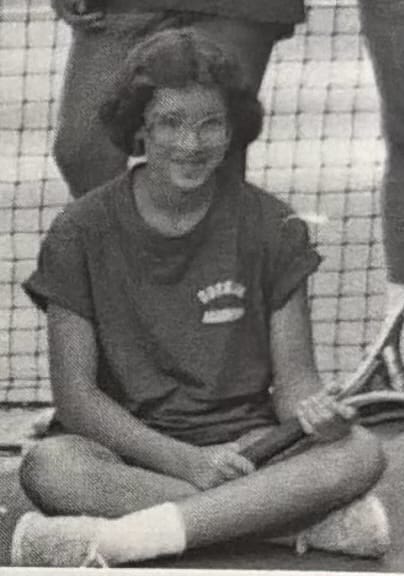
Libby was a “lifer” at Durham Academy, having attended from kindergarten through 12th grade. She graduated in 1989. During her time at Elon College in Elon, NC, she would call or email me on occasion to help with a piece of writing. It was the least I could do for a young lady who had a significant impact on me relatively early in my career. I knew a little of the academic challenges she had faced early in her schooling. She had taken evening study skills classes at The Hill Center, an incredible institution that in the 80’s was managed by the same Board as Durham Academy. That made me admire her all the more. She tackled any challenge full on and would not stop until her high expectations of herself were satisfied.
As a student at Elon, she found a way to succeed in challenging college courses. I suspect that her drive, her engine, comes from her parents. One needs to spend just a few minutes with them to know that Libby received plenty of love and encouragement. They recognized her learning challenges and did everything possible to give her the support she needed. They then expected nothing less than her doing her best. Ginny, in particular, is a life force one can’t deny. I’ve seen her fight fiercely for her children, and I’ve seen her love talented educators just as fiercely. Libby certainly has those same traits.
After Libby graduated from Elon with a BS in Education, she was hired by Don North as a teaching assistant in second grade, a role she held from 1993 to 1995. Since then, she has been the lead second grade teacher. Teresa Engebretsen, another former colleague and dear friend, currently holds the title of having taught at Durham Academy the longest – forty-five years. Libby has a very good chance of eventually taking that title. If one considers the thirteen years she was a student at Durham Academy, Libby’s influence on the DA community already spans forty-five years!
From ages four to thirteen, Libby was a gymnast. As a way to encourage Libby before meets, Ginny gave Libby something unicorn-related — unicorn sticker, pencil, figurine – launching Libby’s lifetime affinity for unicorns. When Libby was asked to pick a mascot for her classroom, she naturally chose the unicorn. Thirty years later, unicorns are everywhere in her classroom. Her students’ bathroom pass is shaped like a unicorn. The reading nook in the back of her classroom is known as “The Unicorner.” Her students, known as the Lang Gang each year, enthusiastically embrace the unicorn theme.
Once Libby began her teaching career, no one would have blamed her for focusing solely on her teaching and not wanting to take any additional classes. But that’s not Libby. She now has a M. Ed. with a concentration in learning differences from UNC Chapel Hill as well as an additional certification in Reading K-12. This young lady, who admittedly struggled a bit during her early years of education, went out of her way to further her education for the benefit of those she was teaching.
Libby can’t remember a time when she didn’t want to teach. “I used to line up my dolls on my bed and make them little paper pads/clipboards and ‘teach’ them.” She babysat for many families in Forest Hills, the neighborhood where she grew up. Libby also taught Sunday school while still in high school. She volunteered at a local daycare, too. She even spent many of her summers as a counselor at Camp Riverlea, a day camp for children K-7th in Bahama, NC, after being a camper from ages 6-13. Considering all the babysitting she did for my daughter Liza and other DA faculty children, Libby’s life focused more often than not on caring for children.
Perhaps this is why Libby is so very grateful for those who cared for her at Durham Academy. “I had many teachers at DA who fostered a love of teaching and role-modeled what quality teaching was all about. These teachers exemplified leadership, caring, had high expectations, and taught me how to be my best self and believed in me. I try to instill these characteristics in my students.” On her own gratitude tour, her first stop would be Rob Hershey, head of DA during her student days. She remembers him as being always approachable and fair. Libby received the prestigious F. Robertson Hershey Teaching Award in 2006. She considers it her highest achievement. She would also welcome the opportunity to thank Don North, the Head of DA who hired her fresh out of Elon in 1993. “He took a chance on someone who had zero experience. I’ve tried to pay it forward ever since.”
What has kept Libby in the game for thirty-two years (with no end in sight) is the spark that children exude when they learn a new skill, make a new friend, or make a strong connection with something they’ve read. The connections she has made with the children and their parents are the spark that make her realize she’s still doing what she loves the most.
Like any teacher who has been at it for over three decades, Libby has faced challenges and even heartbreak that have made her a better teacher. She had just begun her eighth year of teaching when 911 happened. That day reminded her that caring for her students and helping them make sense of the world were her most important roles as a teacher. It wasn’t lost on any of us that we were having dinner on the 24th anniversary of that tragedy. The horrific shooting at Sandy Hook Elementary in the winter of 2012 made her feel very protective of her students. She had no doubt what she would do as a teacher in that situation. When Covid began having its impact on the United States in 2020, she and her colleagues were forced to pivot in ways they’d never imagined. “These were moments that made me question what I was doing,” she admits, “but I’m a better teacher from having helped myself and my students through these experiences.”
Teachers are like parents in that we envision all of our students one day as happy adults. Libby has sadly experienced the deaths of several of her students before they graduated from Durham Academy. She grieved deeply along with the school community, and then she filled the role of comforter and counselor for those around her. Whether through major world events or in challenging moments closer to home, Libby has learned and grown.
After any length of time spent in education, all teachers can point to moments in which they’ve doubted what they were doing. Libby advises, “It’s okay to cry, but wait until the school day is over. Children may sense crying (and indecisiveness) as a weakness, and they will take over. But boo hoo all you need to at the end of the day.” Libby does not mean that children should never see emotion from teachers, though. On the contrary, she feels children need to know that teachers have feelings. “I cry in front of my students every time I read E. B. White’s Charlotte’s Web, Patricia Polacco’s Uncle Vova’s Tree, and Kate DiCamillo’s The Miraculous Journey of Edward Tulane. Those are genuine, meaningful, and appropriate tears to shed and share.”
What Libby knows is that teaching without emotion is not effective teaching. If the children and the profession don’t matter enough to bring you to tears every now and then, maybe another profession might be in order. She suggests being a problem solver rather than a trouble maker and using common sense, too. She also mentions that teachers should role model being good listeners when helping students communicate with each other.
Of course, issues will arise (as they do in any profession), and Libby has learned how to navigate the aggravation and angst so that they don’t affect her teaching. She talks often with trusted friends and her parents, and she realizes she can’t solve every problem that crosses her path. She apologizes when she’s been in the wrong and moves on. She has faith and trust in the administration at DA that they are leading the school in a direction that supports the mission – being happy, moral, and productive. Even during her high school days, Libby was wise beyond her years. She still is. “I spend a great deal of time analyzing and evaluating my behavior and choices as a colleague and educator, and I work hard to take accountability for my actions and decisions.”
Libby is at an interesting time in her career. She’s been teaching long enough to remember the days before the onslaught of technological advances began challenging education. Yes, they are supposed to be helpful, right? Not in all ways. “Anything related to social media and AI are education’s greatest challenges. Online bullying, too, is a real problem. Social media has become an addiction/obsession for many students, even ones still in elementary school.” One needs to spend only a few minutes in Libby’s classroom to see that she is doing her best to give her students many chances to explore the world around them and interact with one another in hands-on activities.
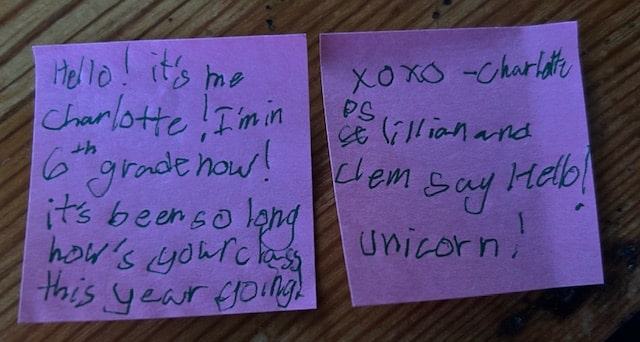
They interact with her, too. She expects it. That’s why her students, year after year, comment on her caring, creativity, high expectations and emotional intelligence. They don’t forget her sense of humor and how much she supported them in easy and hard times. During dinner, Libby pulled two sticky notes from her purse. A student she’d taught four years before had left the notes on her desk that afternoon. One read, “Hello! It’s me Charlotte! I’m in 6th grade now! It’s been so long how’s your class this year going!” The other read, “Xoxo – Charlotte PS Lillian and Clem say Hello! Unicorn!”
Students may not realize the impact they have on their teachers since the other way around is what is most often highlighted. Libby influenced me as an educator in that she reminded me how important relationships are in teaching, even outside the classroom. I came to know Libby on the tennis court and in the gym and as she babysat my daughter. She didn’t let me forget I mattered to her, even after she graduated from Durham Academy. As our evening at the restaurant wound down, she leaned over and quietly almost under her breath said, “You never didn’t believe in me, you know.”