
Overview:
This tribute celebrates Peter Holland’s lifelong dedication to Blue Ridge School, highlighting how his leadership, service, mentorship, and unwavering loyalty transformed both the institution and generations of students and alumni.
In 2014, Peter Holland thought he’d write a book. Understand that he claims he was never much of a writer, but something meant enough to him that he wanted to write a book about it. In 2018, he published Blue Ridge School A Storied History: Vol. 1. It was Peter’s love letter to a school that changed his life. It was the first piece of writing that came to mind as I decided to write my own love letters by way of a gratitude tour.
Here’s the thing. Every school, truly every institution, has that one person who represents the history of that organization better than anyone else. Peter Holland, in my estimation, represents Blue Ridge School better than any other individual who’s ever graced that campus. Yes, there are the founders of the school. Yes, there are heads of school who meant a great deal to the history of the place. Yes, there are faculty members, past and current, and other alumni who have meant a great deal to the school, but no one has remained involved with his alma mater and has had a greater impact on Blue Ridge than Peter Holland. How lucky am I that Peter became my colleague and that I can call him and his wife Anne dear friends. I could tell so many stories of our working together on campus as well as our visits with alumni, but there are also dozens of stories I cannot tell. Is there a better indication of friendship than having stories you cannot tell?
I had been at Blue Ridge for a year when Peter Holland, a BRS graduate from the Class of ’66, was hired by the school in 1999 to serve as Alumni Relations Director. Oh my goodness had he been involved with the school in multiple ways before then, but that was the year he became a paid employee. As I entered the realm of fundraising for the school, Peter and I soon became traveling buddies, and he would become a beloved mentor.
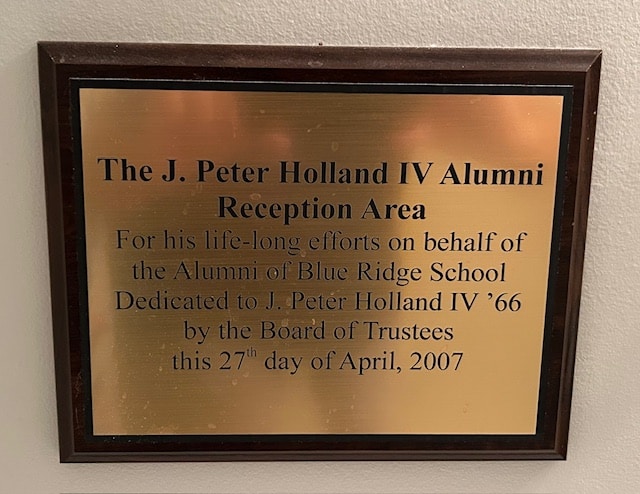
As do many schools, Blue Ridge has a room dedicated to alumni memorabilia. When Peter retired in 2007, the school honored Peter by naming the reception area of that alumni hall after him. His plaque reads, “The J. Peter Holland IV Alumni / Reception Area / For his life-long efforts on behalf of / the Alumni of Blue Ridge School / Dedicated to J. Peter Holland IV ’66 / by the Board of Trustees / this 27th day of April, 2007.”
During one of our road trips, Peter asked if I’d ever crossed paths with a guy named Rob Hershey. Peter knew that Rob had spent some time in North Carolina but wasn’t sure at which school, and he knew I had taught at a school in Durham. I told Peter, “He’s not just any guy. He’s the guy who hired me to teach at Durham Academy in 1985!” Peter explained that he and Rob were childhood friends. Peter’s wife Anne was Rob’s sister’s childhood friend. This blew my mind!
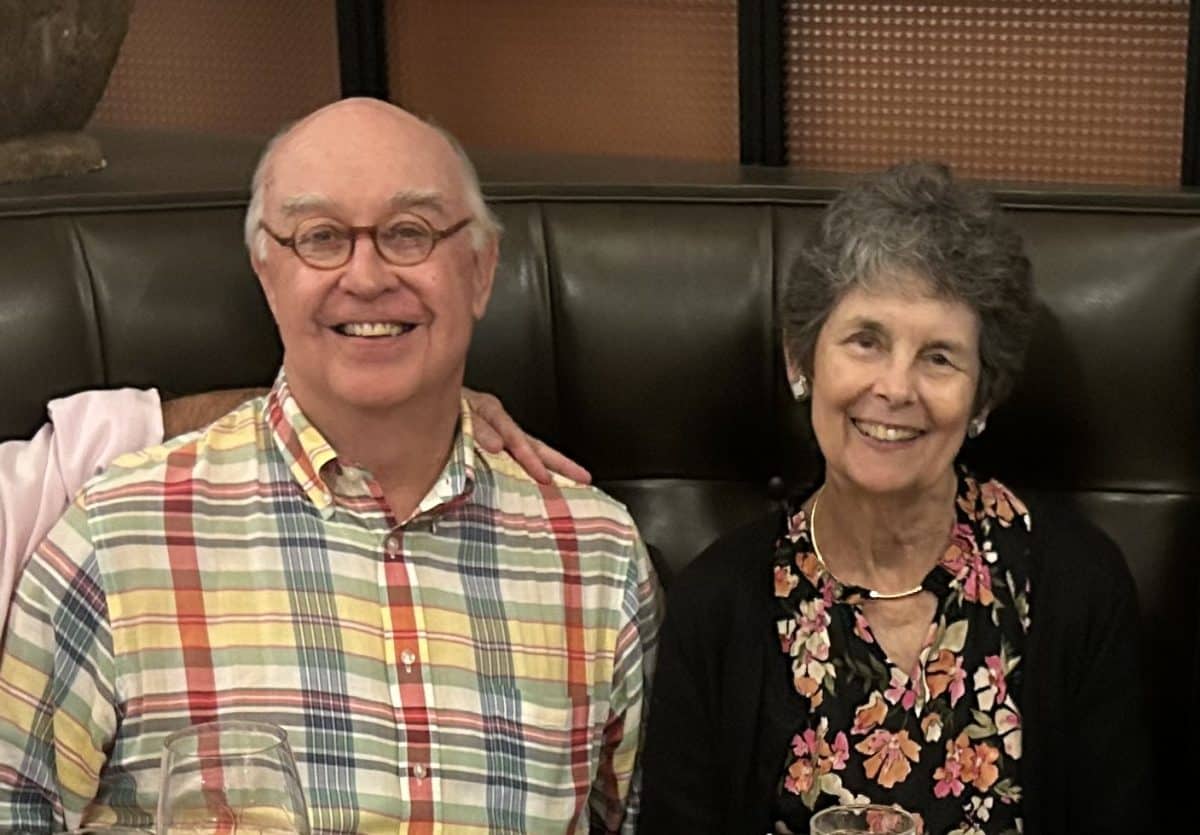
In my tribute to Rob Hershey, I explain how it came to be that Peter, Rob, their spouses and I enjoyed dinner together in September 2025 at Sorella’s in Virginia Beach. Though the two couples surprised me by paying for my dinner (that’s not how it was supposed to go), I was allowed to show my gratitude by purchasing beverages for everyone. Peter sipped on bourbon while his wife, Anne, enjoyed a glass of red wine.
Peter wondered why I wanted to include him in a celebration of educators since he’d never been a classroom teacher. I reminded him that he served weeknight and weekend duty, and he chaperoned many off-campus trips during his time at Blue Ridge. One might argue that those responsibilities carried more weight than being in a classroom. Also, Peter was one of them. He was a Blue Ridge boy. He understood how it felt to be away from home at an all-boys boarding school. He taught many life lessons during his employment at the school.
Peter remembers that one year a few days before graduation he was to take a group of seniors off campus for “Senior Day” as one last bonding experience. He asked why one particular senior was late for the bus. Another senior informed Peter that he wasn’t late but instead had been dismissed from the school the day before. He wouldn’t be allowed to walk with his fellow seniors and would not be given a diploma. I was working closely with Peter during this time, so I witnessed his reaction the next day as well as what he eventually did for this young man.
The student’s father called Peter a year or two later. He wondered if there might be a way to grant his son a diploma since he had fulfilled all of the academic requirements necessary and still felt loyal to the school. He knew he’d made a big mistake and just wanted some consideration. No one valued his time at the school and had more respect for a Blue Ridge diploma than did Peter. He also knew this young man was remorseful. Though he had not walked with his classmates on graduation day, he deserved a second chance to walk the grounds of the Blue Ridge campus with his head held high. Peter worked his magic. Today, this gentleman drives from his Norfolk, VA, home often to visit his alma mater, and he brings his wife and two children with him. He attends athletic events in the Tidewater area, too, anytime Blue Ridge teams are visiting. He proudly shows his Blue Ridge School diploma to anyone who asks.
I learned a great deal from Peter during the eight years we worked side by side and on the road – and not just about loyalty to a school. When I first met him, I was taken by his pale yellow, soft purple and preppy pink Oxford cloth button-down dress shirts. Having worn drab blue and brown shirts all of my life, I even poked a little fun at him. Soon enough, though, I was shopping for my own yellow, purple and pink shirts. I called them my Easter egg collection. Peter showed me how to branch out a bit and have a little fun with my attire although I never attempted to replicate his affinity for bow ties.
Our desks were close enough in our office that I could overhear his phone conversations. Nearly every day, he called his wife Anne around lunchtime. They would plan their evening meal. Did one of them need to stop by the store? Who would make this dish or that dish? They would spend time together in the kitchen that evening. I thought those were among the most romantic conversations I’d ever heard. Knowing I’d seldom prepared a meal with my ex-wife (and certainly had never planned one), I envied their relationship. On the morning my gratitude tour visit with Peter and Anne came to an end, they prepared breakfast together for the three of us.
In 1991, Peter was invited to join the Board of Trustees, which was tasked to add BRS alumni to the Board. During the eighth year of his tenure on the Board, Peter learned that Headmaster Ed McFarlane and the Advancement Office were searching for a full-time Alumni Relations Director. Peter wanted to help in that search (and maybe he had another agenda) so he called Ed to ask a few questions about the position.
The conversation went something like this…
“Hello, Ed. [following several pleasantries] I have a few questions about the Alumni Director’s position.”
“Okay, Peter. Shoot.”
“Will this person be expected to live on campus?”
“Well yes, it would improve his overall effectiveness.”
“What salary might this person expect?”
Ed threw out a figure that seemed reasonable. And then Ed remarked, “It sounds as if you might be interested in the job yourself.” Peter smiled on his end of the telephone conversation and told Ed he was indeed interested.
Blue Ridge had just gained one hell of a great liaison between the school and its graduates.
When Peter first returned to Blue Ridge, Anne was employed as an art teacher at Indian River High School in Chesapeake, VA. She remained behind that first year to fulfill her contract as Peter moved into an on-campus apartment. It’s no surprise that Anne and Nancy Frye, another talented artist and wife of Carl Frye (whom I have also visited on my gratitude tour), struck up a quick friendship soon after she arrived. They remain dear friends today as they post their art and news of art in social media.
Both Anne and Peter, though educated for the most part in independent schools, had a public school beginning and believe in the importance of public education. In fact, Anne told me during my visit, “Public education must remain strong, must be made strong through more funding, if education at all schools can remain viable.” I agree whole-heartedly with this. I’m a product of public schools and taught at two public schools in my first three years. My children attended public schools. My hope is that everyone understands that those of us involved in independent schools recognize the importance of strong public schools.
Peter and I shared a boss during our time together at Blue Ridge – Rob Murphy. Rob would definitely be on Peter’s gratitude tour (as he was on mine). He made our important work seem not so much like work much of the time. Others he’d visit (a few are deceased) are Hatcher Williams, Headmaster of Blue Ridge when Peter was a student; Jordan Churchill, history teacher, consummate gentleman and devout Christian; Ed McFarlane, Headmaster who re-emphasized the school’s mission and re-energized the enrollment upward at Blue Ridge; Jim Niederberger, beloved history teacher, organist and baseball coach; and John Young, longtime and highly respected English teacher. These gentlemen represent the history of Blue Ridge better than any other five educators ever involved with the school. This is why there is truly no one better suited to write that history than Peter. He has known them all!
After retiring from Blue Ridge, Peter found employment with the Easter Shore of Virginia Historical Society. As the Executive Director, he was in charge of operations and fundraising while reporting to a board of twenty-four members with different opinions on everything. He even acted as a docent of its historical house museum when needed. In more recent years, he has volunteered for the Virginia Beach Rescue Squad. Peter’s dad was a founder of the Resue Squad back in the day, and he has enjoyed continuing that tradition.
When Peter wrote Blue Ridge School A Storied History, the end result was a type of teaching. The lesson was how a recipe of tradition, faith, sound body, sound mind, character, and feeling genuinely respected could set young men on a path for success. Many people told Peter there had to be a chapter in the collection about him. He balked at the idea, of course, but I finally insisted on writing the chapter myself. With Peter’s permission, portions of that chapter follow.
“No volume that attempts to capture the colorful and influential people of Blue Ridge School since it’s re-opening in 1962, would be complete without a chapter about this book’s author – J. Peter Holland IV, Class of 1966. On several occasions numerous people made that very point to Peter, and each time Peter brushed aside such a notion. One must understand that it’s Peter’s humility that, in part, inspired him to piece together this collection of vignettes. He has always seen others as the important ones. He doesn’t allow himself to realize that he is also truly significant to the history of the school.
“In the eighth grade Peter went away to St. Paul’s School for Boys near Baltimore as a boarder. (It was primarily a day school with only about thirty boarders.) During his sophomore year and by his own admission, he was absolutely floundering academically before and during his two and half years at St. Paul’s. Peter was midway through his sophomore year and knew he was dangerously close to flunking out. He had always wanted to go to Norfolk Academy where some of his friends went. He had taken their entrance exam three times only to fail it on every occasion. His parents were at their wit’s end as they brought him back home to make a go of it at Virginia Beach High School one more time.
“A next-door neighbor told his parents about a new and small boarding school just north of Charlottesville, Virginia. Their son was one year younger than Peter, was finding success there. Peter was tired of disappointing his parents and himself, and he was embarrassed to have left St. Paul’s. He was ready to prove to everyone that he could find success in a classroom. Therefore, he was open to the idea of seeing what this new school in the mountains, in the middle of nowhere, could offer.
“Since the rest of his sophomore year and his junior year also hadn’t gone too well in Virginia Beach, Hatcher Williams decided that Peter should repeat his junior year. Yes, this would certainly prove to be an excellent move for Peter, but little did anyone know at that moment that it would also lay the foundation for a life-long relationship between a young man who was searching for himself and a School that would give him everything he needed to succeed.
“Jordan Churchill early-on had a significant impact on Peter. ‘He was a phenomenal man, a great teacher, and his character was beyond reproach. He made me want to stretch, to reach. He was very tough yet fair, and I wanted to please him. We all did. Mr. Churchill was unflappable. He was such a gentleman. Integrity just oozed from him. He made me want to work harder.’ To know Peter is to know that he doesn’t grant such high praise unless it is well deserved. His words about Mr. Churchill were spoken with sincere reverence for a man he admired.
“Before Blue Ridge, Peter’s grades weren’t anything to write home about. Outside the classroom, he was just going along with the crowd. At Blue Ridge he was encouraged to take part in extracurricular activities as his grades were now beginning to improve. Peter had never held any leadership positions, and he wasn’t particularly athletically gifted although he loved all sports. These were the areas in which adults on campus, particularly Mr. Churchill, made some headway with him. ‘All during my junior year, he would ask if I planned to be a prefect next year and maybe run for a senior class office. I’d never given such a notion much thought in the past. But I began to think that way during my junior year.’ [Prefects at Blue Ridge are elected seniors who serve as major role models and lead residence halls.]
“He went out for varsity football and made the team. He played sparsely. He was the last guy cut from the varsity basketball team and was the #3 or #4 man on the tennis team. He still wasn’t the most talented athlete on these squads, but he surprised himself as he found success he’d never experienced before. ‘The coaches took the time to teach me certain skills, to encourage me, to give me a chance and to have high expectations of myself.’
“To Peter’s surprise as much as to anyone’s, he served as prefect, vice president of the senior class, Student Council President and on the Honor Council during his senior year. He never quite made the Honor Roll, but his grades showed marked improvement. The self-confidence he was gaining outside the classroom was spilling into his school work, and that confidence was translating into B’s and even an occasional A, for the first time in his academic career. ‘I developed what they now call grit. In my day, we called it working our butts off, getting back up when you were knocked down. The teachers at Blue Ridge gave me responsibilities and had the expectations that I would fulfill those responsibilities. This was true in and out of the classroom.’
“After receiving his diploma from BRS, Peter went to Louisburg College in North Carolina, for his freshman and sophomore years. He then transferred to the University of Tennessee in Knoxville. He loved it – big time SEC football, fraternities and girls. He majored in Sociology, mostly because he earned his first B in college in that course. He then moved back to Virginia Beach after graduating from UT in 1970. Later, he moved to northern Virginia with a government job after which he started working with a catalog/retail clothing business. He then moved back to ‘The Beach’ to continue working in the men’s clothing business with both retail and wholesale companies.
“In the mid ’70s, Henry Morschheimer ’67, had the idea to form a Blue Ridge School Alumni Association. He pitched his idea to Hatcher Williams, who soon presented the plan to the Board. The Board enthusiastically endorsed the idea. It didn’t take long for Peter to become one of its most active members. In fact, he held every office except treasurer during his many years with the Alumni Association. One of the functions of the Alumni Council was and still is to recognize distinguished alumni. Peter and his friend John Wellford ’69 were the first two recipients of the Alumnus of the Year award for their work for the betterment of the Alumni Association and the school.
“All of this time, Peter had been thinking of going into business for himself. Specifically, he wanted to sell and market his own barbecue sauce. He was finally able to realize that dream with Peter’s Beach Barbecue Sauce in 1989. He produced, distributed and marketed his sauce for the next ten years. ‘Starting from scratch to achieving regional success with my barbecue sauce was very satisfying. Blue Ridge had instilled in me the belief that I could be successful in any endeavor as well as the confidence to take risks and go for it.’
I think of myself as a grateful person. Peter’s gratitude is on another level, though. He offers this perspective on his relationship to Blue Ridge. “My being away from home, from my mother and father, made me think for myself. That was an advantage. I made my own choices, my own decisions, and I learned to live with those choices and decisions. I became an independent thinker.”
When asked why he continues to be so involved with the school nearly sixty years later, he replies, “Blue Ridge is the cause that I have chosen to champion. As I think about the people who influenced me, the unique mission that has remained steadfast, and the positive difference the school continues to make in young men’s lives, I have every reason to remain involved. The school has proven itself more than worthy.”
I trust there is no need at this point for me to further explain why I love Peter Holland. He is a blessing to his alma mater and to me.