

Overview:
Shirley Underwood’s mentorship and exemplary teaching inspired a lifelong career in education, highlighting the transformative power of dedicated teachers who lead with heart, hands, and mind.
In the spring of 1979, I completed my final semester at the University of Tennessee. To earn my degree in Secondary English Education, I had to student teach. I don’t recall having any choice in where that would happen so I must have been assigned to Carter High School in the Knox County school system. I was earning that degree in education as a fallback plan. I still at that point had aspirations of becoming a sports journalist.
I, of course, had been a student for many years, so I knew my way around a classroom. I had several remarkable teachers over the years and had fond memories of how they managed classrooms, taught various concepts and made students feel good about themselves. Now, I was expected to do those things. I was nervous. Combine that with the fact that my heart wasn’t really in it, and it could have been disastrous.
But then Shirley Underwood happened. Shirley was the Chair of the English department at Carter in 1979. I had been assigned to her senior English class. On my first day, I watched Shirley teach her class. She was energetic. She was funny. All but a few of her students seemed to be hanging on her every word. The two or three who weren’t were soon asked easy questions to bring their attention back to the lesson. She paced about her classroom like a lion tamer cracking her whip in ways that gave each student a chance to perform. What her students didn’t realize was that Shirley was performing, too. Her function was to make them the stars of the show, and they loved it. They loved her. She loved them back.
What the heck had I just witnessed? It wasn’t enough to sell me on becoming a teacher, not yet, but she certainly got my attention on that first day just as she masterfully maintained the focus of her students. It was going to be a fun time, no matter what I decided. By the end of that semester, thanks to Shirley’s role modeling and encouragement, I had made what would become a life-changing decision. I wanted what Shirley had each day in that classroom. I wanted to be a teacher.
Shirley left Carter at the end of that school year to become assistant principal at Powell High School in Knox County. That would leave a teaching position open at Carter, and Shirley thought I should have it. Not only high school students listened to Shirley but also administrators. I had my first teaching position in my pocket even before I had completed my student teaching.
Through social media, Shirley and I stayed in touch off and on over the next forty-six years. I knew she had become an assistant to the superintendent of schools in Knox County, and I knew that her beloved husband Stanley, whom I had met in 1979, had passed away. When I retired from teaching on June 30, 2025, I also knew the first person I needed to thank for my rewarding career.
Shirley and I met in Knoxville just twenty days later. I hadn’t seen her in person since 1979. It was a surreal, joyous moment I’ll never forget. We hugged. I couldn’t stop hugging her. The tears flowed. I was in the actual company of an amazing woman who had given me the encouragement to embark on a career in education.
As mentioned in my introduction, I was inspired by Chick Donohue, who delivered beer to his buddies in Vietnam as a symbolic gesture of his gratitude. I was well aware that beer might not be the beverage of choice or the appropriate beverage for the location of our visit with those I would thank on my gratitude tour. Shirley and I were at the Panera Bread on Kingston Pike at 11 am on a Sunday morning. Though she told me my gesture was not necessary, she finally gave in and said she’d have a flavored tea. Two things went wrong with my plan. First, Shirley is a member of Panera Bread’s Sippy Club so her beverage was going to be on the house already. Second, when picking up our drinks, I accidently switched them so that she found herself sipping on my ginger ale while I took a big gulp of her tea. It was our first big laugh of the day, and we decided not to switch the drinks back to their rightful sippers. Well, Mr. Donohue, I was clearly going to have to get better at this!
Three hours went by with our hardly noticing. We laughed a lot. We cried. We reminisced about our mutual careers, and she told me what had impressed me the most about my student teaching. Her strategy with students who could be a distraction to themselves and to others was to spread them throughout a classroom in hopes that would isolate them and therefore make them less likely to act up since they’d be around students who were paying attention. Instinctively, apparently, I employed a different strategy. As I got to know the students during my first few days, I moved the handful of students who couldn’t focus too well to seats that were near one another and to me. Imagine a lion tamer moving all of the growling lions to perches that were closest to him/her. It was a strategy that worked for me and would continue to work for me over the course of my career. Shirly had thought it was brilliant and was one of many indications that I had a natural knack for managing a classroom.
Shirley is a country girl at heart, having grown up in the mountainous area of upper East Tennessee. Unlike me, she knew she wanted to be a teacher even before she began elementary school. “I never dreamed of any other career.”
She first attended Berea College in Kentucky, then transferred to East Tennessee State where she earned her BS in English. Eventually, she would earn an M.S. in English, Curriculum and Instruction, and Administration and Supervision at the University of Tennessee in Knoxville. Shirley has been a lifelong learner (many great teachers are) so it’s no surprise that she also earned a certificate in Appalachian Studies from a Berea College/University of Kentucky collaborative program. As recently as 2025, she took an AI course at the University of Tennessee.
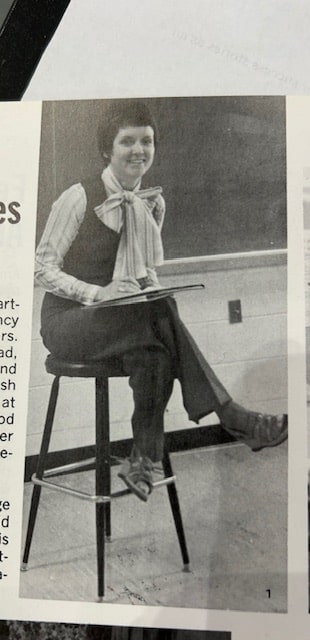
Her career began at Washington College Academy in Limestone, TN. She taught English and was the Dean of Girls. Even at that early age, she proved she could take charge of matters beyond a classroom. It was during her second year there that she met Stanley Underwood. He had been hired over the Christmas break to take the place of the assistant dean of boys and social studies teacher who had been drafted into military service. He repeatedly shared his version of the meeting through the years. “I was in the teacher’s lounge meeting my new colleagues. The door swung open and in prissed this little sprite in her three-inch heels. She marched straight to me, stuck out her hand, and said, ‘Hello. My name is Shirley Collins. I am senior dean, and you are on duty this weekend.’” He sometimes added the note, “From that moment, I was smitten.”
By February, the first real off-campus date was scheduled; by mid-March, Stanley had proposed; in July, they were married. In Stanley’s obituary fifty-three years later, their niece said of Stanley, “…he embarked on a lifelong adventure to show the world what true love really looks like and succeeded beyond words.…everyone who ever met them or heard him talk about Shirley knew they were in the presence of ‘magic.’ Their love story will never end.” Shirley adds, “I never saw a marriage I envied.” Though they each had busy personal and professional lives, their time together was what they enjoyed most.
Once married, they moved to Knoxville. She then taught English at Gibbs High School in Knox County, TN. Not surprisingly, she would soon also become the Department Chair. Carter High School was her next stop where she once again taught English and served as Department Chair. I suppose we can say that fate brought us together at that point.
As effective and important as she had been in the classroom, she then moved to Powell High School in Knox County, TN, to serve as Assistant Principal. She was still Shirley and still having an impact on young people, but she was now turning her attention to supporting adults in the educational field as well.
She completed her career in education in the Knox County Schools District Office, first as Supervisor and Assistant to Director of Curriculum and Instruction, then, as already mentioned, Assistant to the Superintendent. By now, it should be evident that Shirley was much more than just an assistant. Mr. Morgan often relied on Shirley (and Shirley happily obliged) to resolve many issues that arose during his tenure. In 1996, Shirley received the national Excellence in Education Award. She was one of only twenty-three administrators across the country to earn that recognition. She clearly taught adults as well as she taught young people!
The list of all the ways she contributed to the advancement of education after leaving the classroom is extensive. Here are just a few of the ways in which she continued to have an impact even beyond Knoxville:
Tennessee Department of Education, Nashville, TN—Exemplary Education Program, various districts and schools in Tennessee;
Tennessee Department of Education and Vanderbilt University, Nashville, TN—Trainer for Institute of School Leaders;
Think Link Learning (later Discovery Education) Nashville, TN—Trainer in
numerous districts and schools in many states;
University of Tennessee, Knoxville, TN — Lead Facilitator, VOLS (Volunteers Online Leadership Studies), a school administrator training program.
Shirley gave fifty-five years to the field of education, but, honestly, as I discovered during our three-hour meeting on July 20, 2025, and the numerous emails we’ve exchanged since, she’s still an educator. I can’t explain why any better than she does. “My spark has always been wanting to share the efforts of my hands, heart, and mind with others—students,
teachers, friends, family…just about everyone I’ve met. The feeling (or maybe knowledge) that I could help ignite in others an enthusiasm for learning and for becoming better people has been my driving force.”
My goal is to acknowledge the critical role that educators play in our lives, to celebrate educators, and I’ve started with celebrating the important mentors, colleagues and students in my career. When I asked Shirley whom she would visit on her own gratitude tour, she had a difficult time narrowing the list.
“When I think of my life and my career, there are so many to whom I owe appreciation. I hardly know where to begin. This question has kindled many fond memories and great emotion.”
DAD — a phenomenal teacher with no formal training. He instilled in me the belief that “if it’s worth doing, it is worth doing well” and encouraged me to learn anything I could anytime I could;
EMMA RUTH WOOLSEY— a friend and neighbor who always encouraged me and who had confidence in my abilities;
JACKIE MULLINS—a seventh-grade teacher who taught me that all learning had value and assured me I could do (and be) anything I wanted;
DAVID WETZEL—a principal at Carter High who demonstrated the value of not doing things as they have always been done. His skill as a teacher and his passionate drive to “get the job done” motivated me;
ALLEN MORGAN—a principal at Powell High and later Superintendent of
Knox County Schools who taught me more than I can possibly enumerate: how to build a good team by valuing the contributions of everyone; the value of win-win’s in nearly all situations; that true leadership comes from modeling (never expect others to do what you are unwilling to do); to give credit to others every chance you have; to love, honor, motivate, inspire and reward yourself, your family, your students and colleagues;
NORMA MERTZ—a University of Tennessee professor and dean who taught me the value of powerful questioning and evaluative reflection, the awesomeness of diversity, and that knowledge and experience are essential for growth;
STANLEY UNDERWOOD—my husband who provided unending encouragement and the financial and emotional security to take risks for the sake of students, schools, and my career. His humor and his love got me through the rough times and inspired me every day of his life.
To completely capture Shirley Underwood’s essence would be a futile exercise. During my three hours with her at Panera Bread, I was reminded of her playfulness, her joy, her deep love for Stanley, her willingness to offer an opinion on any topic. She took her opportunities to teach others very seriously, but she has never taken herself too seriously. She’s that person you want at your party every bit as much as you want her to teach your child. In all those fifty-five years, she never concerned herself with how she might be putting the spotlight on herself as she put the spotlight on her students and co-workers. When asked what she considered her most notable success, she couldn’t even imagine I was asking about recognitions she garnered over the years. Instead, she replied, “seeing my students accomplish great things personally and professionally.”
Of course, Shirley faced challenges over the years, but she saw them as opportunities. She dealt with them while doing her job. Though frustrating, setbacks were temporary and ultimately resulted in a better thing. She had learned from inspiring mentors to always look for the win-win. More than any aspect of any subject we might teach, this is what our students need to hear. This is part of the magic I witnessed in the spring of 1979. I could not have asked for a better role model.
When she considers the challenges that educators face today, it’s the same as society’s challenge. In a world in which one would think our advancements are making life easier, just the opposite seems to be occurring. Is it even accurate to call them advancements? Young people and even young educators lack coping skills and sound psychological health. Society cannot expect educators to meet these challenges alone. I think we could all learn a thing or two from Shirley’s playfulness, the sparkle in her eyes, her joy, her not taking herself too seriously, and especially the sincere love she feels for others.
The following are excerpts from a talk that Shirley, at the request of the Sullivan County School Superintendent, gave in 2008 to a group of teachers who were in need of inspiration. She includes not only her own wisdom but wisdom from others.
Why do I teach? How could I not? Teaching is who I am—always: with students in schools,
adults in sessions like this, in interacting with nieces and nephews whom I love beyond what words can say. Teaching is significant, meaningful work and involves what makes us
human. It is about our hands (hard work), our head (knowledge, what we know, what we help others know), and especially our heart (the humanity of teaching, the passion we bring to help others dream and work toward the fulfillment of their dreams).
I believe that good teachers work hard and that great teachers inspire and motivate. They make a difference in the lives of children. The great teachers know that a passing comment may be the very message that inspires a child and sets him in pursuit of a skill, a concept or even a dream. It is that individual connection that makes teaching (and great teachers) an almost divine experience. We make a difference one child at a time.
I believe teachers have great power, sometimes unrealized, but a power that we tap in those magical moments when the stars are aligned and learning occurs as a result of us. Perhaps Ham Ginott said it best: “I have come to a frightening conclusion that I am the decisive element in the classroom. It is my personal approach that creates the climate. It’s my daily mood that makes the weather. As a teacher, I possess a tremendous power to make a child’s life miserable or joyous. I can be a tool to torture or an instrument of inspiration. I can humiliate or humor, hurt or heal. In all situations, it is my response that decides whether a crisis will be escalated or de-escalated and a child humanized or de-humanized.”
I believe that everything is relative—with our students, with each of us. In this room, there are those who carry great burdens of personal pain and suffering and there are those whose load is light. In the classroom, the same is true. Never assume we know what weights these young people bring to us.
Here’s an excerpt from Judy Morasci’s “Teachers are America,” modified slightly by Shirley Underwood and Dan Dunsmore.
“What is it that our kids really need? What do they really want? Math, science, history and social studies are important, but children need love, confidence, encouragement, someone to talk to, someone to listen, standards to live by. Teachers provide upright examples, the faith and assurance of responsible people. Teachers strive to find the best in their students, even where some see little hope. No other profession bestows a finer gift than teaching—reaching out to the brilliant and the not so brilliant, the gifted and the not so gifted. Teachers, you leave the world a little bit better than you found it. If you have redeemed just one life, you have done life’s work.”
Why do you teach? Think of a child, a specific child. Put a face, a heart and
head to every lesson, every class, every thought of why you teach. Articulate why you teach. Share it with the world. Share your passion. Great teachers know and practice giving from the head, with our hands, and with our heart. Why do I teach? I teach because I love it. I live it. I breathe it. And my life is blessed because all of this is so.





Thank you for this article about Shirley. She lived on one hill and I lived on a neighboring hill in the Baileyton area in Greene County. We attended a two teacher elementary school & Baileyton High School together. We were at ETSU together. She was a couple of years ahead of me. She has been my friend for many years and continues to be that friend today. Shirley deserves every honor that she has received and probably so many more too. I have always looked up to her and she still inspires me today.
Thank you, Barbara, for your kind words. If not for Shirley, as my tribute describes, I would not have become a teacher. She remained my inspiration for forty-three years. If you are so inclined, please look for my tributes to other educators, scheduled to be published once a week.
I really enjoyed reading this chapter on Shirley Underwood. While I did not know Shirley personally, I have been able to see and enjoy the results of her mentorship on Dan. It is important to remember and honor the teachers who have had an impact not only on their own students but also on the students of the teachers they have mentored. I am happy that she led Dan to becoming a teacher.
Such kind words, Chuck. It’s true. If not for Shirley, I would likely have become mired in some smoke-filled backroom at some newspaper (do they exist anymore?) writing about sports. She changed the trajectory of my life, and I will be forever grateful.
What an amazing tribute!!
I really appreciate your reading my tributes, Dedra. Many more to follow! Shirley is still to this day a force of nature, not to be denied. One thing she said to me during our meeting in Knoxville keeps popping into me head. She never left her home in the morning without a smile on her face – put there by her dear husband Stanley. His love for her made it easier to love her students every day. You have that with Alex, I know!