

Overview:
Leigh Alley champions a whole-child approach to education, emphasizing that when schools prioritize relationships and educator well-being, both teachers and students thrive.
In an era when education policy often focuses on test scores, pacing guides, and performance metrics, educators like Dr. Leigh Alley are reminding the profession of a foundational truth: schools are human systems before they are academic ones.
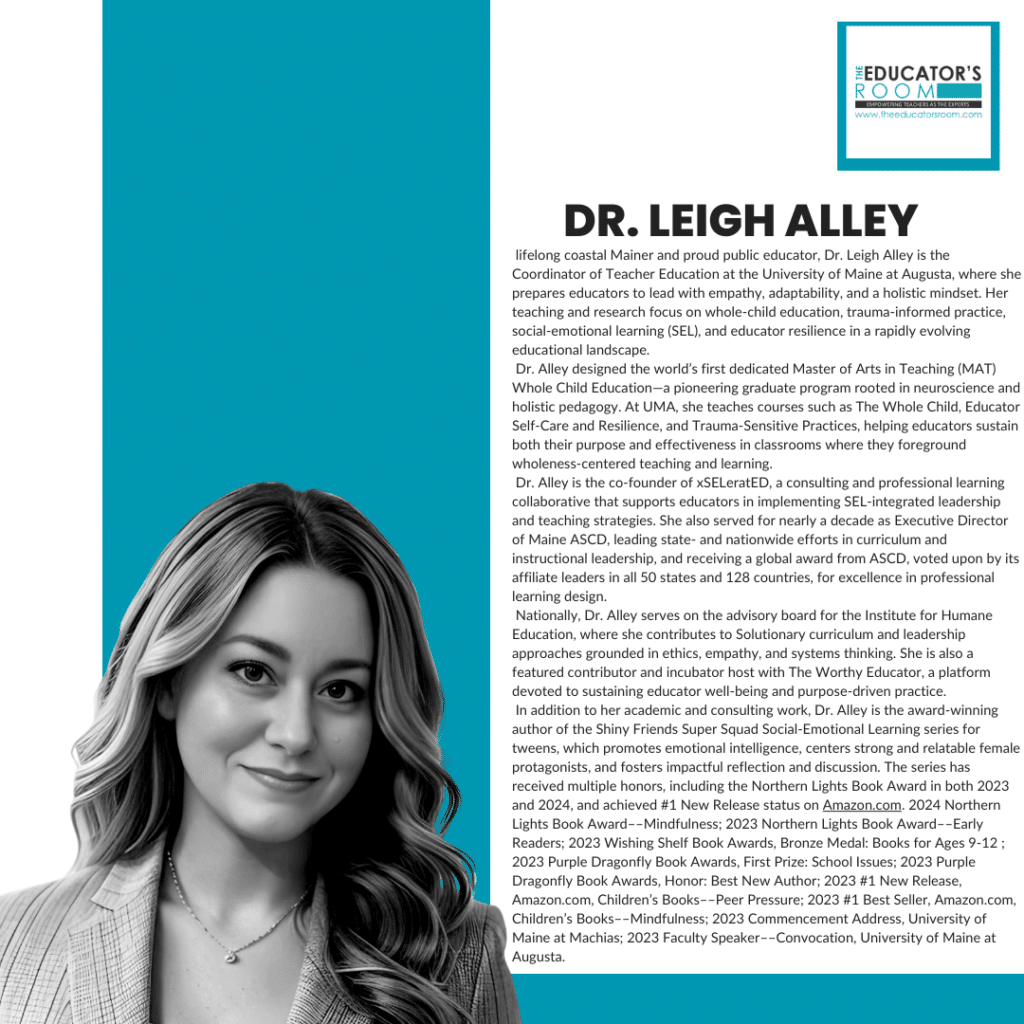
A lifelong coastal Mainer and proud public educator, Dr. Alley serves as Coordinator of Teacher Education at the University of Maine at Augusta, where she prepares educators to lead with empathy, adaptability, and a holistic mindset. Her teaching and research focus on whole-child education, trauma-informed practice, social-emotional learning (SEL), and educator resilience in a rapidly evolving educational landscape.
In recognition of her leadership and influence in the field, Dr. Alley was also selected as a member of the second cohort of the 2026 Top 50 Educators, an honor presented by The Educator’s Room to celebrate innovative educators shaping the future of teaching and learning.
Building the Next Generation of Whole-Child Educators
Dr. Alley designed the world’s first dedicated Master of Arts in Teaching (MAT) Whole Child Education, a pioneering graduate program rooted in neuroscience and holistic pedagogy. Through this program and her teaching at UMA, she prepares educators to sustain both their purpose and effectiveness in classrooms that foreground wholeness-centered teaching and learning.
At the university, she teaches courses such as The Whole Child, Educator Self-Care and Resilience, and Trauma-Sensitive Practices, helping educators develop the tools necessary to navigate the emotional and relational complexities of modern classrooms.
Her work consistently centers the idea that educator capacity and student success are deeply interconnected.
“I was drawn to education because I have always believed learning can be a turning point in a person’s life—not just academically, but emotionally and relationally; that certainly was the case for me,” Dr. Alley explains.
Like many educators, her career began with a focus on instruction and curriculum. Over time, however, she realized that the deeper work of education lies in cultivating environments where both students and educators can thrive.
“Early in my career, I thought my work would focus on instruction and curriculum. Over time, my passion deepened into something more holistic: building the conditions where people can belong, heal, and grow.”
Today, that philosophy drives what she calls wholeness-centered teaching and learning—an approach grounded in the belief that supporting the whole child requires first supporting the whole educator.
“I’m committed to helping educators develop the clarity, language, and practices to support the whole child, and to support themselves and their colleagues at the same time. I’ve come to see that when teachers are resourced, connected, and well, they become the kind of stable, brave, relational leaders students need.”
Redefining What Support Looks Like
One of the most powerful moments in Dr. Alley’s career has been witnessing the transformation that occurs when educators feel genuinely supported.
“A defining moment for me has been watching teachers shift from ‘I’m failing’ to ‘I’m learning’ when they’re given the right support,” she says. “I’ve been in too many rooms where educators carry stress, grief, and exhaustion in silence—and then feel ashamed for it.”
Her work intentionally creates spaces where educators can acknowledge those realities and rebuild from them.
“The moments that reaffirm my commitment are the ones where a teacher names the truth of what they’re carrying, experiences real belonging, and then starts to reimagine what’s possible for them and for their students.”
Designing Schools for Human Rhythms
Dr. Alley is also the co-founder of xSELeratED, a consulting and professional learning collaborative that supports educators in implementing SEL-integrated leadership and teaching strategies. The initiative is built around the xSELeratED Schools Framework of which she is architect—Understanding Myself, Nurturing Myself, Understanding Others, Nurturing Others, and Building a Better World.
Her approach is notably practical.
“My approach is adult-first and systems-aware. I don’t ask educators to do ‘one more thing.’ I help them build shared language, micro-practices, and community routines that reduce friction and increase relational capacity over time.”
One of her most innovative strategies is what she calls seasonal cadence in school design.
“I also use seasonal cadence as a design strategy: different times of year require different kinds of care, reflection, and community-building. That helps schools normalize human rhythms rather than forcing constant output.”
Leadership Beyond the Classroom
Dr. Alley’s leadership extends well beyond her university role. She served for nearly a decade as Executive Director of Maine ASCD, leading statewide and national efforts in curriculum and instructional leadership. During her tenure, the organization received a global award from ASCD, voted on by affiliate leaders across all 50 states and 128 countries, recognizing excellence in professional learning design.
Nationally, she serves on the advisory board for the Institute for Humane Education, where she contributes to Solutionary curriculum and leadership models grounded in ethics, empathy, and systems thinking.
She is also a featured contributor and incubator host with The Worthy Educator, a platform dedicated to sustaining educator well-being and purpose-driven practice.
For Dr. Alley, this work is ultimately about building systems that value humanity as much as academic outcomes.
“One of the greatest challenges has been pushing back against the idea that educator wellness and relational work are ‘extras.’ In many systems, what can be measured is what gets valued, even when it’s not what truly sustains learning.”
A Message to Teachers on the Brink
For educators who feel exhausted or disconnected from the profession they once loved, Dr. Alley offers a message that reframes burnout.
“First: you are not broken. Burnout is not a personal failure. It is most often a predictable response to chronic overload, stress, and insufficient support.”
Her advice begins with honesty.
“If you feel stuck, I want you to start by getting honest about what is draining you and what is nourishing you, without judgment.”
Then, she encourages educators to start small.
“Choose one tiny practice you can sustain. One that brings you back to your students and back to yourself. That might be a two-minute reset before the day begins, one relationship-building routine that becomes dependable, or one boundary that protects your energy.”
“Passion doesn’t always return through inspiration; sometimes it returns through safety, sustainability, and small wins.”
Stories That Empower the Next Generation
Beyond her academic and consulting work, Dr. Alley is also an award-winning children’s author. Her Shiny Friends Super Squad Social-Emotional Learning series helps young readers explore emotional intelligence, empathy, and self-awareness through relatable characters and engaging storytelling.
The series has earned national recognition, including multiple Northern Lights Book Awards, and the Wishing Shelf Book Awards, and achieved #1 New Release and #1 Best Seller status on Amazon in children’s categories related to mindfulness and peer pressure.
Her broader professional recognitions also include serving as Commencement Address speaker at the University of Maine at Machias and Faculty Speaker for Convocation at the University of Maine at Augusta.
A Legacy of Humanity in Schools
When asked about the legacy she hopes to leave, Dr. Alley’s answer returns to the human core of education.
“I want to leave behind a legacy of love and practice that makes school feel more human.”
“I want future educators to inherit structures that protect their energy, honor their complexity, and help them build cultures of belonging and courage.”
For students, her vision is equally powerful.
“I want a world where they are not only taught, but truly known—where they learn how to understand themselves, nurture themselves, understand others, nurture others, and build a better world.”
“If my work helps schools become places of healing, repair, and growth, and helps educators stay in the profession with heart and fortitude, then I will know that I have succeeded. For me, professionally, there could be no greater fulfillment and joy.”
In a profession often weighed down by urgency and accountability pressures, Dr. Leigh Alley’s work offers something both radical and necessary: a reminder that when schools prioritize relationships, belonging, and human wellbeing, learning naturally follows.