
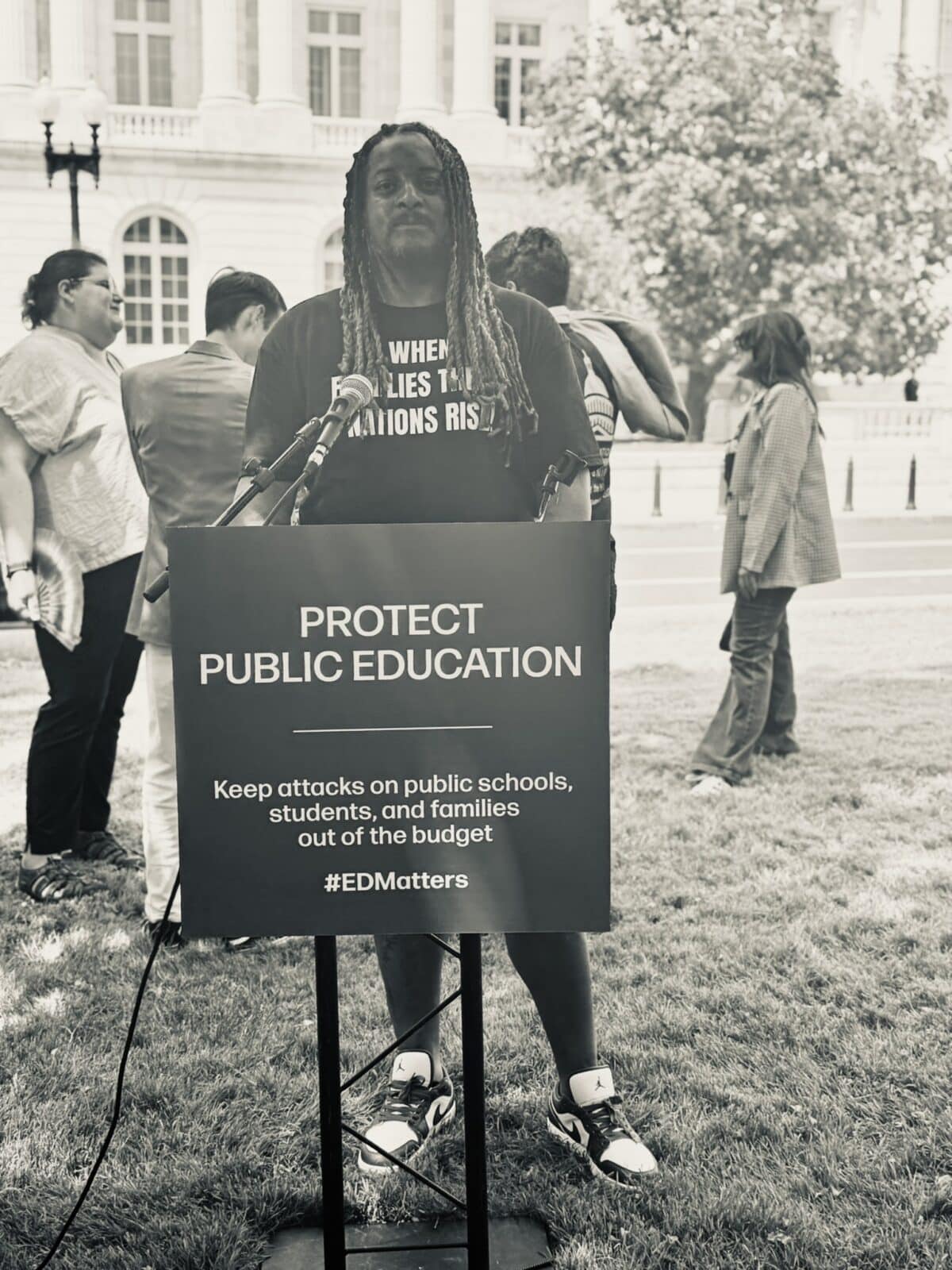

Overview:
Jamial Black is reimagining education as a form of justice work by using classrooms and community leadership to affirm student identity, disrupt systemic inequities, and build structures that empower both educators and students toward liberation.
In a national moment where education is increasingly shaped by policy debates, cultural tensions, and systemic inequities, educators like Top 50 Educator, Jamial Black, are reframing the profession as more than instruction; they are positioning it as a site of intervention, advocacy, and liberation.
Black, a first-generation scholar, educator, and founder of Roots of Wisdom Scholars, did not initially set out to become a teacher. His aspirations were rooted in law. But during his undergraduate experience, a critical realization shifted his trajectory: the legal system often encounters Black youth only after harm has already occurred. For Black, that reactive posture felt insufficient.
Instead, he began asking a more urgent question—what if intervention happened earlier?
That question led him to education, not as a departure from justice work, but as a more strategic entry point. In his view, classrooms are where inequities can either be reinforced or disrupted long before they calcify into lifelong outcomes. “Why not start earlier,” he reflects, “by affirming brilliance and equipping young people with the tools to navigate systems that were never designed for their success?”
This upstream approach now defines his work.
A defining moment in Black’s career came during his time volunteering with the Atlanta Public School System’s Parents as Partners Academic Center (PAPAC). What began as service evolved into leadership when he was asked to serve as a parent liaison in the Grant Park community. There, he became a bridge—connecting families and schools while repairing fractured trust.
Working closely with multilingual families, Black saw firsthand how language access and cultural affirmation could fundamentally shift student engagement. When families felt welcomed and respected, students showed up differently—more confident, more connected, and more prepared to learn. That experience solidified his belief that education extends beyond curriculum; it is deeply rooted in relationships, dignity, and access.
As a Black male educator—part of a demographic that represents roughly 1.3% of the teaching workforce—Black is intentional about rejecting the limiting roles often imposed on educators who share his identity. Rather than being relegated to disciplinarian roles, he centers his practice on mentorship, intellectual rigor, and cultural affirmation. His bilingualism becomes a tool not just for communication, but for inclusion.
In his classrooms and community spaces, representation is not symbolic—it is structural. Students are not managed; they are mentored. They are seen, heard, and challenged in environments that affirm their humanity.
But trailblazing comes with resistance.
Black speaks candidly about navigating systems that were never designed with him in mind, often facing explicit and implicit pressure to dilute his identity in exchange for professional acceptance. Rather than conform, he chose clarity. Grounded in a legacy of leadership—from his late uncle, a pioneering physician, to ancestors who served as Buffalo Soldiers and community organizers—Black views his presence not as an exception, but as a continuation.
“Trailblazing,” he explains, “means choosing integrity over assimilation.”
That philosophy extends to how he advises educators experiencing burnout. He challenges the pervasive narrative that exhaustion is a personal failure, reframing it instead as a systemic issue. His message is clear: educators must stop internalizing dysfunction and start reclaiming their boundaries, purpose, and well-being.
“Choosing yourself is not quitting,” he asserts. “It is preservation.”
Black’s advocacy is equally uncompromising. He encourages educators to move beyond performative compliance and toward collective action—documenting inequities, organizing with communities, and leveraging both data and lived experience to push for systemic change. For him, professionalism should never require silence.
If given the opportunity to lead at the national level, Black would implement a comprehensive framework centered on educator and student protection, equity, and well-being. His vision challenges traditional metrics of success by insisting that achievement cannot be separated from safety, belonging, and dignity.
Beyond the classroom, Black’s influence is expansive. Through fellowships with organizations like The OpEd Project and the National Black Child Development Institute, as well as his work with Profound Gentlemen and the National Parents Union, he operates at the intersection of education, policy, and community power. His op-eds, workshops, and public engagements amplify narratives that are too often marginalized, while offering actionable pathways forward.
As Founder and Executive Director of Roots of Wisdom Scholars, he is building what he describes as “infrastructure”—sustainable systems of mentorship, mental health support, and culturally grounded learning that extend far beyond a single classroom.
Ultimately, Jamial Black’s work is about more than reform—it is about transformation.
He envisions an education system where educators are not asked to shrink to survive, and where students are not treated as problems to be solved, but as whole people to be nurtured. His legacy is not rooted in titles or accolades, but in the systems he builds and the power he helps others reclaim.
If future generations inherit not just permission, but the power to challenge injustice and build something better, then his work will have done exactly what it set out to do: ensure that education becomes a vehicle not just for learning—but for liberation.