

Overview:
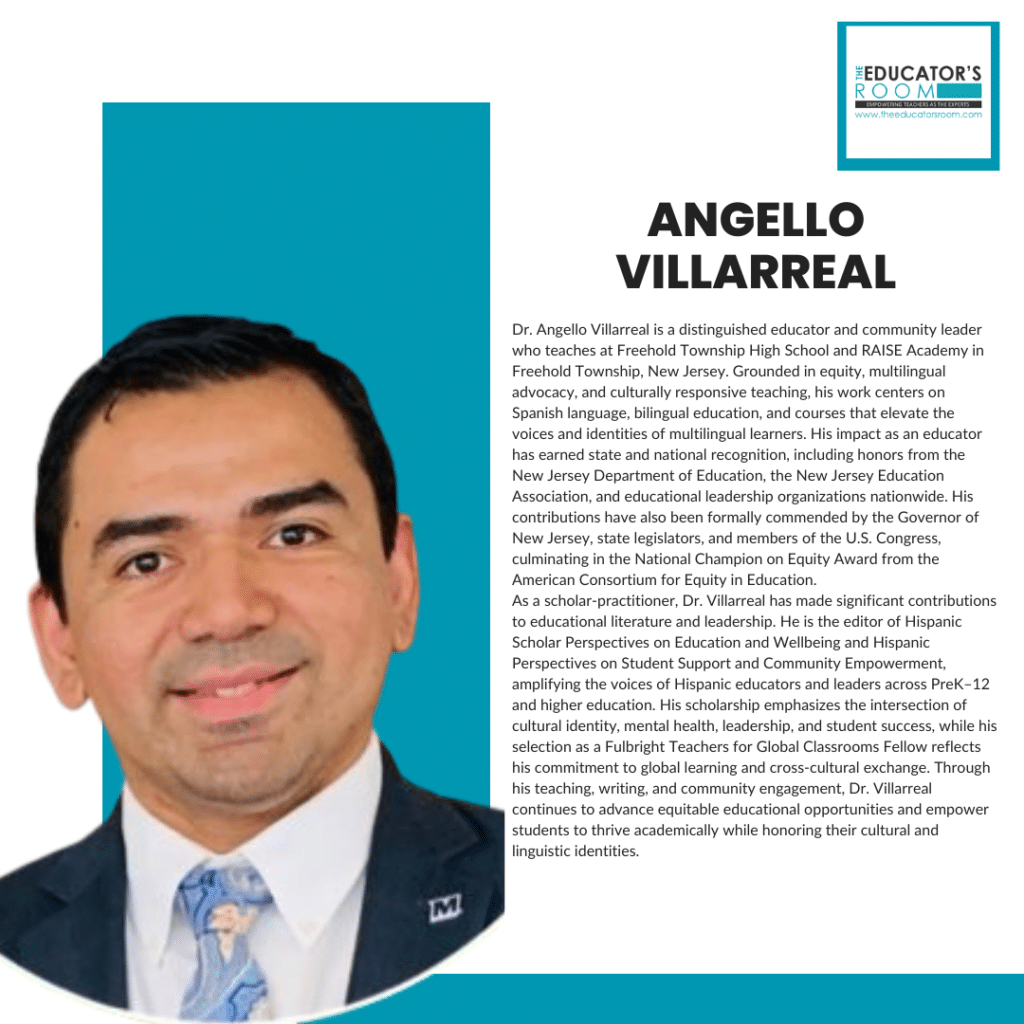
Angello Villarreal, a bilingual educator who journeyed from Peru to New Jersey classrooms, empowers multilingual students through culturally responsive teaching, strong family partnerships, and global advocacy for equity and belonging in education.
In classrooms across America, educators often speak about the power of representation, belonging, and resilience. Few embody those values as fully as Angello Villarreal, a scholar, teacher, and community leader whose journey from Peru to New Jersey classrooms reflects the transformative potential of education itself.
Dr. Villarreal teaches at Freehold Township High School and RAISE Academy in Freehold Township, New Jersey, where he works with multilingual learners in Spanish language and bilingual education programs. Through culturally responsive teaching and advocacy for equity, he helps students embrace their cultural identities while excelling academically.
As a member of the second cohort of the Top 50 Educators, Villarreal’s work extends far beyond the classroom. Recognized nationally for advancing opportunity and representation in education, Dr. Villarreal has been honored with numerous awards—including the National Champion on Equity Award from American Consortium for Equity in Education—and has received formal commendations from the Governor of New Jersey, state legislators, and members of the U.S. Congress.
But his journey into education did not begin in a traditional way.
From Peru to the Classroom
“I have always wanted to work with others,” Dr. Villarreal reflects. “At first, when I was in Peru, I just wanted to be a basketball coach and I knew I wanted to work in that kind of capacity.”
When he arrived in the United States, however, life took a different path.
“I worked in Corporate America as I couldn’t afford to go to school, and pay my bills.”
It was the birth of his son that ultimately changed everything.
“Once my son was born, that is when I decided to look back and do what I always wanted to do.”
Today, that personal commitment shapes how he approaches every student who enters his classroom.
“As a teacher I see my students as future coworkers, friends, bosses, and the environment of my own 3 children at home, so that is why I always invest so much of my time and energy in them and do my best to go beyond my own classroom.”
Building Safe Spaces for Students
Unlike many educators who can point to a single turning point, Dr. Villarreal says his commitment to teaching has been reaffirmed repeatedly by his students themselves.
“There is not a defining moment, but a combination of many from many students that they keep reaffirming my commitment to education.”
What matters most to him is the trust students feel when they walk into his classroom.
“Learning from my former, current…and future students their challenges and dreams and learning that they have a safe space in my classroom is key.”
That sense of safety does not happen by accident. Dr. Villarreal has intentionally built systems that connect families, students, and schools in meaningful ways.
Strengthening the Home–School Connection
One of his most distinctive classroom practices is simple but powerful: consistent communication with families.
“Communicating with my students’ parents on a regular basis. Not just the phone calls when something is wrong, but informing them what we do in class.”
Each month, he writes to every parent to highlight classroom activities and student learning.
“I write to every single one of my students’ parents every month and highlight our work, and what we do in our class. The purpose is for them to also have a topic of conversation at the table and support, in some way, engagement among all of us.”
Equally important are the conversations he has with students themselves—conversations that go far beyond academic content.
“I talk to my students regularly not only about the classroom or content, but how everything is at home, their family, friends, and the school year as a whole.”
Perseverance in the Face of Barriers
Dr. Villarreal’s own path into teaching was far from easy.
In New Jersey, aspiring educators must pass multiple Praxis exams to enter the profession. For Villarreal, most of the tests came naturally—except one.
“Math, Reading and Praxis II (Content in Spanish), I was able to pass it quite easily. Writing on the other hand, I failed it over and over.”
As a multilingual educator learning English as a second language, the writing component proved particularly difficult.
“It took me 9 times to pass it as English was my second language, and the writing component was extremely difficult for me at the time.”
The stakes were high.
“That test would’ve determined whether or not I could’ve become an educator or not.”
What kept him going was the same motivation that had inspired him to pursue teaching in the first place.
“My son was my inspiration and the one that made me believe in myself and to not give up on myself.”
Lessons for Teachers Facing Burnout
For educators who feel overwhelmed by the demands of the profession, Dr. Villarreal offers advice grounded in personal discipline and self-awareness.
“Something it took me a while to learn is to say no. From different projects, to advising certain clubs, having more time for myself has helped me a lot.”
While he continues to work extensively—including a second role at an alternative school—he prioritizes time for himself and personal goals.
Physical wellness also plays a critical role in his routine. Recently, he started doing Karate at the same dojo as his kids as he wants to keep motivating them and leading by example.
“I wake up everyday at 3am to go to the gym and I go to bed around 8pm. I have been doing that for many years now, and it has helped me a lot. Now, I attend Art Beins Karate in Freehold, and I am able to push myself even further.”
For him, maintaining balance is essential to sustaining a long-term career in education.
Advocacy Through Dialogue and Community
Dr. Villarreal believes that meaningful change in education begins with conversation and collaboration—even with those who hold opposing viewpoints.
“Creating partnerships with the community, and with organizations.”
He emphasizes one skill above all others.
“Talking and—key word: listening, without interrupting—creates a discussion so that I can understand others, learn from others, and they can also understand me.”
That approach, he says, has helped him navigate some of the most challenging situations educators face today.
Mentorship and Brotherhood
Beyond his formal teaching responsibilities, Dr. Villarreal works closely with young men through a mentorship group known as “The Brotherhood.”
The group meets regularly to build leadership skills and support students’ mental health.
“This is a group of young-male students that get together once or twice a month and we work on leadership skills, mental health, and we truly become a brotherhood where we support each other.”
It is a reflection of his broader belief that education must address the social and emotional realities students carry with them each day.
Expanding Influence Beyond the Classroom
Dr. Villarreal’s impact also reaches into scholarship and global education.
As a scholar-practitioner, he has edited two influential volumes—Hispanic Scholar Perspectives on Education and Wellbeing and Hispanic Perspectives on Student Support and Community Empowerment—which amplify the voices of Hispanic educators across K–12 and higher education.
In addition to research and publications, he uses modern platforms to connect with students and educators.
“Many times I try to come up with positive messages for my students on TikTok and Instagram… and increase my connections on X/Twitter and LinkedIN”
His commitment to global education has also earned him recognition as a Fulbright Teachers for Global Classrooms Scholar, allowing him to collaborate with educators abroad and bring international perspectives into his teaching.
National Recognition and Leadership
Dr. Villarreal’s work has been widely recognized. Among his many honors are:
- Fulbright Teacher Global Classroom Participant – Traveling to Uruguay in 2026
- National Equity Champion in Education (K–12) – American Consortium for Equity in Education
- ASCD Emerging Leader and Champion in Education – ASCD
- TUMI USA – Professional Award for Peruvian-American Excellence in the United States
- Princeton University Distinguished Secondary School Teaching Award Finalist
- Excellence in Educational Leadership Award – Monmouth University
- Excellence in English as a Second Language Award
- Global Seal of Biliteracy Professional Fluency Award
- Top 5 Latinos of New Jersey by The United States Latino Affairs
- Marquis Who’s Who in America (2023) for contributions to education
He has also received numerous scholarships and honors from Pi Lambda Theta and was inducted as an honorary member of Kappa Delta Pi International Honor Society in Education. Recently, he was just interviewed by 7-time Emmy Award winner, Ken Rosato and his morning show while also featured in a local magazine.
Reimagining the School Day
If Dr. Villarreal could change one thing about the structure of education today, it would be simple—but profound.
“More recess in between classes for students to socialize, play, and be kids.”
In an era of intense academic pressure and rigid schedules with technology taking over, he believes that unstructured time is essential for healthy development.
A Legacy of Representation and Inspiration
Looking toward the future, Dr. Villarreal hopes his work will inspire both educators and students.
“As far as educators, I would love to see more male educators to support the whole child growth of students; but also to support and empower our female teachers in any capacity.”
For students, his hopes are even more personal.
“I would love to learn if, at least, I was able to make a difference to them. Not just for them to learn about the subject I taught them, but if I was able to either inspire them in any way shape or form.”
Even the smallest impact would matter.
“Perhaps even remembering some of my words or phrases.”
Or perhaps something even more meaningful.
“Even if me, or my classroom, was the only safe space they had.”
In a profession defined by quiet, daily acts of care, Dr. Angello Villarreal’s story reminds us that teaching is not only about lessons and curriculum—it is about resilience, relationships, and the belief that every student deserves to be seen, heard, and empowered to thrive.