
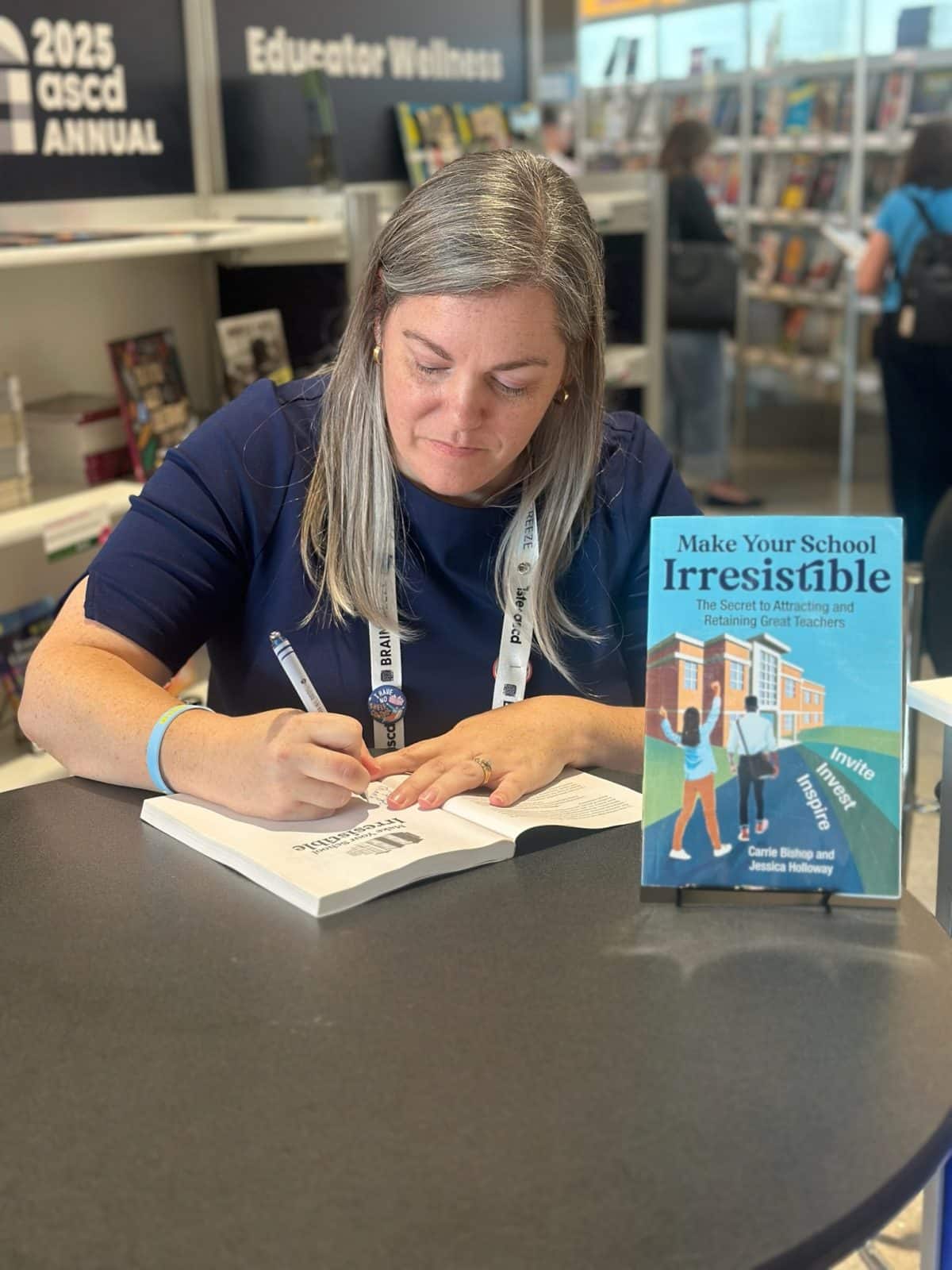

Jessica Holloway’s journey in education began long before she became an instructional coach. Her first job, coaching tumbling and cheerleading, planted the seeds of her lifelong commitment to helping others grow. “Teaching felt like a natural transition from coaching,” Holloway explains. “The goal is similar: know where someone is starting and support them in reaching their potential.” Today, as an instructional coach and innovation leader at Top 50 Educator, she continues to channel that same passion, supporting teachers so that students experience learning at its fullest.
A defining moment in Holloway’s career came in her sixth-grade Language Arts classroom. She had shifted to student-led book clubs, moving away from teacher-directed instruction. One day, she and the inclusion teacher stood in the doorway, finalizing a support plan, when they realized that class had already begun—without a single prompt from them. Students were fully engaged, managing discussions, journaling, and tracking their own progress. “In that moment, I saw learners so invested in their own agency that the teacher became a facilitator rather than a monitor,” Holloway recalls. “It reaffirmed my commitment to designing learning experiences that empower students to own their journey.”
Holloway’s classroom strategies go beyond engagement—they bridge learning with real-world impact. She co-creates problem-based learning units infused with design thinking, helping students empathize with users before prototyping solutions. These units connect classroom concepts to local businesses and organizations, turning theoretical exercises into actionable contributions that benefit the community. Her approach reflects a belief that education should develop critical thinkers capable of influencing the world around them.
Trailblazing, however, often comes with challenges. Holloway has navigated resistance in systems that prioritize competition over collaboration, particularly in STEM initiatives. To overcome this, she developed a statewide STEM Network, initially for her district but eventually including educators across Tennessee. The network fosters resource-sharing, dialogue, and professional growth, ensuring more students have access to high-quality STEM experiences. For Holloway, the measure of success isn’t accolades—it’s the expanded opportunities for students.
Her advice to teachers feeling burnt out is practical yet profound: “Try a change—switch schools, grade levels, or content areas. Sometimes it’s about finding the right fit for your talents and passions. Participate in fellowships or professional learning that challenges and grows you.” Holloway’s own career was redirected by a STEM Fellowship, which helped her merge literacy and STEM in new, transformative ways.
Advocacy, Holloway emphasizes, is about combining data with storytelling. “Numbers provide the head with understanding, but stories move the heart. When educators humanize the challenges students face, decision-makers are compelled to act.” Her philosophy underscores the power of strategic alliances among teachers, parents, and communities to achieve systemic change.
If Holloway could implement one policy at the Department of Education, it would be equitable funding for both sports and academic extracurriculars. “Leadership, discipline, and skills come from both arenas. Ensuring parity supports every student’s development and future readiness,” she explains. Similarly, she advocates for a shift from standardized compliance to professional and student agency, creating spaces where teachers can innovate and students can actively shape their learning.
Beyond her classroom, Holloway’s influence extends through her co-authored book, Making Your School Irresistible: The Secret to Attracting and Retaining Great Teachers, workshops, and leadership roles in programs including STEM Fellowships and TechGoes HomeCHA. Her work ensures that teacher expertise is valued, supported, and leveraged to improve student outcomes across schools.
Jessica Holloway’s legacy is one of empowerment, innovation, and sustainability. She envisions schools as ecosystems of lifelong learning, where teachers are partners in growth and students are recognized for their unique strengths. Through her work, Holloway ensures that education is not just a path to achievement but a vibrant, equitable, and inspiring journey for generations to come.