
Overview:
William Scipio overcame a difficult childhood marked by poverty and family instability to become a devoted father, educator, mentor, and community leader in Baltimore, dedicating his life to serving young people and the homeless through faith, education, and compassion.
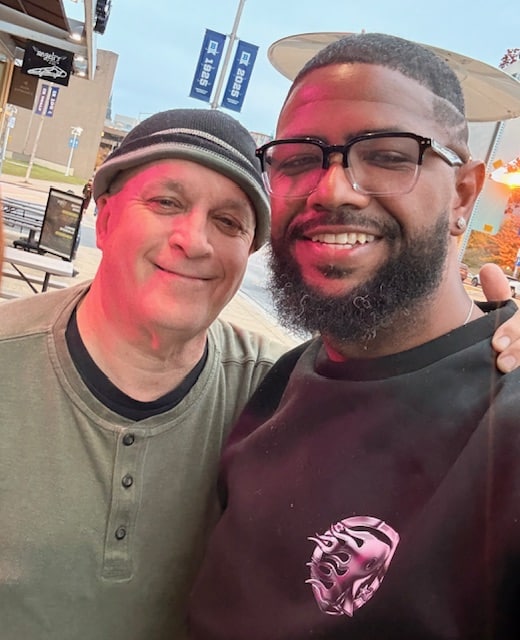
I met William Scipio at the Brass Tap in Baltimore, MD, Wednesday evening, October 29, 2025. Though in the past he has typically paid for my dinner when we’ve gotten together, this time he allowed me to foot the bill. His beverage of choice was Wheatley vodka with sweet tea. I’ve grown close to many students in my career, but I can’t think of one with whom I’ve connected more emotionally than William. His story is one of resilience during a ridiculously challenging childhood, his faith, his gratitude for the chance that a boarding school in Virginia gave him, his love for his son, his constant wish to give back to the community in which he was raised, and his eventually becoming a teacher himself.
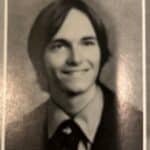
When the school year began in 1998, I was going through a significant transition in my life. Blue Ridge School had just hired me, and I was wondering if I could handle the long hours required at a boarding school as well as being an attentive single father to two young children. In my first week in the Learning Center at BRS, I met William. He was a freshman from inner city Baltimore. He and I were from very different neighborhoods, but we somehow hit it off immediately. He struggled with his writing. But he loved to tell stories about his grandmother. I encouraged him to start writing those stories. It was almost magical how his writing began to improve as he wrote one hilarious story after another about how she’d raised him. He truly loved his grandmother. His antics, her scolding and their love for one another bounced off the page like sparkles from a sequin shirt.
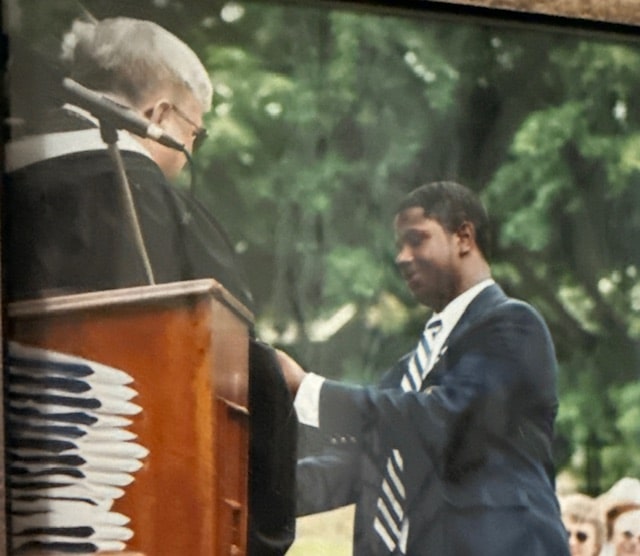
William graduated from Blue Ridge in 2002. On graduation day, quite an entourage arrived on campus to celebrate William’s accomplishment. Mr. Cooper, who had taught William in the fourth and fifth grades at Gilmor Elementary, was there, as well as Elder Harris from New Song Academy. Casey and Lindy Lord, who had played a large role in his being able to attend Blue Ridge, were beaming with pride. Chick Lord, who sadly had passed away during William’s junior year at BRS, was there in spirit. William’s girlfriend at the time and her mother were also present. His cousin Maria Craig made sure William’s mother was there, too.
His mother slept through the entire ceremony. His dad wasn’t there. Though William was reluctant to talk a great deal about his parents, he’d let me know a little bit over the years – how they’d never married, how their struggles with drug abuse had resulted in both of them being mostly absent, especially his dad who was in and out of prison during much of his childhood, how William had waited up late night after late night for him to come home.
Because of his parents’ challenges in being present, William spent quite a bit of time with his dad’s two sisters until he was four years old. Several older cousins were in those aunts’ houses, too, and they enjoyed beating on the younger William every chance they got. His dad moved out of the house permanently when William was four, and William then lived with his grandmother. Thus began a bit of healing. His grandmother was a social worker who loved on William and disciplined him in all the caring ways he needed. She became the source of those funny, poignant stories that William would write during his years at Blue Ridge. He told one story particularly well. He wrote it the old-fashioned way – on paper with a pencil. I wish I’d had the forethought to save it. It is full of children’s shenanigans, a grandmother who wasn’t about to lose control of her grandchildren, humor, and love — a lot of love.
William and his cousins had his grandmother outnumbered on most days. They were rambunctious, and his grandmother, unlike his aunts, wouldn’t tolerate any violence inside her house. Therefore, they would sometimes take their energy outside and into the neighborhood. William recalls that there were several vacant houses on his grandmother’s street. They made for perfect alternate indoor playgrounds even if also not entirely safe.
One day, a bright idea came to one of the kids. Maybe William, maybe one of his cousins, pointed out that the roofs of these houses were also vacant and how much fun it would be to turn flips and make other dives off those roofs onto a stack of abandoned mattresses below. They didn’t count on their grandmother being able to hear their screams and other joyful noises from inside her house. When she looked out to see what the commotion was about, she nearly blew a gasket. She leapt from her easy chair, grabbed a broom, slammed open her front door, and hollered all holy hell at those boys. None of them could move fast enough to escape at least one whelp from the business end of that broom.
William had already injured his leg after bouncing off the mattresses and falling back against the side of a house. He saw this as an opportunity to plead with his grandmother for a little leniency. “I don’t care a damn about your leg! Serves you right! You’re lucky it wasn’t your head or neck!” And then he also felt the weight of the broom as he scurried away to catch up with his cousins, who by that point were laughing so hard they had to cross their legs not to pee themselves. William told and then wrote many other similar stories, all full of a young boy’s mischief and a grandmother’s tough love. One needs to read only a handful of those stories to realize she was one of his saviors. His church saved him, too. Many caring adults at Sharon Baptist made sure William would not live a life on the streets.
In his elementary school years, William attended New Song Academy, a public charter school that seeks to empower young men and women in the Sandtown-Winchester neighborhood of Baltimore to become leaders in their communities. William is quick to give others credit for his rising above truly challenging childhood circumstances and finding success in his adult life, but I think he’s always had qualities in him, God given perhaps, that others readily appreciate. Among those qualities are genuine kindness, an enthusiasm for learning, and a desire to serve others. The teachers at New Song Academy surely recognized those qualities as they partnered with Pathways to Success — an organization that supports underserved students by focusing on a Consistent, Authentic, Respectful, Empowerment (CARE) model — to give William the opportunity to attend Blue Ridge School. This is also when Casey, Lindy and Chick Lord stepped in to be of significant assistance. There were other boarding school options available to William. “Honestly, I chose Blue Ridge because I liked the color blue.”
Blue Ridge was an even more foreign environment for William than it was for me. We both consider ourselves blessed that fate brought us together in this new world that would prove to be life changing for both of us. Why we were immediately so drawn to one another and why our bond grew stronger each time we interacted can be explained to some extent by the fact that we were both flailing in deep water during the fall of 1998. We rescued one another without knowing that’s what we were doing. William found success after success at Blue Ridge not only academically but also through participation in athletics and especially his singing in the chapel choir with Director Dolores DeAngelis, a legend at the school. “I couldn’t sing a note on key when Mrs. DeAngelis recruited me. I didn’t even want to try. But Mrs. D. promised me she would teach me how to sing. She did. Singing in the BRS Choir is one of my cherished memories of being at Blue Ridge. And now I have no problem belting out songs at the top of my lungs.”
After a brief time at Bowie State University in Bowie, MD, in 2002, cut short due to culture shock, he decided to return to Baltimore. William began working with troubled youth at a home organized by the Reverend Jentry McDonald in 2003. This would prove to be the first of many positions to which William would gravitate as a way to give back to young people in need of support.
William and I had stayed in touch after he graduated, of course, mostly through land lines (if anyone can recall those). He called me one night frantic. “My girlfriend’s pregnant. What do I do?” More from instinct than from any clear thinking, I said, “You’ll be that child’s father and raise that child and never walk away.” I was so proud of him for taking my advice and hanging in there through his girlfriend’s pregnancy.
In October and November of 2004, William and his girlfriend visited the Johns Hopkins Hospital several times in preparation for their son’s birth. The Kennedy Krieger Institute across the street caught William’s eye each time. He learned that Kennedy Krieger offered counseling services to young people with neurological disorders and neurodevelopment disabilities and that a counseling position would pay more than he’d ever earned in the past. He called and scheduled an interview. It was to happen on December 7, 2004. As fate would have it, his girlfriend went into labor that same day. “She and I rushed to get dressed, and all I could find to wear at that moment were some sweatpants and a t-shirt that was way too small for me.” William didn’t miss his son’s birth that day, but he did have to show up for his interview across the street in those sweatpants and that tight t-shirt.
Fortunately, the interviewer was understanding and actually even impressed that William had shown up for the interview in such casual if ill-fitting clothes. He was hired that same day. “Other than knowing I needed to provide for my son, I really can’t say what drew me to Kennedy Krieger. God definitely intervened. So many times in my life, I’ve allowed God to determine my path. I’m a strong believer that God has a plan for us. He placed me in that position. Those young people weren’t struggling for the same reasons my childhood was rough, but they still needed help.”
The counseling was challenging for William, and things weren’t working out with his girlfriend. But William didn’t walk away from his son. In fact, he has never walked away. He broke the pattern his father had begun. As William’s girlfriend became more and more distant from him and their son, he stepped up to take on more and more of the parenting. At this same time, he was rising in the ranks as a counselor at Kennedy Krieger.
Then William’s grandmother passed away in 2007. This was a devastating blow, one that resulted in a tear-filled phone call to me. As I comforted William that night, we recalled many fond memories of his grandmother, including that time she smacked him with a broom after he’d jumped off a roof and all the times he watched her work her magic in her kitchen. My family and I had opportunities over the next several years to spend time with William and his son during visits to either Baltimore or Washington, DC, and they visited us a few times in Virginia. As young Will grew older, William realized he needed to devote even more time to him. In 2012, he decided to leave Kennedy Krieger to take on less emotionally-draining positions as a manager for Sage Dining Services in Baltimore, a manager at Einstein Bros. Bagels at the BWI Airport, and kitchen manager for House of Ruth in Baltimore.
Though William appreciated the chance to receive a high school education outside of Baltimore, his heart never left his beloved city. He understood better than many, perhaps, how important it was to give back to Baltimore. In 2014, he founded DeaconChef, Inc., a non-profit ministry focused on feeding the homeless and providing other support services. “Through a vision that God had given me to feed the homeless, Deacon Chef has organized monthly meals to feed 150 to 200 people who are living on the street.”
One way in which William’s cooking for the homeless may be different from other similar programs is that he feels that homeless people deserve variety as much as those who have various cuisines readily available to them. “I mix it up. We have done cuisines from around the world, different variations of foods, different styles of cooking and then twice a year we hold a cookout. We will also sometimes create pop-up restaurants, which means everything is served restaurant style with side services.”
William partners with members of his church as well as family and friends, who make donations to ensure these meals are a success. He has also convinced the local Starbucks to make hot beverages available from time to time. William knows the homeless need more than just nutrition. “We ask churches and corporations to donate hygiene products and money. A major corporation one Thanksgiving donated $5000 that allowed us to purchase over 300 winter coats.” DeaconChef, Inc. has done turkey giveaways and food baskets, too, for needy kids. “We’ve adopted roughly 50 families for Christmas and have even donated to other organizations who feed the homeless as well.”
William wanted to provide for kids in the summertime as well, which led to Camp Dream from 2014 to 2020. The camp served seventy-five young people each summer. “We were able to offer this camp at no cost to the children for several years. We did have to ask for a nominal fee in its final years of operation.” The camp ran six to eight weeks throughout June, July and August. It allowed inner city Baltimore children to have a summer camp experience that might not have otherwise ever enjoyed.
In 2016, he returned to his nearly lifelong love for culinary arts as he became a line cook in the Coppin State dining hall. This interest in cooking had begun with his grandmother. He loved being with her as she cooked for her grandchildren in her small kitchen. “I was the only grandchild allowed in her kitchen when she was cooking because I’d watch and learn from her rather than try to destroy things. It was such a treasure to watch how she’d improvise on recipes and come up with delicious meals.” In his four years at Blue Ridge, William took on various tasks in the dining hall to offset tuition costs. A Sage staff member by the name of Ed took William under his wing and taught him a great deal about feeding large numbers.
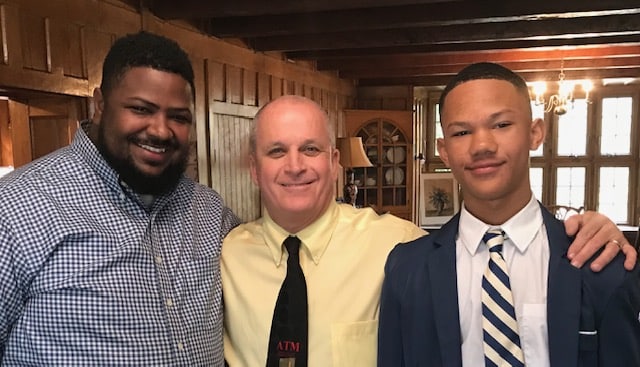
In 2019, young Will reached high school age. William wanted him to attend Blue Ridge but knew the school would have to provide financial support. Of course that wouldn’t be a problem. He would be a legacy! William also wanted me to be Will’s advisor. I balked at first. Honestly, I worried that, if anything went wrong, it would threaten the close relationship I had with William. I eventually agreed. The result was that I had the privilege of being Will’s advisor for four years as well as his sophomore English teacher. I had taught friends’ children in my career but never a former student’s child. As I began to consider my retirement from teaching, I knew I would stay at Blue Ridge until at least 2023, the year Will graduated.
With Will at a school that William loved and knew would give him a sound education in a safe and caring environment, he once again pursued a career in which he would have the chance to serve young people who were struggling for various reasons, in this case with their education. This led him to The Strawbridge School, also known as Everstand, in 2019, to teach a culinary class, one of several “completer” classes offered as troubled students earn a high school diploma. This is another challenging population of students due to their particular needs, and William isn’t quite sure how much longer he can continue. I asked him if he’s ever concerned after handing sharp knives to his students for their or his safety. He explained that no student has ever attempted to cut another student or him. However, one student did once threaten to set William on fire.
For the most part, though, the students at Strawbridge “get” William, and he “gets” them. William, too, grew up in Baltimore with less-than-ideal parental role models. Because of other loving family members as well as the support of other caring adults and especially his church, William was given a chance at a better situation. He wants these students to feel his love as well as the type of discipline his grandmother gave him. “They are often times one step away from lock up. If they succeed at Strawbridge, they have the opportunity to return to their public school. Unfortunately, the public school has sometimes been such a bad situation that a few of them each year misbehave on purpose to stay in our program or even go to jail. I try my best to build their confidence and give them hope.”
William is especially proud of one young man who had no interest in cooking when he first came to Strawbridge. For this young man, William’s culinary class was the least unpleasant of the offered completer classes. Somehow, though, William and this young man made a connection. William recognized that the student had skills and a curiosity that served him well as he explored how to best prepare one dish after another. The young man graduated from Strawbridge and is now employed as a chef at a local restaurant. He calls William frequently for advice – and to express his gratitude. William’s supervisor prays each year that William will return because she knows he has enhanced the culinary curriculum in many ways and has a reputation of giving plenty of tough love to his students.
The morning after William and I met for dinner on October 29, he flew to Atlanta to visit Will during Parents’ Weekend at Morehouse College, where Will is a junior majoring in kinesiology. I texted him early to wish him safe travels, to tell him to give Will a hug from Merf and me, and to ask for the pictures we’d taken after dinner. William’s reply read, “I was just thinking about how much you’ve meant to me over the years. You’ve been such a huge part of my growth, and I honestly wouldn’t be who I am today without your guidance, love, and support. You saw potential in me when I didn’t see it in myself, and that changed everything. I just want you to know how deeply grateful I am for you and the impact you’ve had on my life.” As you might imagine, William has let any adult who has ever played a part in his development know of his appreciation. What he may not fully grasp is how thankful we are for him. He has repaid us tenfold for whatever support we’ve given him over the years by parenting his son, giving back to his hometown and becoming an educator himself.