
Overview:
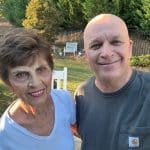
A Knoxville-born majorette turned lifelong educator, Mary Richardson has spent 42 years teaching in South Carolina, meeting her students' emotional and physical needs as devotedly as their academic ones.
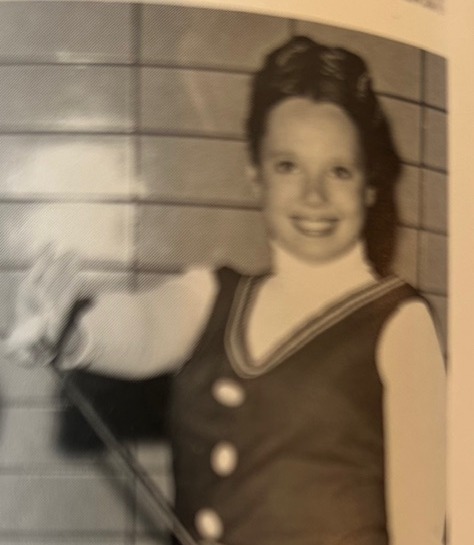
One of the fond memories I have of Mary in high school was watching her perform on the South High School football field as a majorette in Knoxville, TN, from 1972 to 1975. She sparkled. I and everyone else could tell she wasn’t just going through the motions. In fact, Mary began preparing for her majorette days when she was only three as she took both dance and baton classes. This led to her being a warm-up dancer for Dolly Parton in the mid ’60s when Dolly sang on the Cas Walker Farm and Home Hour. Everyone knows about Dolly Parton, but you’d likely have to be born and raised in East Tennessee to know the significance of Cas Walker and his grocery stores.
Since Mary and I both resisted cliques in high school, our opportunities to be at the same friend gatherings were plenty. As president of our senior class (don’t be impressed; I was the sucker who volunteered for that spot), I became responsible for coordinating our class reunions. Mary has attended all but one, even after she moved a good distance away from Knoxville. I’ve never seen her without a smile on her face and a kind word for everyone.
Seeing her at class reunions and being connected with her through social media have allowed me to follow her life course. My class listing, created many years ago, shows that her interests are church and corvettes. I know from recent photos that she also has an interest in horses. Wouldn’t you want to get to know a lifelong educator whose interests are church, corvettes and horses?
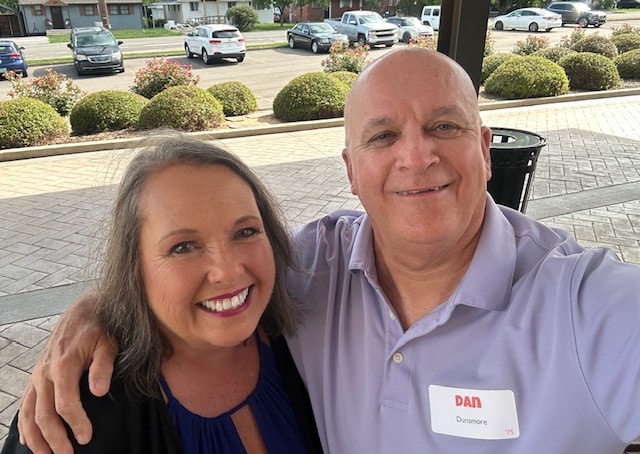
During our 50th high school reunion on Saturday, July 19, 2025, Mary and I once again had a chance to visit. Though I did not directly purchase her beverage of choice that evening in the spirit of Chick Donohue’s generosity as depicted in The Greatest Beer Run Ever, I was responsible (in my class president role) for seeing to it that she was able to enjoy her Trenta-cup of lemonade and hors d’oeuvres at no cost.
After walking the stage with me and about a hundred other South High graduates in 1975, Mary attended Sullins College in Bristol, VA. The only path Mary ever considered was education. Her mother had operated a daycare in the downstairs of her childhood home. Her older brother, sister-in-law, five cousins and their spouses were teachers or administrators as well. When she eventually returned to the University of Tennessee in Knoxville, it was to earn her Bachelor of Education degree in 1979.
Mary’s first teaching position was in the Oneida Special School District in Oneida, TN, about an hour northwest of Knoxville. She taught 2nd grade for one year. She loved the students, her colleagues and the administration, but the 144-mile round trip from Knoxville to Oneida weighed on her, so she chose not to return for a second year. Mary was also healing at that time from a personal loss. To make ends meet in 1980, she worked for an optometrist in the mornings and in an ophthalmologist’s office in the afternoons. “God knew I needed that time away from teaching.”

On a blind date in 1981, she met her future husband. “He was such a blessing, exactly who and what I needed in my life.” She married Duane Richardson in January 1982. Duane, having completed a management training program for the Kroger Company, was offered a position in Augusta, GA. Mary missed the classroom but knew that Duane would likely be transferred soon. Three months later, they were in Anderson, SC. Knowing the transfers still were not over, Mary worked as a Head Non-Food Clerk for a Kroger store, all the while thinking about her return to education.
As predicted, they moved one year later to Aiken County, SC. This would prove to be the end to Duane’s transfers. Mary was as eager as ever to impact the young people who meant so much to her, so she immediately applied for a teaching position in the Aiken County Schools. As she was still unpacking in 1984, she was offered a 7th grade math and science position at Leavelle McCampbell Middle School. Her wish to be back in a classroom came true.
That same year, Duane and Mary’s family grew by one as their first daughter was born. The long drives from home to school were over, but Mary now had to answer a different, more important question for herself. Her answer was yes. She wanted to be a mother AND a teacher. “It is tough to juggle time with family, job, and life. Teaching to reach every student’s needs is challenging. I learned early in my career that planning time is to be used to plan for your students.”
She and Duane were blessed that in 1985 Mary’s mother moved to Aiken County to help with her granddaughter. “She was the best Granny. She gave her time and talents to our growing family, and I will forever be thankful.” Mary was able to work an extra hour or so in the afternoons after school. When she came home, she was able to be a full-time mother, wife, and daughter. She was even able to pick up a little extra work at Aiken Technical College in the late ’80s.
A second daughter was born in 1990. Duane and Mary, with the loving help of Mary’s mother, were able to find a comfortable work-life balance. In 1999, Mary moved to North Augusta Elementary School within the same Aiken County school system. Teaching 5th graders was an adjustment, but she loved the change. Mary’s precious mother passed away in 2003, which led to additional adjustments, but by then her two daughters were in their teens. Through creative scheduling and sheer determination, she earned her Master’s Degree from Southern Wesleyan University in 2005. Again within the same school system, she moved in 2007 to Hammond Hill Elementary and began teaching 5th grade.
Mary’s family time was valuable, but she, as do all public-school teachers, needed to take recertification courses, which she did through the College of Charleston and the University of South Carolina. In 2010 as her daughters flew the coop, she began tutoring students of all ages in math, which she continues to do today. In the fall of 2018, Mary jumped at a chance to become a homebound instructor for Aiken County schools. Since 2024, she has instructed adults in algebra at the Johnston Learning Center.
Mary is currently in her 42nd year of teaching and has no immediate plan to stop. She considers herself a lifelong learner who accepts challenges and appreciates the rewards from working with young people who continue to give her a sense of purpose today. She particularly looks forward to seeing that spark in a student’s eyes and the bright smile on that student’s face when he or she has grasped a concept. “Everyone has a purpose in life, and I felt my purpose was to teach and make a difference in the lives of the youth I was blessed to work with.” It doesn’t take long after meeting Mary and hearing her talk of her family and career to realize that her work ethic and joy are with her in everything she does.
When Mary considers whom she would visit on her own gratitude tour, she recalls qualities in her teachers that have little to do with their knowledge of the subject. She’d first visit Ms. Helton. She taught Mary that compassion is an important personality trait in the teaching profession. “I’ll always remember the letters she wrote to me when my father passed away.” Mary has never forgotten that small act of kindness that meant the world to her.
Mary learned patience and kindness from her math teacher Ms. Hudson. “At those times when I struggled with math, she wouldn’t let me give up. And now I’ve taught math during much of my career!” Mary learned to be encouraging from Mr. Maxwell and to make learning fun from Ms. Wallace. She appreciates the “book” knowledge she gained from each of these instructors, but the true impact each of these educators had on Mary was showing her how to treat others with respect.
As society supposedly makes strides to make our lives easier, that doesn’t always seem to be the case, especially with young people. Mary feels that, more than ever, educators must consider all of the developmental needs our students have today. “Their needs are not just academic ones. Their physical, emotional and mental heath must also be addressed.” Educators should continue to meet regularly to discuss students with IEP’s or specialized plans. All students should have a checklist that is discussed with other teachers, professionals, and parents on a regular basis, not just at the end of the school year.
When Mary first entered the teaching profession, she didn’t think of any situation in which she’d ever actually visit a student’s home. She’d hear stories of poverty that she thought must surely be exaggerated, but then she had opportunities to see the living conditions of her students. “It was definitely eye-opening.” She saw dirt floors, no indoor bathroom, no television, no electricity, little food, many without a vehicle, and some in neighborhoods with high crime rates. It was a reality check to see firsthand that many of her students and their brothers and sisters were fighting each day to survive their living conditions. It wasn’t neglect or abuse. These families simply found themselves in tough circumstances.
“I discovered that my classroom was my students’ safe haven during the week. Fruit, snacks, juice, bottled water, and all necessary supplies became available in my classroom daily. My guidance counselor made sure they had appropriate clothing and that food was sent home on weekends.” Mary knew she had to meet her students’ other needs before she would have any chance of educating them.
As she reflects on what has been an enormously fulfilling career, Mary’s biggest regret involves failing several students early in her career – three in her second year, one in her third year. It is likely that many students (and their families) don’t realize the painful impact their failure has on the teacher who has given the failing grade. She didn’t blame them for failing. She blamed herself. It inspired her to be an even better teacher. “Learning to implement several strategies to help struggling students allowed me to have 100% passing afterwards.” You’ll recall that Mary embraced the challenges of teaching. She rose to the challenge of finding a way for each of her students to find success in her classroom.
Even though Mary has enjoyed winning awards, receiving grants, and being recognized for her accomplishments, her true reward has been developing friendships with her former students as adults. She has been touched time and time again as they share their success stories with her and introduce her to their families. “Hearing from several of them over the holidays, texts or calls on my birthday, and receiving random cards remind me that my classroom was a safe environment filled with learning, kindness, and compassion. The atmosphere I created helped my students become caring, thoughtful, grateful adults. That made me feel successful.”
Mary has always been one who tries to go above and beyond what is expected. She did that as a student at South High School, as a majorette, as a daughter, wife and mother, and certainly as a teacher. “Being reliable, dependable, and responsible, even if I did not totally agree with a certain aspect of my job, was essential. I would voice my concern and try to offer better alternatives, but I performed my duties above what was expected.” Her advice to young educators is to do the same.
What worked for Mary was being prepared for the next day before leaving school that afternoon. Even if that isn’t always possible, she suggests being confident about one’s game plan before entering the classroom the next morning. At the end of each day, she asked herself the following questions. Did I do my best? Did I earn my paycheck? Did I meet the needs of my students? What could I have done differently? What is on my agenda for tomorrow? This is an excellent checklist for teachers just entering the profession, but teachers at any point in their careers must give themselves grace. As you make hundreds of decisions each day (that’s not hyperbole), you’ll mostly make correct choices, as did Mary, if your heart is in the right place.
Mary recalls being nervous and scared on her first day of teaching in 1979. It was exciting, though, and she couldn’t wait to share how great it was with her family and friends. Though she is still teaching adults, her last day at Hammond Hill Elementary in 2018 was filled with tearful goodbyes as she locked her classroom door for the last time.
Being too humble to ask, Mary has relied on her daughters to tell her what her former students have thought about her over the years. Kelly and Katie have told her many times that her students consider her patient, kind, nice, a good listener, fair, and a teacher who was always trying to help them with their struggles. I know her former students were impacted by her dedication and passion for living, too, even if they didn’t quite voice it in those terms.
Mary and Duane have in recent years replaced their passion for corvettes and horses with other interests. “Those two hobbies were so much fun but also expensive. We wanted to use our resources for other interests.” One of those interests is their two-year-old great granddaughter. They are blessed to be with her four afternoons a week. “She keeps us busy, keeps us young, and brings us much laughter and joy.” No doubt Mary will instill a love for learning in her great granddaughter just as she has done in her children and grandchildren.
Cooking together and coming up with new recipes are also favorite joint ventures for Mary and Duane. They still have a love for animals, too, which has led to their involvement in the TNR (Trap-Neuter-Return) program, which is a humane and nonlethal way to manage colonies of feral cats. “Duane builds shelter boxes for the colony, and we both go daily to put out fresh food and water.”
Mary was raised in a family of educators and learned well from her parents how to care for other human and non-human beings. Her passion has not diminished even if fulltime teaching has been replaced by other activities. I see that passion each time Mary attends a reunion. Her joy spreads to everyone, and that gleam in her eyes grows when she speaks of her family and her years as an educator.