
Overview:
Diane Haertel’s decades of quiet leadership, compassion, and service at Marist School, where her resilience, humility, and unwavering support profoundly impacted students, colleagues, and the broader school community.
As mentioned in my tribute to Bishop Joel Konzen, I learned of an English position at Marist School in Dunwoody, GA, in 1982, after teaching one year in the DeKalb County School system. It would mark a turning point of sorts for me. I attended public schools my entire life. My first two teaching positions were in public schools. I believe in the importance of public education.
My first year at Marist was eye-opening in many ways. At times when I wondered if I was right to make the switch to independent education (in this case, a sectarian school), Diane Haertel reminded me that children are children and that wealth does not preclude challenges at home nor learning differences. It was her heart that kept me bolstered as she told me more than once, “These students need you to care about them and to teach them well every bit as much as public school students do.” I never returned to public education, and Diane’s sage words proved to be true throughout my career.
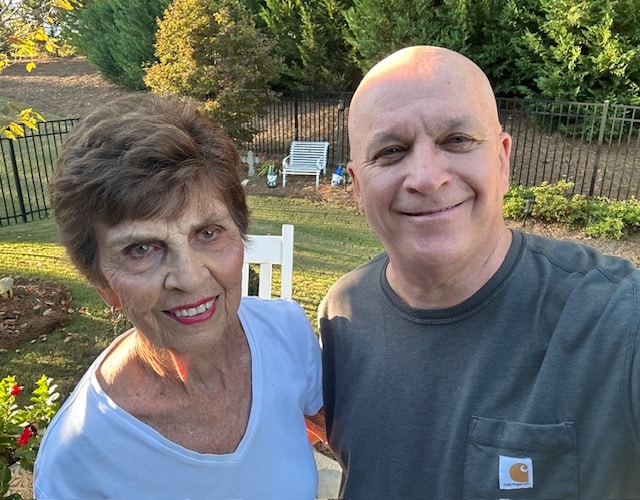
I met Diane at her home in Cumming, GA, on Tuesday evening, October 14. She served me a dinner that included a salad, baked potato and chicken. It was delicious. I presented her with a bottle of Josh Sauvignon Blanc as a way to thank her for her impact on me while I was at Marist as well as the difference she made to many others in her career.
Diane, the middle of three daughters, is from Chicago, IL. In the early 60’s, she went to work as a secretary in the Chicago sales office of Delta Airlines. On a trip to visit a secretary in the corporate office in Atlanta, GA, in May of 1962, she met her future husband, Lee. Lily, one of the girls traveling with Diane from the Chicago office, was engaged to Lee’s brother. Lily asked Lee, who was stationed in the Army in Columbus, GA, to come to Atlanta so she could meet another member of her future husband’s family. Lee met Diane. They danced that night, and they both were smitten. In August 1962, Diane and Lee had their first date when he was home on leave. They corresponded until his discharge from the Army that December. They were married in June 1964 and lived in the Chicago area until January 1967 when Lee’s work required him to move to Cuyahoga Falls, OH, since many of his clients were in the Ohio area.
After several years there, he made a job change with a new company that would move them back to the Chicago area. In November 1969, they settled in Lombard, IL. “We were thrilled since Lee’s parents and a brother were in LaPorte, IN, just an hour away on the other side of Lake Michigan. Lee’s other brother also lived close. My parents, two sisters and many other relatives lived in the area, too. Since we already had two children and one more on the way, we were really looking forward to spending time with both sides of the family.” A month later, their youngest was born. All three children eventually attended Christ the King in Lombard. Because the building where Lee’s office was located was sold in the late 70’s, the company decided to relocate to Atlanta. “That was a tremendous change for all of us. The past ten years had been so enjoyable.”
With three children in tow (Deborah having completed eighth grade, Glenn having completed seventh grade, and Dean having completed third grade), they moved to Atlanta in 1979. Deborah and Glenn started in the ninth and tenth grades at Marist and Dean in the fourth grade at Spalding Drive Elementary School. Soon an opening was available for Dean at St. Jude the Apostle Catholic School nearby. Diane and Lee were happily adjusting to the suburbs of Atlanta and were thrilled with Marist and St. Jude the Apostle.
In March of 1982, life for the Haertel family took a tragic turn. Lee was diagnosed with cancer that month. He passed away three months later. The cancer was a surprise as he was only forty-four and in good health. He and Diane had not yet built a retirement portfolio that would allow her to continue to be at home. She knew she would need to return to the workforce as soon as she could find employment. Her two older children Deborah and Glenn entered their senior and junior years respectively at Marist that fall, and her younger son Dean, the one I came to know best, entered 7th grade.
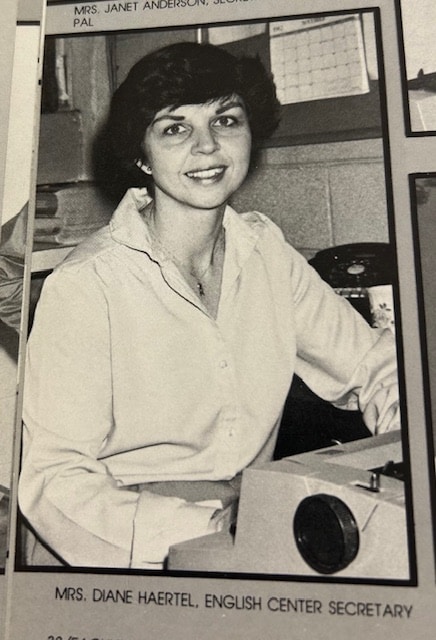
Diane had been a frequent volunteer at Marist since Deborah and Glenn had begun attending in 1979. One of her favorite activities was the school’s annual Christmas Bazaar. She has fond memories of working with other committed parents to coordinate and run that event. Still, she was not necessarily thinking that Marist is where she would land a job. Not too long after Lee’s passing, though, she heard that Marist needed a secretary for the English and Social Studies departments. She thought at the time that the position would be a way back into the workforce with no thought of being there beyond her children’s graduations. She interviewed in August and was hired. 1982 was also my first year at Marist as an English teacher, so we met on my first day on the job.
As one might imagine, Diane’s emotions were all over the place in 1982. She had just lost her husband of eighteen years. She had suddenly become the single mother of two teenaged children and another who would soon also enter high school. She considered herself lucky, however, that her children’s school had a position available. Shortly after starting her job at Marist, she was trying to complete some final yardwork as summer ended. While trimming shrubs, she sliced her finger so badly that she required stitches and a formidable bandage. Having faced more serious challenges in her life, she showed up to Marist the next day ready to explain her injury and to do whatever was asked of her. Still, she wondered how her typing and filing might be compromised. In typical Diane fashion, she didn’t skip a beat. “The secretary position was a wonderful place to start after being out of the workforce for eighteen years.”
I certainly took a liking to her immediately. It was the first time I’d had a secretary. She obviously really wasn’t my personal secretary, but her constant cheerful willingness to help me made me feel that way. And I definitely needed her help. Though I was teaching at a Catholic school, not everyone who worked there was Catholic. That included this Presbyterian. I had no idea if Diane was Catholic, but I knew I respected her personality. Throughout my life, this has occasionally happened to me. I’ve met someone and taken an immediate liking to that person, then have found out months later that person is Catholic. My wife calls me a “Catholic Wannabe.” She’s right in one important way. I’ve always admired the personality traits in the Catholic people I’ve met. They are unselfish, humble servants of others. They ask for no attention for their good deeds. They just do what is right with no fanfare. I wish I could be that way. There’s not a better representative of the values instilled in Catholic people than Diane.
I was way more needy than any teacher should have been. I truly tried very hard not to take advantage of Diane’s perpetual willingness to help, but I know I abused her kindness. She never complained. Diane doesn’t complain. She plays the cards that are dealt to her, always with an eye to help others. Schools succeed because of employees such as Diane. Though she never spent a minute as a classroom teacher, she was as important to Marist School as any administrator or faculty member who has ever graced that campus.
I came to know Diane’s son Dean in a couple of ways. First, I was his English teacher. Second, I was his basketball coach. That could have been an overdose of Dunsmore, but Dean and Diane managed that well. Diane never missed one of Dean’s basketball games, home or away. I came to know Diane’s daughter Deborah fairly well, too, as she spent time with a few of the varsity tennis players, a sport I also coached. I knew of Glenn but had fewer interactions with him. The Haertel family was universally respected. I marveled at this family’s character. I wish I had met Diane’s husband. He must have been as remarkable as the rest of the family. I don’t recall even a hint of anyone questioning the behaviors or attitudes of the Haertel family.
In the summer of 1983, Diane was asked to help with Marist School’s five-year evaluation plan. School computers were still in the dot command stage in the early eighties. Diane, competent as she had been eighteen years earlier in the workplace, was suddenly learning how to use a computer for the first time and how to navigate dot commands while creating the evaluation plan. “It was challenging for sure, and I felt as if I’d been thrown into the deep end of the pool, but I got it done.” Getting it done is one of many ways to describe Diane’s work ethic, and it is one of the multitude of reasons colleagues adore her.
During her years as secretary to the English and Social Studies departments, Diane worked with at least ten teachers. She would type tests and handouts for the students. Again, the workplace was quite different in the early eighties so this was not unusual, but Diane was unusually dependable. She also stood out because she didn’t stand out. She didn’t want to. She did all that was asked of her and on time. A year or two after I left Marist, Diane moved to the Admissions Office where she continued to do splendid work until the school needed someone in the Alumni Office.
After many changes while at Marist, Diane had the opportunity to work in the athletics department. Once she moved there, she stayed for the remainder of her twenty-eight years. Diane had always loved working, whether it be outside or inside the home, but she loved interacting with people even more. “Athletics gave me opportunities to interact with many more individuals than any position I’d ever held before. I was in frequent contact with coaches, parents, students, faculty members, and many businesses just about every day.” Though athletics was not required, numerous students participated in fall and winter sports and about half of the student body participated in the many spring sports. Diane recalls very few dull moments in or out of the office as there were always coaches coming and going as well as multiple games or events each week.
When Diane first became secretary for the athletic department, her office was in a half trailer next to the gym. It was such an old trailer that various small creatures would often make their way in. Diane, never deterred by anything, would shoo or escort these creatures away so that coaches, players, and families could meet in the small conference room that was adjacent to her small space. When it was time to demolish the trailer, the athletic office moved to the area below the cafeteria until the new offices were ready in what is today the Centennial Center. This was an adjustment for all.
It is rare, even unique, that a person in Diane’s position would eventually become Assistant Athletic Director, but that is exactly what became of Diane. She cherished the honor and continued to do the good work she’d always done. Once the new building was completed, she was thrilled with her new office and its large window. Her days were typically exceptionally long as she arrived between 6:30 and 7:00 each morning and often stayed late to help with athletic events. As the person who would coordinate team parents and volunteers to work concessions, she was often amazed at how willing parents were to help when needed. I would suggest that Diane’s friendly disposition as well as her willingness to pitch in herself had a great deal to do with never being short of volunteers.
When the 1996 Summer Olympics came to Atlanta, Diane was given a wonderful opportunity to help. She jumped at the chance and was assigned to volunteer with Track and Field. The training included working at the Grand Prix, the dress rehearsal and then the Olympics. Being able to volunteer with so many famous runners was special.
Though Diane never sought the spotlight, her work ethic and positive attitude were recognized multiple times. Before she moved to the athletic department, the National Honor Society inducted her as an honorary member. In 2003, the Marist football program was dedicated to her as well. Even more significant to her was her induction into the Marist Blue and Gold Circle in 2007. On February 6, 2010, Archbishop Gregory honored Diane as one of the outstanding employees of the year as she represented Marist School at the annual Office of Catholic Schools banquet.
In the twenty-eight years that Diane served Marist School, she had a positive impact on many. A few of those many past Marist students have become well known to the public as college players, pro players and coaches. Their dedication not only to sports but also to academics helped them succeed in their years after high school. While at Marist, they often came in early or late to the athletics office to meet with coaches, watch films or just have a quiet place to study. Diane had many opportunities to interact with these wonderful students.
As our visit came to an end, I asked Diane about the source of her values. That is, what made her the special person that everyone loved? She blushed but then said, “My parents taught us to like people for people, not for what they do or have. They also taught us to be good listeners because trouble starts only when you start talking.” Her Catholic family was service-oriented, too. “We sisters never shied away from getting our hands dirty when helping others.”
These days, Diane lives not far from Marist, close enough to participate in several events at the school each year. She is blessed with eight grandchildren. Deborah has a son and daughter, Glenn has two sons and a daughter, and Dean has three sons. “Being able to attend my children’s award ceremonies, games, anything they participated in, was always important to me. Working at Marist gave me many of those opportunities. When my children got older and started their own families, Marist became my family away from home. Now I try to give as much attention as possible to my grandchildren.” I consider myself quite the lucky human being to have been one of Diane’s colleagues and to count her among my good friends even today.