

Overview:
Bishop Joel M. Konzen’s lifelong commitment to education and faith, highlighting his humble leadership, lasting impact on Catholic schools, and dedication to serving and inspiring young people.
In 1982, after teaching for a year in the DeKalb County School system, I learned of an English position at the Marist School in North Atlanta, GA. I discovered in my research before applying for the position that the goal of the Marist Brothers and Fathers is “to make Jesus known and loved through the education of young people as a model of Mary.” Until that moment, I’d never considered independent education, and certainly not a sectarian or Catholic school.
I was raised in the Presbyterian church. Throughout my life, though, I have become good friends with many people raised in the Catholic faith. In my experience, those raised in the Catholic church tend to be unselfish servants who seek no attention for doing good. These are qualities that appeal to me even if I struggle to exhibit them myself. With my already-established fondness for those raised Catholic, I decided to contact Marist.
I did not have many educators in my corner at that point in my career. Likely, I called upon Shirley Underwood from my experience at Carter High School back in Knoxville to write a recommendation. Therefore, I can give Bishop Joel Konzen credit for being among the first to see qualities in me I didn’t quite see in myself in that summer of 1982, only seven years removed from high school.
I remember feeling nervous and intimidated the afternoon I was to meet with Father Konzen (who would become a Bishop years later). When he welcomed me into his office at Marist School, much of that feeling vanished almost immediately. His kind eyes and gentle, welcoming voice put me at ease even before I sat down. After a few more minutes of introductions, I realized I had no reason at all to feel nervous or intimidated. I should have simply recalled my past experiences with those raised in the Catholic church. Over the next three years, I would have many interactions with Father Konzen, all positive and reassuring. He was my first and best role model as a religious leader. He showed me the kindness and humility that should come with that position. He always made me feel that he was there to serve me. My previous feelings were soon replaced with nothing but utmost respect.
As I drove to the Archdiocese of Atlanta in Smyrna, GA, on the afternoon of October 15, 2025, forty years after my final year at Marist, feelings of nervousness and intimidation once again crept into my psyche. I wondered why Bishop Konzen had even agreed to our meeting and if he remembered me very well even though our email correspondence had already indicated he at least recalled who I was. Also, he had risen through the ranks to become a Bishop so I wondered if that had changed him. A personable lady met me inside the front door of the Archdiocese to take my name and give me a visitor’s pass. Another friendly lady soon met me to escort me upstairs to Bishop Konzen’s office. I had with me a bottle of Glen Moray Speyside single malt Scotch I had chosen for Bishop Konzen as one more way to show my gratitude.
When I arrived at Bishop Konzen’s modest office, his door was open. A kind face I had not seen in forty years as well as his warm smile and calming voice welcomed me. We shook hands. He thanked me for the beverage and suggested we sit at a nearby table. At that moment, memories of my first meeting with him in 1982 came back to me. He hadn’t changed a bit. Of course the Catholic church would want this gentleman to become a Bishop. Of course he would become a prelate, ordained to the episcopacy in 2018 to serve the Archdiocese of Atlanta, GA. What better example to others than this teacher and man of God. How blessed I was that he took the time to visit with me for well over an hour.
Joel Matthias Konzen was born in Oak Harbor, OH, a small town east of Toledo. He is the younger of two brothers. His father was a pharmacist, whose first wife had died of cancer. They had had no children. His father was fifty, and his mother was forty-one when Joel was born. His mother was a teacher until her two sons were born and then substituted from time to time.
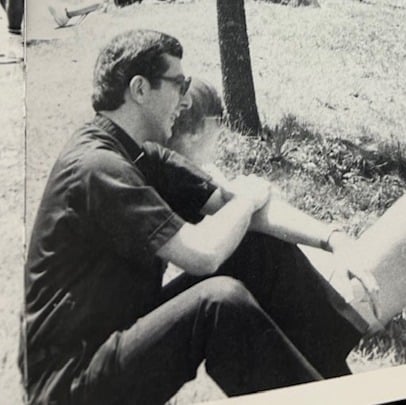
Bishop Konzen recalls walking to the chalk board to solve a math problem in his elementary school. “I was tripped on my way back to my desk for coming up with the correct answer.” He knew, even at that young age, that education mattered and that he wanted to be among like-minded students rather than those who would poke fun at him. Despite the occasional ribbing he received for simply being an attentive student, he had mostly good experiences in his public elementary school. Additionally, his mother always made teaching seem both important and enjoyable. Being Catholic mattered to him as well. He loved the Saturday morning catechism classes taught by Catholic sisters. He recalls saying to his local pastor at the end of his eighth-grade year that he thought he’d like to be a priest. He certainly had the credentials. That combined with his strong interest led the pastor and his family to help him attend Pontifical College Josephinum in Columbus, OH, during his high school years. He graduated in 1968.
Since he had a particular interest in literature, Bishop Konzen earned a BA degree in English from St. Meinrad College in Saint Meinrad, IN, in 1972. He then professed his religious vows with the Society of Mary in Washington, DC, in 1975. This religious order, also known as Marist Fathers, had a history of involvement in education, which appealed to him. His first teaching position was at St. Peter Chanel High School in Bedford, OH, where he gave instruction in English and Theology in 1976-1977. He, being unfamiliar with the wordless sound of flesh striking flesh, recalls the harrowing moment of hearing two of his students begin to duke it out while he was writing on the blackboard. He credits that year with being a thorough preparation for his later time in school administration as he was expected to teach six classes, run the bookstore, and chauffeur an elderly religious brother when he needed to go somewhere.
Bishop Konzen then returned to DC to earn his MA in Systemic Theology from The Catholic University of America in 1978. The following year, he earned his Master of Divinity at Notre Dame School of Theology in New Orleans, LA, and was ordained to the priesthood. He also served as Chaplain in the Orleans Parish Prison in New Orleans, Deacon at St. Andrew the Apostle Parish in New Orleans, and Associate Pastor at St. Edmond Parish in Lafayette, LA. In 1980, he accepted a position at Marist School as Director of Admissions & Financial Aid. He was excited that his new position gave him a chance to teach English and Theology again. Administrators, faculty and students admired his enthusiasm and caring ways. Soon, he was asked if he would prepare to serve the School as Headmaster.
Loving the idea of being the leader of a team of educators, Bishop Konzen had nonetheless not considered all aspects of his responsibilities. “Rusty Frank, president of the Mid-South Association of Independent Schools, asked me what my criteria and plan would be for bringing on new teachers. I had never thought about that aspect of the job.” When he accepted the position as Principal of Marist School in 1982, I was among his first hires. Perhaps I have a certain amount of early naivety to thank for his decision to hire me, but I’d like to think he saw in me a fellow caring person who also loved teaching English. I was at Marist for only three years, and Bishop Konzen hired many teachers in his twenty-eight years as Principal, yet he does recall that neither students nor parents complained about my teaching or coaching, and that I was willing to do all that was asked of me. “That went a long way in earning my respect in those days. It still does.” Father Konzen would grow to love the hunt for new faculty and staff, and he is proud that he made respectable decisions much of the time.

As Principal, Bishop Konzen was keen to enforce the rules, which did not always sit well with the senior class that first year. “Yes, there was push back that year, but the students soon came to understand that the rules weren’t unfair and served to make them better people.” It helped that he was also still a classroom teacher that year so the students knew he was on their side. Whenever possible, he would teach English, Theology or Leadership Studies throughout his career because he viewed teaching as a great way to get to know students and to be “in the trenches” with faculty. “I was always cognizant of what a good high school education did for me, as far as getting me very well prepared for higher study, and I was energized by being able to do the same for the young people in my classes and in the schools where I was an administrator.” Teaching also helped him keep his finger on the pulse of the School. “Teachers have to solve problems on the fly. That helped me in my administrative position.”
Educators do not stop learning after we’ve earned our degrees. In fact, many educators will admit that their most important lessons are learned after they begin teaching. Bishop Konzen was no exception. Coming to understand learning differences and how they impacted his students’ progress and success had a definite impact on his approach to teaching. Likewise, coming to see how planting the occasional game or bit of fun into a course helped him provide levity and incentive to his students. “I also attended as many of their activities outside the classroom as possible. I made a point of complimenting them on their performances in drama or music productions and athletic contests.” He noticed how students’ participation in class picked up after such conversations. It is therefore no surprise that the majority of his students would describe him as purpose-driven, interested in their accomplishments outside the classroom as well as their progress in the classroom, and always available to them.
In 1988, Bishop Konzen experienced a significant challenge. The Marist Province (Fathers) decided to create a three-person leadership model. That is, he and two others would serve as co-Principals of the School. Bishop Konzen assumed they would have equal input and say-so in all decisions. “That’s not how it went. The other two often opposed my thinking, which put me in a very uncomfortable position.” He decided he would leave Marist. From 1989 to 1991, he pursued and earned his MA in Educational Administration at The Catholic University of America in DC during which time he also served as Vicar Provincial for the Washington Province. Knowing his heart was still in education, he accepted a position as Principal of St. Michael’s Catholic Academy in Austin, TX, from 1992 to 1997, after which he returned to DC to once again serve as Vicar Provincial.
Bishop Konzen knew before leaving Marist School in 1989 that it was the place he had valued the most in his career. He believed in its mission and enjoyed the faculty, staff and students. He simply had found himself in an untenable position. He had dealt with other unsavory situations by praying for acceptance or a change in his own attitude. He had in the past been able to share responsibility with trusted associates in administration, which had made his own investment and/or worry a bit lighter. But the three-person leadership model had simply proven beyond what he could accept.
In 1999, he was presented with the opportunity to once again be Principal at Marist. This time, he would not be part of a three-person leadership team and would answer directly to the President. He was thrilled with this arrangement, but his first months back were still awkward at times. The previous Headmaster, a layman, had hired a certain portion of the faculty, who were stunned at his departure and somewhat reluctant to make the change to new leadership. He persevered, though, thanks to his own supporters and because he loved Marist enough not to leave under that type of pressure. He served Marist School as Principal for eighteen years in his second stint. By 2018, he had benefited secondary education for thirty-four years.
Only a remarkable request that year would draw Bishop Konzen away from Marist, and he accepted that offer knowing it would mean separating from the school he loved. “I was stunned when I was asked to become Auxiliary Bishop, Vicar General and Moderator of the Curia for the Archdiocese of Atlanta.” There’s that humility again. He earned that position after years of unselfish service to others in various churches and schools. He led with the same love and calm strength I came to know from 1982 to 1985.
Bishop Konzen’s care for the world of education has extended far and wide. He’s happy that he could be part of getting the tuition-free Reach for Excellence Program at Marist off the ground in the early 2000’s. Also of particular note was his involvement in the formation of two other Catholic schools in Georgia. He was first instrumental in the formation of Notre Dame Academy in Duluth, GA, in 2005. He then played a significant role in the formation of the Cristo Rey Atlanta Jesuit High School in 2007. In 2015, he was able to direct much of the necessary funding toward making the charitable Pope Francis/Bishop Konzen School and Health Complex in Ghana, West Africa, a reality. He would not want it to be known necessarily that he, rightfully so, has earned recognition for his service. This began in 1987 with Principal’s recognition from the United States Department of Education’s Exemplary Secondary Schools Awards Program. In 1989, he was named “Man of the Year” by the Notre Dame Club of Atlanta. He then received the Excellence in Education Award in 2015 from the National Catholic Educational Association.
As Bishop Konzen considered whom he’d visit on his own gratitude tour, many educators at every level came to mind, teachers who had a profound influence on him by making the profession seem bountiful and attractive. Though he likely said thank you at the time, he’d jump at the chance to once again show his gratitude for second-grade teacher Mrs. Mary Epling, his middle school religion teacher Sister Mary Patricia Schnapp, his high school English teacher Monsignor Leonard Fick, his college English teacher Father Mel Patton, and his college French teacher Sister Mary Alice Lawhead. “They were impressive both by virtue of what they knew and communicated but also because of their relatability.”
Bishop Konzen considers himself quite fortunate that he has been able to fulfill his calling to the Society of Mary and also find joy in teaching. “I never wavered in my commitment to the priesthood, and I was pleased that I could combine that with work in education, which always seemed to be where I would be most effective as a priest.” He admits that he felt the weight of his own sometimes faulty expectations in his first year of teaching. In his second and third years, those expectations morphed into much more manageable goals and methods. Making the acquaintance and, often, friendship of other educators helped him see that what he was doing was a true profession with standards, objectives and returns. “Keeping up with former students and seeing their successes also invigorated me year after year and amplified my core commitment to the profession.” To teachers new to the profession, Bishop Konzen advises not to be choosy. Instead, take the experiences that are assigned and learn from them. Keeping a record of likes and dislikes will allow young teachers to reflect on what has been meaningful and intriguing. Knowing oneself and being true to that self also matters. “Being aware of what you really are about and what you truly hope to share with students will help you find success and joy in the classroom.”
He recognizes that educators today face challenges that past generations of teachers did not face. The question of personal vs. virtual instruction looms large. I share his concern, but he speaks far more eloquently about it. “Virtual instruction emphasizes the mechanical character of exchanges but misses the fine points of social interaction, the very traits that will become increasingly important in later settings. Also, the abbreviated speech and amputated narration that has become common or even normalized by social media does not sufficiently prepare young people to make a favorable impression or to know how to respond to a variety of communication prompts.” He believes, too, that teachers need to light a fire under students regarding the amount of reading that they are (not) doing. In short, technology poses a challenge to the careful and thorough education that undergirds future accomplishment.
As my visit with Bishop Konzen came to an end, I felt thankful for him not only because of his impact on me and education in general but because he has been a religious leader of impeccable character. He has lived a Godly life in which he has humbly served others, especially young people through education, under the name of Mary. That afternoon as I sat across from him in his Archdiocese office, he was as approachable and generous as ever. He is an excellent role model for us all.