

Overview:
Creativity can and must be intentionally cultivated within standards-based education by designing tasks and instruction that allow for open-ended, divergent thinking alongside clearly defined academic expectations.
In a standards-based learning environment, it may seem that exploratory, open-ended learning doesn’t fit. Standards are pre-determined pathways. They can feel rigid and narrow. In contrast, curiosity-driven learning naturally ventures into unpredictable territory. That’s the beauty of it. That unpredictable territory is where new ideas emerge, and creativity thrives. Back in 2006, Sir Ken Robinson delivered the now most-viewed TED talk entitled “Do Schools Kill Creativity?” In it, he said our education system was built on a hierarchy of measurable successes that inadvertently cut out creativity. It doesn’t need to be this way. Open-ended learning, which nurtures creative thinking, can exist within a standards-based system. In this article, I will discuss the history of open education, why it failed, and how we can restore creativity in our classrooms.
Open Education
As school districts nationwide continue to grapple with standards-based grading, implementation of MTSS (multi-tiered systems of support), and guaranteed viable curriculum, the once-popular open-classrooms movement of the 1970s feels antiquated. Almost the antithesis of today’s trends in education, open classrooms had no set curriculum, no whole-class learning, and no standardized measurements (Drummond, 2017). The idea was to create spaces that would foster creativity. This was how we would continue to lead the world in innovation. While open classrooms may have had some varying levels of success, it was, by design, hard to measure. The movement was swiftly squelched by back-to-basics which doubled down on highly prescribed learning outcomes in the areas of reading, writing, and arithmetic (Weiss, 2005).
Advocates of both movements have continued to shape education reform for decades, with the ever-increasing complexity of technology. Consider, for example, the rise of personalized learning in the 2010s–likely influenced by the introduction of the iPad (2010) and Chromebook (2011). We imagined an individualized learning plan for each and every child (yay open classrooms!) that would take them through each and every prescribed component of their education (yay back-to-basics!). Unfortunately, personalized learning coupled with back-to-basics doesn’t necessarily translate to classrooms that stimulate creativity and innovation.
Many technology-based approaches to personalized learning amount to nothing more than tailoring or personalizing the reading of texts to students of different abilities—rather than personalizing a mix of activities that give students a richer and more meaningful educational experience, said Elliot Soloway, a professor of computer science at the University of Michigan who has studied and developed digital education tools (Cavanagh, 2014).
It’s worth noting that personalized learning wasn’t new in 2010, nor dependent upon technology. In fact, Maria Montessori was advocating for something similar back in 1907. Even today, Montessori schools allow for student ownership of learning through a carefully curated classroom of choice pathways with limited use of computer technology (Franz, 2024).
Our Mission
Given the seemingly contradictory notions of open learning and guaranteed outcomes, coupled with the promise of personalized learning in a highly digital world, it might be good to reflect on what our mission is in the first place. Do we want all students to know the same things? If so, who decides? Should students have a choice? Should they all be generalists, that is, have general knowledge about a lot of stuff? Or is it okay for students to customize their learning pathways and outcomes?
There aren’t easy answers to these questions, yet every day decisions are made that, nonetheless, answer them. As an extreme case, a child who needs intensive math or reading instruction due to gaps in their learning might be pulled from art or music for that to happen. This modern practice is precisely what Sir Ken Robinson griped about in his TED talk. Though the issues surrounding intervention decisions are complex, they still expose the hidden biases behind such practices. Namely, in a standards-based, standards-measured system, there’s an implied obligation to elevate certain educational outcomes. I wonder if this is still the current vision of the Department of Education.
According to their website, the ED’s mission is to promote student achievement and preparation for global competitiveness by fostering educational excellence and ensuring equal access. Powerful, but unclear. Promoting student achievement could mean “everyone knows the same stuff” or it could mean “everyone knows more than they did last year.” And as for global competitiveness, there’s no way to know what skills/knowledge/resources a student might need to pursue any number of careers across the globe. If anything, it boils down to an ability to learn new things and adapt to new circumstances. That’s a far cry from mastering this or that skill at this or that time for a particular standardized test. In fact, the Partnership for 21st Century Learning, endorsed by the Department of Education, situates “core knowledge” (what we all think of as school) within a broader focus on the 4 Cs – creativity, communication, critical thinking, and collaboration. They also promote interdisciplinary themes such as financial and civic literacy. ED’s mission statement ends with fostering educational excellence and ensuring equal access. Again, are we fostering excellence that allows students to pursue their passions and interests, or are we fostering proficiency in areas others deem important? Does equal access ensure the 4 Cs and interdisciplinary themes are experienced by all students or does it only mean access to core knowledge?
The Problem
As discussed above, the problem that continues to plague education is how to define success. I believe the issues surrounding open and closed education never seem to get resolved because both sound good. Do we want children to have basic knowledge of core subjects? Yes! Do we want them to lean into creativity and innovation? Yes! Do we want them to master reading, writing, and arithmetic? Yes! Do we want them to round out their experiences with music, art, and theater? Yes! Ultimately, we need a way to merge these two ideals. We need a way to allow for open-ended learning within a closed system of standards and standardized measurements. Only then will we stop killing creativity.
A Creative Solution
A creative solution is to literally teach creativity as a way of thinking. According to Sir Ken Robinson, creativity is the process of having original ideas that have value. The process he’s referring to is called divergent thinking. Try this:
- Find something to write with and write on.
- Set a timer for one minute.
- Start the timer and write down as many ideas as you can to use a paper clip. Go!
Hopefully, you came up with more ideas than just clipping paper. When I’ve done this task with teachers, they typically come up with lots of ideas (e.g., hang an ornament). Whether they have value or not depends on the situation. Value might be the standard by which the idea is measured. Consider that many of those same teachers use the “I do, we do, you do” format when they teach. They demonstrate a skill/concept, have everyone in class try it together, then have students try it on their own. If the learning target was “using paper clips,” those teachers might first demonstrate how to clip papers together. Then they’d hand out similar stacks to students and they’d all try it together. Lastly, they’d have a variety of paper stacks around the room for students to try on their own. And, in doing so, no divergent thinking would occur (i.e., there wasn’t space to suggest ornament hanging).
Now substitute “using paper clips” for anything that’s taught. Whether it’s the Pythagorean theorem, finding evidence to explain the meaning of text, or magnetism, a teacher who follows the “I do, we do, you do” format will undoubtedly identify all of the things students need to know or be able to do ahead of time. But if we want divergent thinking, we would need to flip that format.
- You do: Students come up with lots of ideas.
- We do: Class discusses which of those ideas have value.
- I do: The teacher helps students synthesize their learning.
This format is more in line with the initial paper-clip exercise. Imagine you were teaching Pythagorean’s theorem. Don’t start with the formula. Instead, engage students in an inquiry-based activity that helps them grapple with the application of the formula. For example, you might give two points on the coordinate plane as airports and a third point as the airplane. Then ask which is closest for an airplane to refuel. Students would now be allowed to play with mathematical ideas such as counting, drawing triangles, estimating, measuring, etc. Then, as a class, you could discuss the (de)merits of each idea. You might even highlight the ones that seem more precise or on the path towards the actual theorem. Now you’ve got a captive audience ready to learn both the theorem and the distance formula. You also have a classroom of students ripe with ideas. The more opportunities they have to practice divergent thinking, the more creative they will be!
Believe you me, I can hear the critics in the room. If I were reading this article, I’d have plenty of “buts” popping into my head. But sometimes using a tool differently than intended can be problematic (e.g., proper use of scientific equipment during a lab). But sometimes there are specific rules that need to be followed (e.g., a unit on baseball). But sometimes I just need my students to understand a skill/concept in a specific way so we can get into the real learning (e.g., a class learns about writing conventions so that they can then better understand the unconventional writers within a genre). These are all excellent “buts” that clarify the need for balance within the two competing educational movements of the past. Instead of open education or back-to-basics, let’s get really intentional about when we can and when we cannot allow for divergent thinking.
A Practical Solution
A task is anything we ask students to do for learning and/or assessment. It could be a great driving question or a performance activity. Tasks can be crafted to allow for open/closed strategies or open/closed solutions. For example, suppose you ask students to use a hammer to hang a picture with a nail. This task is closed, closed. That is, there’s one tool to use and one outcome. You could modify the task by allowing a choice of tool to hang a picture with a nail. Now the task is open, closed. It is open to choose a tool, but the result should still show a picture hanging with a nail. Maybe the student will use another piece of hardwood instead of a hammer? A third way to modify the task is to ask students to use a hammer to accomplish a job suited to hammering. Notice, hanging a picture by nail is now just one of many options. Maybe they will use the hammer to shape metal? This third modification would be closed, open because it still requires students to use a hammer but they can choose what they use it for. Lastly, an open, open task might be asking students to choose a tool and demonstrate its use for some relevant application. This is truly open-ended.
Open, open tasks might seem daunting from a teacher’s perspective. How do I manage/assess 30 students making 30 different choices? Consider that open, open tasks can be constrained. You could, for example, limit the tools to choose from (e.g., a hammer or screwdriver) or limit the options (e.g., hang a picture with nails or screws). This still offers students options and choices but it’s way more manageable. Using constraints is how you might craft high level questions to assess a particular standard. But maybe during the unit, you can let students embrace open, open tasks with fewer constraints.
All tasks whether open or closed can be meaningful and purposeful as summarized below:
- Closed, Closed means there is one tool/strategy and one answer. These tasks work well for practicing a specific skill.
- Open, Closed means there is more than one tool/strategy but one answer. These tasks work well for comparing various strategies, models, ideas, and/or representations.
- Closed, Open means there is one tool/strategy and more than one answer. These tasks work well for applications of a specific skill/concept.
- Open, Open means there is more than one tool/strategy and more than one answer. These tasks create the most space for divergent thinking, student voice/choice, personalized learning, project-based learning, and student ownership of learning.
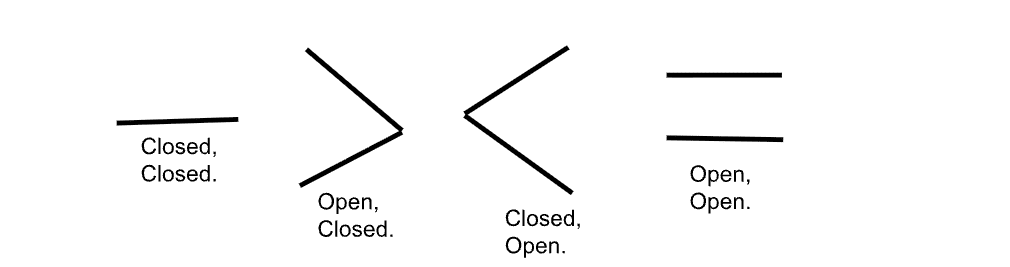
The symbols above were created to help you remember the subtle differences between task types. If you view each one from left to right, you can see that closed, closed tasks offer one way. Open, closed tasks invite different strategies but all end in a single way. Closed, open tasks begin with one strategy but end in different ways. Open, open tasks create parallel paths for students to choose (e.g., hammer a nail or turn a screw).
The chart below shows a wide variety of tasks created by teachers of 5th through 12th grade. Each row begins with a content standard, then shows four ways to engage students in that standard using strategic task design. I’d argue that any version of “open” allows for divergent thinking to occur.
| Standard | Closed, Closed | Open, Closed | Closed, Open | Open, Open |
| Math:Solve real-world and mathematical problems by writing and solving equations of the form x + p = q and px = q for cases in which p, q, and x are all nonnegative rational numbers. | John adds 13 shells to his collection. He now has 30 shells total. This situation can be modeled by the equation x+13=30. What does x stand for? Solve for x using the subtraction property of equality. | John adds 13 shells to his collection. He now has 30 shells total. This situation can be modeled by the equation x+13=30. Find several ways to solve for x. | Minimum wage is $7.25/hour. Find the cost of something you’d like to purchase that is over $50. Write an equation to represent how many hours it would take to pay for the item.Solve using the division property of equality. | Look up minimum wage in a state other than your own. Find the cost of something you’d like to purchase that is over $50. Write an equation to represent how many hours it would take to pay for the item in that state.Find several ways to solve for x. |
| Humanities:Locate and refer to relevant details and evidence when explaining what a text says explicitly/implicitly and make logical inferences. | Discuss why Russia’s full-scale invasion of Ukraine has caused economic hardship. Cite examples from the text to support your answer. | Discuss reasons why people of Ukraine might be experiencing economic hardship. Cite examples from the text to support your answer. | Discuss ways in which Russia’s full-scale invasion of Ukraine has affected the population. Cite examples from the text to support your answer. | Choose an event over the last 5-10 years that has had a negative impact on the people of Ukraine. Cite examples from the text to support your answer. |
| Humanities:Describe how events unfold, as well as how characters respond or change as the plot moves toward a resolution. | Write and respond how the conversation with Angie changed the outlook of Hudson. | Choose a conversation in the text that changed Hudson’s outlook. | Write and respond how the conversation between Hudson and Angie changed either character’s outlook. | Pick any character whose outlook has changed and justify using evidence from the text. |
| Science:Motion and Stability: Forces and Interactions | Conduct an investigation with an electromagnet that shows a change in strength of the magnetic force by changing the amount of coils in the electromagnet. | Conduct an investigation with an electromagnet to provide evidence that magnetic fields exist between objects exerting forces on each other even though the objects are not in contact by changing one variable of the electromagnet. | Use an electromagnet to conduct an investigation regarding magnetism to demonstrate magnetic polarity, attraction/repulsion, or magnetic field strength. | Conduct an investigation and evaluate the experimental design to provide evidence that magnetic fields exist between objects exerting forces on each other even though the objects are not in contact. |
| Personal Finance:Examine the benefits and costs of using credit (credit & debit) | You bought a Playstation for $499.99 with your debit card. How much more would you have paid if you financed it for 12 months at 5% APR? | Find a product over $400 that you’d like to purchase with your debit card. How much more would you have paid if you financed it for 12 months at 5% APR? | You bought a Playstation for $499.99 with your debit card. Choose a rate and number of months to calculate the additional cost of interest you’d pay if you financed it. | Choose a product over $400 that you’d like to purchase with your debit card. Then choose a rate and number of months to calculate the additional cost of interest you’d pay if you financed it. |
| Math:Prove theorems about parallelograms. Theorems should include: Opposite sides are congruent, opposite angles are congruent, the diagonals of a parallelogram bisect each other, and conversely; rectangles are parallelograms with congruent diagonals. | Set up proof in such a way that students will prove opposite sides congruent using ASA then CPCTC. | Set up proof in such a way that students can prove triangles formed by a diagonal are congruent in more than one way. Then prove opposite sides congruent using CPCTC. | Set up proof in such a way that students will prove triangles formed by a diagonal are congruent using ASA. Then have them prove something about the parallelogram using CPCTC (e.g. opposite sides or opposite angles congruent). | Have students design their own proof of any property of parallelograms. Their proof should begin with “Given ABCD is a parallelogram.” From there they should use their knowledge of postulates and theorems to prove their chosen property must be true. |
| Spanish:Learners present information, concepts, and ideas to inform, explain, persuade, and narrate on a variety of topics using appropriate media and adapting to various audiences of listeners, readers, or viewers. I can describe the ingredients of a dish or drink (in the target language). | Create a visual advertisement for Spanish club in which students will have the opportunity to try three aguas frescas. You must use the same sentence formula for each description. | Create a visual advertisement for Spanish club in which students will have the opportunity to try a few authentic foods or drinks. You must use the same sentence formula for each description. | Create a visual advertisement for Spanish club in which students will have the opportunity to try three aguas frescas. Vary your sentence formula for each description. | Create a visual advertisement for Spanish club in which students will have the opportunity to try a few authentic foods or drinks. Vary your sentence formula for each description. |
| SEL:Learners will be able to consistently use appropriate calming and coping strategies when dealing with strong emotions. | Practice progressive muscle relaxation. | What calming strategy would work best if you and your best friend get into an argument during lunch? Why? | Thinking about your previous week, make a list of when progressive muscle relaxation would have helped you calm down. | In the next coming week, use different calming strategies during difficult times. What strategy/s worked best for you and why? |
| Science:Use mathematical representations to support claims for the cycling of matter and flow of energy among organisms in an ecosystem. | Use our example of the savannah to fill in the food web and the trophic pyramid. Determine the available energy per level if the producers had 3,500,000 kilocalories of energy/area. | Using either a tropical rainforest or ocean, choose 5 animals and make a food web and the trophic pyramid. Determine available energy per level if the producers had 3,500,000 kilocalories of energy/area. | Use our example of the savannah to fill in the food web and the trophic pyramid. Determine the available energy per level based on your choice of kilocalories of energy/area. | Using either a tropical rainforest or ocean, choose 5 animals and make a food web and the trophic pyramid. Determine the available energy per level based on your choice of kilocalories of energy/area. |
It’s worth mentioning that some teachers found the crafting of the four task types challenging at first. Especially in distinguishing open, closed and closed, open. But after a while, all were excited to have mastered the craft. Imagine the possibilities!
Restoring Creativity
We are now living in a world where artificial intelligence is at our fingertips. It can write essays, finish computer programs, solve complex math problems, even generate images. It is more critical than ever to identify and capitalize on what it means to be human. To me, that involves highly personalized, customized learning that allows for self-expression, creativity, and empathy. Students need space to develop their voice, style, and learner identity to bring meaning, passion, and purpose into their everyday lives. In this article, I’ve provided two ways to do that; both through intentional integration of divergent thinking. It doesn’t need to stop there. If you want to expand on your implementation strategies for open-ended learning, consider project-based learning (check out pblworks.org). You can also lean into universal design for learning (check out udlguidelines.cast.org/), which offers many ways to open up the learning environment to support diverse learners. Start with better questions. Continue by tweaking the classroom environment. Lastly, team up with colleagues to evolve your classroom into an engine for creativity.
References:
Akers, C. (2018, February 28). Back to basics through the years. Chicago Reporter. https://www.chicagoreporter.com/back-basics-through-years/
Camera, L. (2018, February 21). What is a Montessori school? U.S. News & World Report. https://www.usnews.com/education/k12/articles/what-is-a-montessori-school
Heick, T. (2020, December 30). Personalized learning. SmartLab Learning. https://www.smartlablearning.com/personalized-learning/
Herold, B. (2014, October 16). What is personalized learning? Educators seek clarity. Education Week. https://www.edweek.org/leadership/what-is-personalized-learning-educators-seek-clarity/2014/10
Partnership for 21st Century Skills. (2009). P21 Framework Definitions. Retrieved from https://files.eric.ed.gov/fulltext/ED519462.pdf
Robinson, K. (2006, February). Do schools kill creativity? [Video]. TED Conferences. https://www.ted.com/talks/ken_robinson_says_schools_kill_creativity
Tobia, S. (2017, March 27). Open schools made noise in the ’70s. Now they’re just noisy. NPR. https://www.npr.org/sections/ed/2017/03/27/520953343/open-schools-made-noise-in-the-70s-now-theyre-just-noisy
The Structural Learning Team. (2020, July 28). I do, we do, you do. Structural Learning. https://www.structural-learning.com/post/i-do-we-do-you-do